‘Shell knew’: oil giant's 1991 film warned of climate change danger
Public information film unseen for years shows Shell had clear grasp of global warming 26 years ago but has not acted accordingly since, say critics
Tuesday 28 February 2017 16.45 AEDT Last modified on Tuesday 28 February 2017 17.01 AEDT
The oil giant Shell issued a stark warning of the catastrophic risks of climate change more than a quarter of century ago in a prescient 1991 film that has been rediscovered.
However, since then the company has invested heavily in highly polluting oil reserves and helped lobby against climate action, leading to accusations that Shell knew the grave risks of global warming but did not act accordingly.
Shell’s 28-minute film, called Climate of Concern, was made for public viewing, particularly in schools and universities. It warned of extreme weather, floods, famines and climate refugees as fossil fuel burning warmed the world. The serious warning was “endorsed by a uniquely broad consensus of scientists in their report to the United Nations at the end of 1990”, the film noted.
“If the weather machine were to be wound up to such new levels of energy, no country would remain unaffected,” it says. “Global warming is not yet certain, but many think that to wait for final proof would be irresponsible. Action now is seen as the only safe insurance.”
A separate 1986 report, marked “confidential” and also seen by the Guardian, notes the large uncertainties in climate science at the time but nonetheless states: “The changes may be the greatest in recorded history.”
The predictions in the 1991 film for temperature and sea level rises and their impacts were remarkably accurate, according to scientists, and Shell was one of the first major oil companies to accept the reality and dangers of climate change.
But, despite this early and clear-eyed view of the risks of global warming, Shell invested many billions of dollars in highly polluting tar sand operations and on exploration in the Arctic. It also cited fracking as a “future opportunity” in 2016, despite its own 1998 data showing exploitation of unconventional oil and gas was incompatible with climate goals.
Facebook Twitter Pinterest
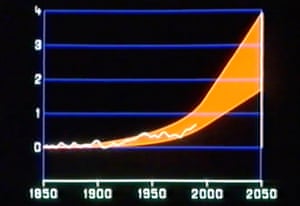
The projections for future global warming in Shell’s 1991 film stand up “pretty well” today, according to Prof Tom Wigley. Photograph: Climate of Concern
The film was obtained by the Correspondent, a Dutch online journalism platform, and shared with the Guardian, and lauds commercial-scale solar and wind power that already existed in 1991. Shell has recently lobbied successfully to undermine European renewable energy targets and is estimated to have spent $22m in 2015 lobbying against climate policies. The company’s investments in low-carbon energy have been minimal compared to its fossil fuel investments.
Shell has also been a member of industry lobby groups that have fought climate action, including the so-called Global Climate Coalition until 1998; the far-right American Legislative Exchange Council (Alec) until 2015; and remains a member of the Business Roundtable and the American Petroleum Institute today.
Another oil giant, Exxon Mobil, is under investigation by the US Securities and Exchange Commission and state attorney generals for allegedly misleading investors about the risks climate change posed to its business. The company said they are confident they are compliant. In early 2016, a group of congressmen asked the Department of Justice to also “investigate whether Shell’s actions around climate change violated federal law”.
“They knew. Shell told the public the truth about climate change in 1991 and they clearly never got round to telling their own board of directors,” said Tom Burke at the green thinktank E3G, who was a member of Shell’s external review committee from 2012-14 and has also advised BP and the mining giant Rio Tinto. “Shell’s behaviour now is risky for the climate but it is also risky for their shareholders. It is very difficult to explain why they are continuing to explore and develop high-cost reserves.”
Bill McKibben, a leading US environmentalist, said: “The fact that Shell understood all this in 1991, and that a quarter-century later it was trying to open up the Arctic to oil-drilling, tells you all you’ll ever need to know about the corporate ethic of the fossil fuel industry. Shell made a big difference in the world – a difference for the worse.”
Prof Tom Wigley, the climate scientist who was head of the Climate Research Unit at the University of East Anglia when it helped Shell with the 1991 film, said: “It’s one of the best little films that I have seen on climate change ever. One could show this today and almost all would still be relevant.” He said Shell’s actions since 1991 had “absolutely not” been consistent with the film’s warning.
A Shell spokeswoman said: “Our position on climate change is well known; recognising the climate challenge and the role energy has in enabling a decent quality of life. Shell continues to call for effective policy to support lower carbon business and consumer choices and opportunities such as government lead carbon pricing/trading schemes.
“Today, Shell applies a $40 per tonne of CO2 internal project screening value to project decision-making and has developed leadership positions in natural gas and sugarcane ethanol; the lowest carbon hydrocarbon and biofuel respectively,” she said.
Patricia Espinosa, the UN’s climate change chief, said change by the big oil companies was vital to tackling global warming. “They are a big part of the global economy, so if we do not get them on board, we will not be able to achieve this transformation of the economy we need,” she said.
The investments the oil majors are making in clean energy are, Espinosa said, “very small, the activities in which they are engaging are still small and do not have the impact that we really need.”
Espinosa, who visited Shell’s headquarters in the Hague in December, said: “They are clear that this [climate change] agenda has to do with the future of their company and that business as usual, not doing anything, will lead to crisis and losses in their business.”
Shell's 1991 warning: climate changing ‘at faster rate than at any time since end of ice age’
Critics say public information film shows Shell ‘understood the threat was dire, potentially existential for civilisation, more than a quarter of a century ago’
Tuesday 28 February 2017 16.45 AEDT Last modified on Tuesday 28 February 2017 17.00 AEDT
Climate change “at a rate faster than at any time since the end of the ice age – change too fast perhaps for life to adapt, without severe dislocation”. That was the startling warning issued by the oil giant Shell more than a quarter of a century ago.
The company’s farsighted 1991 film, titled Climate of Concern, set out with crystal clarity how the world was warming and that serious consequences could well result.
“Tropical islands barely afloat even now, first made inhabitable, and then obliterated beneath the waves … coastal lowlands everywhere suffering pollution of precious groundwater, on which so much farming and so many cities depend,” says the film’s narrator, over disturbing images of people affected by natural disasters and famine. “In a crowded world subject to such adverse shifts of climate, who would take care of such greenhouse refugees?”
The film acknowledged the uncertainties in the computer model predictions at the time, but noted the various scenarios had “each prompted the same serious warning, a warning endorsed by a uniquely broad consensus of scientists in their report to the United Nations at the end of 1990”.
“What they foresee is not a steady and even warming overall, but alterations to the familiar patterns of climate, and the increasing frequency of abnormal weather,” it cautioned. “It is thought that warmer seas could make destructive [storm] surges more frequent and even more ferocious.”
“Whether or not the threat of global warming proves as grave as the scientists predict, is it too much to hope as it might act as the stimulus – the catalyst – to a new era of technical and economic cooperation?” the film concludes. “Our numbers are many, and infinitely diverse. But the problems and dilemmas of climatic change concern us all.”
Facebook Twitter Pinterest
A family leaves their flooded home in Bangladesh. ‘In a crowded world subject to adverse shifts of climate, who would take care of such greenhouse refugees?’ says the film’s narrator. Photograph: Mufti Munir/AFP/Getty Images
The film was made for public viewing, particularly in schools and universities, but is believed to have been unseen for many years. It was remarkably prescient, according to Prof Tom Wigley, who was head of the Climate Research Unit at the University of East Anglia when it helped Shell with the 1991 film.
“It is amazing it is 25 years ago. Incredible,” he said. “It was quite comprehensive on what might happen, what the consequences are, and what we can do about it. I mean, there’s not much more.” He said the predictions for temperature and sea level rises in the 1991 film were “pretty good compared with current understanding”.
“What is really striking is nothing has happened [since] to make you doubt the science as it was stated then,” said Tom Burke, at the green thinktank E3G and a former member of Shell’s external review committee.
Facebook Twitter Pinterest
Shell’s 1991 public information film, Climate of Concern. Photograph: the Correspondant
But Shell’s actions on global warming since 1991, such as major investments in highly polluting tar sands and lobbying against climate action, have been heavily criticised. In 2015, it was accused of behaving like a “psychopath” by the UK’s former climate change envoy and of being engaged in a cynical attempt to block action on global warming. Even its own former group managing director, Sir Mark Moody-Stuart, said in 2015 it was “distressing” that “remarkably little progress” had been made on climate change by Shell and other oil companies.
The revelation of the film, obtained by the Correspondent, a Dutch online journalism platform, and shared with the Guardian, has renewed the criticism.
“The film shows that Shell understood that the threat was dire, potentially existential for civilisation, more than a quarter of a century ago,” said Jeremy Leggett, a solar power entrepreneur and former geologist who had earlier researched shale deposits with Shell and BP funding.
“I see to this day how they doggedly argue for rising gas use, decades into the future, despite the clear evidence that fossil fuels have to be phased out completely,” he said. “I honestly feel that this company is guilty of a modern form of crime against humanity. They will point out that they have behaved no differently than their peers, BP, Exxon and Chevron. For people like me, of which there are many, that is no defence.”
Facebook Twitter Pinterest
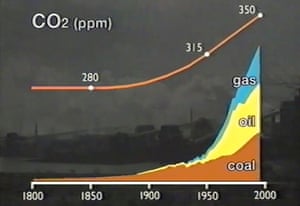
Shell’s 1991 film linked fossil fuel burning with rising atmospheric CO2 and said the “serious warning” of dangerous warming was “endorsed by a uniquely broad consensus of scientists”. Photograph: Climate of Concern screengrab
Paul Spedding, HSBC’s former global head of oil and gas and now at the thinktank Carbon Tracker, said about half of Shell’s reserve base is natural gas, the least carbon intensive of the fossil fuels. “However, its oil portfolio could be a ticking tar-sands time bomb. Tar sands, which make up nearly 30% of group oil reserves, are significantly more carbon intensive than conventional oil. As things stand, Shell’s oil production is destined to become heavier, higher cost, and higher carbon, hardly a profile that fits the outlook described in Shell’s video.”
Shell had, in fact, known of the risks of climate change even earlier. A “confidential” company report written in 1986, also seen by the Guardian, noted the significant uncertainties in climate science at the time but warned of the possibility of “fast and dramatic” changes that “would impact on the human environment, future living standards and food supplies, and could have major social, economic, and political consequences”.
However, Shell remained a member of another business lobby group that campaigned against climate action, the American Legislative Exchange Council, until 2015 and remains a member of the Business Roundtable and American Petroleum Institute, which both fought against Barack Obama’s Clean Power Plan.
The company has said it has remained a member of groups that hold different views on climate action to “influence” them. But Thomas O’Neill, from the group Influence Map, which tracks lobbying, said: “The trade associations and industry groups are there to say things the company cannot or does not want to say. It’s deliberately that way.”
Some of Shell’s investments today are also criticised for being incompatible with the 2C warming target agreed by the world’s nations. A 2015 Carbon Tracker report concluded the company was planning to invest more than $75bn in such projects over the following decade, part of a “carbon bubble” in which reserves are being developed that cannot be burned if climate change is to be halted – a concern shared by the Bank of England and World Bank.
Another Carbon Tracker report in 2016 cited a 1998 Shell document showing the company was aware of this risk. “Shell knew about, but did not act on, the risks of a carbon bubble,” the report said. “Looking back over the last 20 years, it seems like Shell has gone backwards in terms of transparency, and is still recycling the same old green initiatives, and attempting to deflect responsibility in the face of an existential threat to its business.”
Shell was one of the first major oil companies to acknowledge the need to act on climate change and has long argued that providing affordable energy was vital for the world and its development. The 1991 film anticipated the problem: “How could [developing] countries continue to advance but leapfrog the energy-intensive face of development, by which other nations prospered before its adverse consequences came to light?”
But in 2015 its own external review committee concluded Shell’s sustainability report did not “adequately convey the urgency of this [low-carbon energy] transition”. Earlier in February, Shell’s CEO Ben van Beurden said: “We believe that climate change is real and we believe that action will be needed.”
Moody-Stuart, who was also chairman of Shell from 1998-2002, told the Guardian the broad criticism of the company was unfair. “I don’t think enough has been done, but I wouldn’t single out the oil industry. Governments and others have some responsibility and Shell and others have called for a price on carbon since the 1990s.”
“It hasn’t got very far at all but that is not Shell’s fault,” he said. “It is pretty unique for an industry to be actually asking for something which will increase the price of their product, but they are asking for it because that is what is needed to drive the industry in the right direction.”
Burke, a former head of Friends of the Earth, agreed there is a wider problem. “It is too easy to blame it all on Shell for getting it wrong”, he said, as there has been “a broader societal failure”.
Shell’s 1986 report said the climate change problem was one that “ultimately only governments can tackle”. But it also noted, over three decades ago, that the energy industry “has very strong interests at stake and much expertise to contribute. It also has its own reputation to consider, there being much potential for public anxiety and pressure group activity.”