SCTlearning from scratch

Greeting, Jack.

Thanks for the brief summary of SSR. I have some questions in green below. Please help. Thank you. Hope everything is well with you.


set up a rotating ranking for all sectors.

use weekly ranking data

We use IBD's 197 industry group RS ranking which is based on letter grades from A+ to E. There are 197 x 24% = 47 "sectors" ranked under A+, A and A- category (too many).

How many "sectors" should be above the "line" of the RDBMS in the performing hotlist?


this gives you an RDBMS where change of rank (first derivative) and rate of change of rank (2nd derivative) can be analyzed.

What are the first and second derivatives of "sector" RANK? How do measure them as "sector" ranks are in letter grades? Your statements do not make sense to me.


in making big money with big money you have to not exceed the normal block size. See trading 100,000 shares in PVT) In SSR you are dealing with large positions way over 100K shares and way over a couple of million bucks.

you watch positive derivatives of rankings to see entry and you watch for top ranked stocks to slip below 0 on second derivative

these two monitoring actions allow for the crossover trading required to make money available to buy on opportunities.

Now, you are jumping from the derivatives of ranked sectors to that of top-ranked stocks. Are they the same? I am confused.


There is one more caveat. do not trade sector leaders. Watch them so that you can catch sector money makers in anticipation.

Could you be specific about how to time the buying of the laggers on the basis that we use EOD chart and monitoring on hourly or minute charts is not permitted?

Please provide more information about SSR that you think is helpful.


Its like in the triple crown. Who care about winning three races in row. Make the money with the horses that are rested up to wipe prior winners off the map. horse owners could make a lot more money if they knew how to make money rather than train horses. Big money usage in SSR is what it is designed for. It is the time when you have capital in excess of the limits of PVT and SCT. You can't not be using the money to make money.

.....
 
Greeting, Jack.

Thanks for the brief summary of SSR. I have some questions in green below. Please help. Thank you. Hope everything is well with you.

I'll post on each green segment you mention.

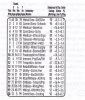
1. I use the top 20 sectors. the whole string of sectors are "numbered" as to their relative ranking.

2. Indiviedual sectors have a series of eekly rankings. thais is as weeks go by the ranking changes.

3. the "week" is a standard time lapse.

4. by using addition and subtraction you get differences/ per week.

5. think of the unit difference/per week as a velocity or speed of change.

6. by comparing the change of velocity over a two week period, you have a unit like iference/ per week /difference per week.

7. of item 6 as acceleration or deceleration. that is the weekly difference is either growing or declining.

in this analysis you are looking for "long" money making opportunities. Skip the "short" position trading. the goal is to see hhow what you are holding is succeeding in making money. If it is stellar that is a continue to hold. If the rate of return is not accelerating or at least holding it's own , then you must consider an exit to have "avaialble cash" for an opportunity.

as you do the investing (short trem trading) it is best to eal within sectors and choose to trade with "certainty". certainty escapes most people who deal in CW type risk and do not understand the tool of certainty available from mathematics.

In sectors, the set of elements has leaders and laggers. as a leader jumps out, this alerts you to be looking for just which stocks are highest quality and which "follow the leaders". when I correted white papers for NY Securiries, INC my job was to allow the "white paper" to be used most profitably by fund managers in sector rotation. this is not comparable to the BS of CNBC rew of 6 to 8 guys having a contest to make 10 decisions in a year. they are just screw offs eating up air time.

By seeing the ectors rotate, you get a grasp of making top dollar all the time. By honing in on laggers that "follow leaders" in a powerful improving sector, you arrive at keeping money making its highest portential velocity by rotating capital to the correct place.

anyone who does stocks sees the three year lists of stoks that make 250 % for three consecutive years. This is not making the optimum money velocity with big blocks of money.

with PVT , you can have 100,000 shares making 17 points in a prifit segment of a position trade. that trade was assessed by a thrid party broker, who then offer a fee and commission discount to traders who use my PVT method.

Here big money is in use in SSR. PVT is limite to a few million per position. SSR is for keeping larger money making a high money velocity.

In trading stocks, the stocks go through phases of activity interest. I refer the this new increased interest as a phase change. the jump is seen in the independent variable. volume shifts by an order of magntude. This mean the public has taken an interest. SSSR scouts this kind of activity interest by using ranking of the sector (a largely fundamental analysis).

One of the most corrosive hairbrained trial I was put through by the SEC was this sort of frontrunning. MLPF&B got fined 100'sK's for their embellishments of those they had coattailing me . When a home office of a brokerage firm starts hyping stock irrationally, a phase shift can happen. I had created 7 new sectors that were not listed as sectors. I plugged in fundamental data to show that they were like bubbles comingg up form the bottom of the sea. we met in scottsdale at the quilted bear restarant to examine them every thursday am. Now the location is called silicon valley. and the overriding mega set is now called semiconductors and computers., etc...

All of money making comes down to dta processing. Breaking data into slugs is done in various ways. At some point the data is used relatavistically. the reason is to have an optimum effectiveness and efficiency.

right now, the bar is so low to be ble to participate, that most vocal participants are just dummies. I deal in perfetion and logic and requires the use of the brain on more than a bese line level. A persom most think and use his brain as a superbrain to step off the base line.

"super" is a Harvard neurologist's term. (rudolph E tanzi). it makes his books more salable. Again I can suggest how the system of markets work and the specific way to apply science and math, BUT not many people have their minds ooperating to be able to follow the theme of making money effectively nor efficiently. Instead they irreversibly damage their minds.
 
Sector analysis and watching industry charts are very important IMO. If one can use the timing of industry charts, it acts as sort of a leading indicator of stocks within the industry. For example, when the sector itself is changing from a short IT to a long IT, you can cherry pick the stocks you want.

I prefer to trade the IT so I go with the leading stocks....not the lagging. Another way to gauge when the industry is going to run, is watching the leading few stocks in any industry to give a green light of when the sector is gonna peal out. Big returns with very few losses!
 
TYVM, Jack. :)

Top 20 sector rank sample (HTMMIS 2011).jpg
 
Last edited by a moderator:
Sector analysis and watching industry charts are very important IMO. If one can use the timing of industry charts, it acts as sort of a leading indicator of stocks within the industry. For example, when the sector itself is changing from a short IT to a long IT, you can cherry pick the stocks you want.

I prefer to trade the IT so I go with the leading stocks....not the lagging. Another way to gauge when the industry is going to run, is watching the leading few stocks in any industry to give a green light of when the sector is gonna peal out. Big returns with very few losses!
Hi Bug.

Where do you get industry charts and the data?
How long is the average time of your IT price move? Do you trade long IT inside a short LT move of a sector?

For his SSR method, Jack says that he trades lagger stocks using leader stocks as his anticipatory indicator. I am not really sure about his rational. But my gut feeling is that he needs sufficient time span to load and then unload his BIG money quietly.

Hope I can move over to longer time frame to give myself more free time too.
 
Hi Bug.

Where do you get industry charts and the data?
How long is the average time of your IT price move? Do you trade long IT inside a short LT move of a sector?

For his SSR method, Jack says that he trades lagger stocks using leader stocks as his anticipatory indicator. I am not really sure about his rational. But my gut feeling is that he needs sufficient time span to load and then unload his BIG money quietly.

Hope I can move over to longer time frame to give myself more free time too.


I use IBDs stuff for the most part. IT moves last a couple months for the general market and about 3 good times to trade IT stocks a year. No for the third Q.
 
4. The double check for assuring that a falsepositive has not occurred. This is the most detailed part of dealing with the nuances of taking the full offer. A good example is the definitiions that differentiate a retrace from a reversal.
This double check is done by looking at the ontext of all three fractals which include the trading fractal ans the two adjacent fractals. Here one must have gone through the deductive proof that all freactals are interlocking.
draw the three directional arrows of the fractals placing them rightmost for fastest. Four kinds of actions can precipitate for one or the other of market sentiments.
They are: reversing; taking an early entry; sidelining because no money can be made in the near future (this is the siuya revelalation in STEMese); or "Holding through" since the sentiment reversal temporarily causes a "retrace".

[SNIP]

anyone can take out a sheet of paper and makea column of the three arrow sets. Fro the relationship I described, please use the "counting" vertically downward whereby the left arrow alternates, the middle arrow is paris and the right arrow is in foursomes. Begin with all ups as the "long" sentiment. you see the names for the four kinds are symetric to the middle of the column.

The above post snippets were taken from another thread found here.

Jack, while in a trade waiting for the next trading action, I often work on drills you have suggested. (I haven't smoked for many years and I don't surf for porn on my trading laptop so what else is there to do while trying to wait patiently?) I frequently find completing these drills beneficial.

I thought I had become marginally adept at deciphering your drills but this one has me stumped. I attached my sketch of the three arrow sets but I fail to see how this leads to ensuring a false positive has not occurred or how it shows where one should sideline because no money can be made in the near future.

Can you offer some constructive criticism on my drill attempt?

-river

three arrow sets.png
 
Last edited by a moderator:
We need to use some more 3x5 cards.


Elsewhere in ET, in a thread where several posters as well as a moderator apparently failed to see how addressing noise, flaws, and anomalies was on-topic for a thread on automated trading, you responded to a question I asked. I’m posting my follow up here in your thread in an effort to placate those members.

You see noise, anomalies, and flaws.


what is done ordinarily is ADD trader fields for risk and money management.


It’s not my intent to be persnickety but is this really any different than using a bookmark and a rtl as failsafes?


The alternative I used was to deal with these items by writing out more 3x5 cards.


Then I placed the cards appropriately.


Here is where the cards go:


1. finish the lateral set of elements system


2. Iteratively refine the gates and kills for the EE's.


3. Do not use RTL's within laterals.


4. when an AND of EE's occurs, then do not assign a P1 at the EE unless the prior EE is a FS and a FS is in the AND.


Thank you for the post; I appreciate the broader perspective in your detailed answer.

-river
 
Last edited:
thanks for moving here.

Finally I'm under more comprehensive treatment and the intense pain is being ameliorated. Next, I will be able to lessen the narcotics.

I can now use both hands to type briefly.

The triad of learning, building the mind, and creating an ATS(s), requires continuing rationality.

Learning requires repetition, building the mind requires merging two sets of perceptions while sleeping. creating ATS(s) requires SA using the proper science and math.

Thus I introduced the FS to retain fast tracking of rationality. No losses keeps a person rational.

In the thread we left a person is providing info. He creates five ATS's a day and can only use 20% of his 1600 profitably in the fees /commissions context outside of having a seat, etc..

He may stay rational by not using his creations since they are losers that work unprofitably. He creates in a cost free environment and doesn't move creations to the real cost environment, usually. he suggests going from retail to institutional to using an institutional seat. to be able to avail most of the created ATS's.

I recommend fifth graders and above do one ATS that is the system of operation of the markets.

they learn all of the parts of the system by repetition. They build an ATS in the mind as inference over a couples of months.

The last step is creating a computer based ATS and operating it. ACCESS in either SQL or C# is the most common. You load the learning sheets as tables or grids. A few tables are dynamic and assure there is only measurable data used: past trend segments are closed by the "left side" data control, and internals kill the use of independent variable data.

The day is traded bar by bar. So two tables automatically follow the bars and the trades, respectively.

The FS remains.

After the ATS is in place, begin with one ES contract.

Use 5 phases to reach a retail steady State of three futures markets and 12 stock streams. After that use SSR for surpluses.

stage 1 Run 2/3 of a month to create a 100 contract ES operation.

stage 2 sweep phase 1 every two days 24 times to create a 100,000 share stock stream. make two more stock streams. Use the 3 plus profits to create a fourth stream.

stage 3 Add second 100 contract second futures market (your choice)
And add three more streams form prior streams over a one month period. 5, 6, and 7)

stage 4 move to low latency area and acquire seats.

stage 5 Add third 100 contract second futures market (your choice)
And add three more streams form prior streams over a one month period. (8, 9, 10)

stage 6 Use 10 streams profits to add two more streams (11,and 12) over two weeks.

this takes about 9 months. The steady state operation is about a million net per day to devote to SSR. the reason for gong so slowly is to be able to keep accomodating the mind as to a slow change of money processing.

Bar by bar seems to be the most reasonable way to "always know you know". Learning the 55 elements that make up the ingredents of 30 small tables can be done from fifth grade on up. An MFE is not in the cards since it omits creating inference as you see in the other thread.

trading is not a speedy activity. the market supplies statistically significant data very slowly. The markets are huge and no individual makes any difference.
 
Back
Top