Hello again, Mr. Hershey. I hate to admit it, but I'm still having a hell of a time with some of the nuances of the information you've recently shared. I plan on highlighting some of the info you've put out there and asking follow-up questions. I hope I'm clear in what I'm asking/displaying.
Post #148
Post #156
Post #163
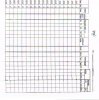
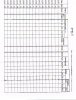
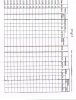
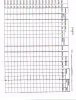
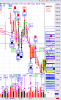
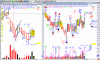
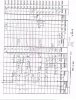
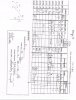
To be sure that I'm using the tools correctly, I took my understanding of the Pink, Gold and Doji lines as well as a RTL, LTL and BM and labeled a 5min chart side by side with a 30min chart of the same time period (20140421 open). Would you kindly review my attachment and help me to further understand the use of the DOJI lines??
I see some lines on your charts that seem to correspond to the OPEN price of the 0935, 1005, 1035, etc. bars, but many of your attachments also show another blueish line and I'm not following what it represents.
Labels on Attachment:
FTT = Failure to Traverse - both RTL and LTL in place and the trend failed to meet the trend line in the extreme direction. There's space between the price bar and the LTL. RTL and LTL not drawn for the 'up' movement.
Pink = The extreme of the bar where the FTT occurred - 3 ticks away from where the BM (bookmark) was placed.
Gold = End of the 2nd bar in a trend. Bar1 = BM placement/Pink area and Bar2 = further movement in the direction of the trade. The gold area takes you away from the 3 tick rule and into the more profitable area.
1. I drew the RTL from bar 1-2.
2. I cloned the RTL and put it at the bottom of bar 1 as both bars are translating bars.
3. I placed a DOJI bar (turquoise) at the open of the 1005 bar (first bar after the 30min ended.)
4. I placed a DOJI bar (periwinkle) at the open of each 30min bar.
As I stated above in blue, would you clarify the use of the DOJI bars and also point out any issues in what's represented in the attachment?
As always, thank you for your time...
Thanks for your questions.
I will post all my notes for today (Friday) so you have a complete day's set of references. But firs let me deal with your Q's.
I mentioned the Doji in one of the beginning posts. I will find it in a while and make reference to it.
You are considering the importance of "context" in trading. Context is important for several reasons. To go through the learning process of the various trader skill levels requires that a person self check himself periodically to assure he has not gains any misconceptions about anything. A person MUST always shed myths and misconceptions by making an effort to surround then with knowledge and skills that come to mind BEFORE anything erroneous already in the mind comes to mind. Earasing is not part of the process that the mind uses. Once something gets in the mind, it is there permanently. There are some peptides which experts feel can be summoned (it takes a very superior mind to be able to do this) to cleanse mistaken inference. The cure is more difficult than the work around.
Our mutual goal is to have and operate a complete system. By going through the work effort of streamlining the system, a great deal of facilty is achieved. Today I was posting a doc for the open. It was almost complete and I was adding an attachment. The Tucson power failed at 6:21. All my computers told me they were not getting info . My modem was telling me it was rebooting.
I felt it was important to explain the upcoming "hold thru" on bar 2. Well I aslo had a check valve to replace on the pool sweeper intake pipeline I small pisce of morter had gotten into the check valve and prevented its full opening (slowing down the pool boy).
I feel that the markets offer so much money that I could spend the lost trading of the open moves to tool up and fix the pipe. The pool was at 96 degrees this am
so it wasn't stressful at all.
For Monday and the ret of the week I will post the carryover so you can get used to see "CONTEXT" muscling into the picture to make the open fun.
Now lets look at you chart and your text. I feel you have the definitions done correctly. WHY they are there is what establishes the market context.
The early levels of skill (all beginner and half of intermediate) are tough for traders because they do not know what they DO NOT KNOW. As they sleep the mind merges the unconsciuos into the conscious AND the mind asks the conscious person to think about weaknesses in the mind's inference.
If you are lost in the woods, you ARE lost inthe woods. BUT if you are canoeing the Yukon river for 500 miles you still do KNOW you are on the river. It only has three bridges in those miles (one at each end and one in the middle). Creek branches happen more often. As you journal your passage, you definitely know where you have been. And you do see an occassional telegraph relay station and a wood fueling area that was clearcut during the gold rush. sidewheeler era. A tree grows 6 feet in 30 years.
I use geometry for market CONTEXT. You define all of the parts. I did the pennant Q's first to get some of the geometry on the table. I made it to "seems" I quess.
The second phrase in defing long and short is the important phrase. since it concerns the defining of when a beginning trend fails.
Picture yourself comfortably making money. you are in trends and they continue. You picture them ending when the end occurs. As you grow more skilled, you get into the next (opposite) trend and resume making money. You use logic ALL THE TIME to KNOW YOU KNOW. If you feel a tinge of fear, anxiety or anger, you KNOW that you do not know you know at thatmoment of the tinge. you recheck what you are reasoning though to get back on the ball.
All the sheets that comprise the complete system are set up for making money using logic by trading the dominant market trends. A failsafe component is there as well to prevent the taking of any losses. By only trading the dominant market CONTEXT and by not losing money, you get to have psotivie feelings all the time (comfort, support and confidence). So when you get the CW trader emotional tinge, you know you do NOT know at that moment. There is an error or ommission in the space. It is not something NEW or something the market is hiding from you. It is YOU having a tinge.
The doji is found on every bar. We have a doji on every bar and we can count on it. Since we have it we can count on it. Why? WHY not?
A doji begins on the beginning of every bar. YOU ALWAYS KNOW YOU KNOW THE DOJI BAR VALUE.
SIX FIVE MINUTE BARS FORM A 30 MINUTE BAR AND AT SECOND 300 OF THE FIRST BAR, YOU ANNOTATE THE DOJI VALUE. relax and do it. JUST DO IT on the five minute chart.
Why? So you can value any signal during the next 30 minutes.
I notice you have a beginning ray that does not make it to the end of 30 minutes. I also see a darker blue ray for the end of each 30 minutes. My conclusion is that the inking of your printer is wearing sunglasses or something cause the blue changes from one blue to another. One ray goes 30 minutes and then it is RESET a the very beginning of the new 30 minute bar.
Market sentiment is done with leg 2 of any bar. Dominance is good to know.
The Doji is the guy in geometry that dictates leg 2 of each bar. At the beginning of the bar you SEE immediately the relative nature of the forming bar. It is moving either away or towards the right. If leg 1 is missing, then you know you know you are on leg 2 immediately. We always like to see a brief leg 1 and then get right back to making more money.
On your chart, youput in the doji ray (blue) immetiately and you see the long context value has risen 13 ticks that you banked on , say 10 contracts. That 30 mins before you saw a dom to non dom to dom set of three moves (a normal tends has these three moves. The first bar of the new context is above the doji so the long is continuing.
I 'll continue in another post.