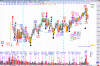
Thanks,since the laterals non domnant it always hits RTL,that`s clear.
One moment,please.You always says that the parallelogram is the only possible geometric figure in the market.I can only see it as an effect.Can you please explain the cause,explicitly?I`d be greatly appreciated!
Thanks again!
By nature left to right moves are non dominant. Dominant moves are the opposite.
There re many many discussions of market behavior and most are incorrect. I do not participate in threads that have screwed up logic of ways of trading. An example is a thing called "The Combine" and it is a contest that has a very flawed context. Often people challenge others to do the contest to "prove" something the challenger wants to find out. Actually, some people see it as a gateway to employment in the financial industry. It could be since the finacnial industry does not make money through trading prowess.
Lets look at your view expressed last. You mention effect and probably you also deal with cause.
The market is a very solid structure. A process goes on in the structure. The process yields results. This is what a system is composed of: structure, process and results.
In a nutshell, the whole system is a complete finite composition that is built from the smallest component into a whole.
As the market moves forward, it can be considered to be a complete system, BUT it is also true that over time the behavior has to fit into a properly concieved complete system. The system is a "cause" and the behavior is an "effect".
Please consider two themes in ET.. One is arbitrary and not a system. What I espouse happens to be a system.
The up/down construct cannot handle market sentiment. The left/right construct fits into the system of operation of the market. Below you get to see how this incompatibility caused strife in the minds of the non system users.
Trends operate in triads: dominant to non dominant to dominant. A market cycle is composed of two opposite trends.
The up/down erroneous construct just uses pairs of opposites.
To understand how a market cycle is constructed, a person has to be able to deal with the period in which trends overlap. A trend ends on a dominant move (M3). Then the next trend begins on a dominant move (M1).
Move three is from point 3 to the FTT of the trend. FTT stands for Failure To Traverse (a right to left failure). In the independent variable, this is an increasing volume period where volume goes from a ttough to a peak.
the new trend begins at this peak and goes to a trough and then to a peak. The trough occurs when the overlap of trends ends. It is called the BreakOut of the prior RTL.
Move two is a retrace and in the independent variable goes from a peak to a trough. Move two is called a retrace and the Move one is called a "reversal". Both begin in the same manner, BUT the reversal continues as a single move going forward to a peak in the independent variable.
as all of this is examined it becomes clearer just what the underlying is. It is market volatility. Trading cycles can be considered to be constant volatility cycles. The sawtooth wave is often a descriptor. Recently, a mistatement was made about the relative performance of longs and shorts. They actually work in the opposite money making characteristic than was presented. No matter, there are many myths pronounced in ET.
For a long I use shorthand B2B 2R 2B to symbolize the three moves.
A short is R2R 2B 2R
Two parallelograms overlap to make a complete trading cycle. Each has an overlap beginning at the FTT and ending at the BO of the prior RTL. All move one's go peak to trough to peak; all other moves have a one to one correspondence of price points and volume extremes. The actuality and requirement is only achieved with parallelograms that overlap.
In science and philosophy, this creates the key added benefit that exists. In markets, the elements that form the system of operation have an intrinsic Order Of Events as an effect.
Look at these two columns (columns are not capable in ET; I edited to an lower case vertical list followed by an upper case list) that depict the market cycle:
up ...............DOM
down.........NON DOM
up................DOM
down.........DOM
up.................NON DOM
down..........DOM
From this you can see how drawing lines to depict S and R does not work.
BUT drawing RTL and LTL's does work. An RTL and its LTL give a place within which the FTT does occur. Parallel lines afford the ability to introduce constant trend volatility (the constant separation of the lines).
Just as in chemistry, the Periodic Table shows the orderliness of the constituents. So do the lookup tables of the SCT show the orderliness of the market cycle. Both are finite and both are depicted as RDBMS's.