SCTlearning from scratch

Hello,

I am new to these forums and haven't traded before. My husband taught me a bit about price cases and the volume elements. That's about as far as my trading knowledge goes. I am going to follow your journal and complete the exercises. Thank you for starting this.

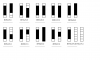
There are 9 variations 2 bars can make together, which is attached. The classification of bar.0 is determined by it's relationship to bar.1.

Correct; nice illustration.

the lateral is the tenth and takes three bars


cna you write the booean expressions for each case.

for programmers use SQL primarily
 
Here is an image I made that can be used by participants to print or open in paint for learning about price bars.

thanks for the imaging
It shows bars are made od ticks
and It shows how pairs of bar can relate


it was used already to show 9 of the ten RDBMS price cases


Thanks for contributing
 
What market(s) is this method best suited for the 1 lot trader? You trade ES right? , I assume for liquidity. Is there a better market to trade for the beginner that has more range per day and more points offered per day? cl,tf,gc,?

I have seen you state that you have 20-40 rts a day in ES before and that is just paying spread and comish to the man is it not?

I trade technical patterns like rectangles, triangles, head and shoulders, DB, DT, . Except I tend to stick to larger timeframes. Why do you seem to encourage the 5 min intraday on ES is my question? If your going to do the in all the time method, wouldn't you encourage CL, TF, GC intraday?

This is a fine post and it shows your are thinking about the system applications and you are making a comparison to past CW (Conventional wisdom) pattern annalysis.

A Lo of MIT did an analysis of all common patterns. HE did a very porr constuct for his research and got what could be expected. Garbage in and garbage out. Too bad for MIT.

So here are some answers


A human partners with the market. This is a question of effectiveness and efficiency.

Humans operate in the 10 to 100 millisecond range. We do more than required to follow a market on an information supply basis. 5 minute time frame is a nice place to operate to do MADA on a bar-by-bar basis using a complete system to extract the ful;l off of the market.

the system has a universal application if the market meets the criteria for use. We consider about 85 markets around the world can be used effectively and efficiently.

Forex doesn't work simply because the market is poorly organized and the independent variable is absent. this is kind of criminal on the part of the forex providers. It also shows ho primitive market structures and their regulation are.

All potential traders have to begin with 1 lot trading. I use the ES so the ES is satisfactory.

Learning is a process. The ES works quite well.

Making money is relative for various people. By using one market's offer as a standard a person can judge his Efectiveness and efficiency. I post charts and logs with trades so anyone can compare to this level of SCT.

During any day, the market makes an offfer in segments continually. Therefore bar-by-bar MADA is appropriate. To trade effectively and efficiently you must have a system that is totally complete and can allow you to always "know you know" in the market trader partner ship.

Thank you for posting your questions that specifcally relate to posts # 1 and 3..
 
Just a little somehin' somethin'

eta; (there are more ways to trade than I care to count)

RN

this is answer to step 2 of drill 1.

you see also an addition that is like candlesticks of four hundred years ago.

Also note the person has one of two orientaionns researched by IBM in 1957 (see their magazine "THINK")

In this case, the person has horizontal orientation as shown bt O's in bars illustrations

Also note that a 5 by 5 was used to :organized the "work" (great work, too) to assure completeness.

RN and I both feel "completeness" leads to fully defined systems.

As it turns out learners come to the table will all the equipment needed to do complete work.

A spim off of completeness is "certainty".

any system lacking certainty at all times is just still a work in progress.

We will do work in an organized way to close all doorrs that have an uncertain qualification.

Quantification is now leaving the scene because it is not complete and never will be.
 
Correct; nice illustration.

the lateral is the tenth and takes three bars


cna you write the booean expressions for each case.

for programmers use SQL primarily
Price Case Expressions

Price Case Expressions.png
 
Last edited by a moderator:
1. Draw a price bar four tick in volatilty. we will call this bar.1. .1 means prior bar. .2 would be two bars ago

I did 2 pics for for Step 1

First is the four Tick Bars

I will post a pic with OHLC next

drillwork.png
 
Last edited by a moderator:
1. Draw a price bar four tick in volatilty. we will call this bar.1. .1 means prior bar. .2 would be two bars ago


I did 2 pics for for Step 1


First is the four Tick Bars


I will post a pic with OHLC next

good pic and good idea to give a ral bar with the flags
all bars have


thanks for doing the work


I appreciate it.

My goal is to show how the mind gets Long Term Memory (LTM) from doing work.

when a person trades ba-by-bar his/her mind see bars as "perception".

The mind matches its memory to the bar on the screen

getting the memory built is how a person acquires knowledge and skills
 
2. Now draw all the variations on step 1. and do it in an organized manner


Here is a pic OHLC in an organized manner

Edwina this is good pic
please put "flags" on bars in future. as bars apper on charts

thanks for getting started

You need to do more for step 2
than just do one bar.
 
Correct; nice illustration.

the lateral is the tenth and takes three bars


cna you write the booean expressions for each case.

for programmers use SQL primarily

For those that use SierraChart, here is my code to determine price case.
Sierrachart uses the C++ programming language.

Hello Jack!

Code:
#include "sierrachart.h"

enum PricecaseEnum 
{
	PC_UNKNOWN = -0xBAD,
	PC_XB = 1, // Translation Black -$$$$-
	PC_XR = 2, // Translation Red -$$$$-
	// Outside bars
	PC_OUTB = 3,
	PC_OUTR = 4,
	PC_OUT_DOJI = 5,
	// Lateral Formations ALWAYS begin with 
	// one of the following PriceCases... 
	PC_HITCH = 10,
	PC_FTP = 11, // Flat Top Pennant
	PC_FBP = 12, // Flat Bottom Pennant
	PC_SYM = 13, // Symmetrical Pennant
	PC_STB = 14, // Stitch Black
	PC_STR = 15, // Stitch Red
};


PricecaseEnum GetPriceCase(SCBaseDataRef InData, long index)
{
	// Determine Pricecase of 2 adjacent price bars (index & index-1)
	// Lateral formations are NOT determined here as only
	// a ***possibility of the start*** of a lateral formation can
	// be determined using 2 bars. (see PricecaseEnum)
	
	// IsLateral and TrackLateral honor lateral user settings 
	// and lateral specific vars, and handles monitoring at least a minimum 
	// 3 bar lateral formation and ultimate end of lateral movement.  
	
	float H0 = InData[SC_HIGH][index];
	float H1 = InData[SC_HIGH][index - 1];
	float L0 = InData[SC_LOW][index];
	float L1 = InData[SC_LOW][index - 1];

	if (H0 > H1 && L0 > L1)
		return PC_XB;

	else if (H0 < H1 && L0 < L1)
		return PC_XR;

	else if (H0 == H1 && L0 == L1) 
		return PC_HITCH;

	else if (H0 == H1 && L0 > L1) 
		return PC_FTP;

	else if (H0 == H1 && L0 < L1) 
		return PC_STR;

	else if (L0 == L1 && H0 < H1) 
		return PC_FBP;

	else if (L0 == L1 && H0 > H1) 
		return PC_STB;

	else if (L0 > L1 && H0 < H1) 
		return PC_SYM;

	else if (L0 < L1 && H0 > H1)
		// Outside Black or Red or 
		if (InData[SC_LAST][index] > InData[SC_OPEN][index])
			return PC_OUTB;
		else if (InData[SC_LAST][index] < InData[SC_OPEN][index])
			return PC_OUTR;
		else
			return PC_OUT_DOJI;

	else 
		return PC_UNKNOWN;

}

 
Back
Top