Schadenfreude Warning: "Karen the Supertrader"

Yes, they may be naive, however if they spread out their investments over various funds, various asset classes, some do just fine. That doesn't mean they won't get taken. The complaint's focal point is regarding high water mark, disclosure, and the ability to generate an incentive fee with proper disclosure of beating the high water mark. The trades itself weren't fraudulent, but the SEC will claim they were based on her intentional desire to generate the incentive fees without the proper disclosure of the risks involved.

The trades were done SPECIFICALLY in a way to cover up the scam which is precisely why each trade required her approval before execution. The trades were absolutely fraudulent. The women worked as an accountant in the limestone business. She knew she was not qualified to run this fund. But she also knew she could manipulate the accounting. I honestly believe she attended one of the many seminars typical ETers attend or read some book about easy money selling premo and was intelligent enough to think she could make it work. Upon realizing what most of us already know, that it doesn't work that easy, she manipulated her trades. I do not believe she set out to do this from the beginning. I think once she realized that you can't simply make free money selling premo, there was no way out for her.
 
No, what's laughable is the high net worth accredited investor who doesn't seem to understand this, yet forks over a minimum $250,000 to invest in her fund. It has nothing to do with people on ET.

Most high net work individuals have advisors who make these decisions for them. Don't get me started about those people. Many of them are members of ET! :)
 
The trades were done SPECIFICALLY in a way to cover up the scam which is precisely why each trade required her approval before execution. The trades were absolutely fraudulent. The women worked as an accountant in the limestone business. She knew she was not qualified to run this fund. But she also knew she could manipulate the accounting.

The trades only became fraudulent because she designed them to specifically collect the incentive fee even though she hadn't passed the high water mark. The spread sheet designed by her employees will probably be used at trial as a key piece of evidence.

The complaint at paragraph 16 says her fund began in 2008, while the other fund she ran wasn't until 2011. The NFA conducted an audit in 2013 addressing certain deficiencies.

the SEC alleges the "scheme trades" weren't until 2014. From paragraph 58:

"In response to these enormous losses, beginning in November 2014 and continuing almost every month to the present, Defendants entered a series of trades (“Scheme Trades”) in the accounts of the HI Fund and the HDB Fund that had the purpose and effect of avoiding realization of the losses."

Perhaps as you say she was "not qualified" to run the fund. However, she had 25 years of experience as a CPA. The limestone business is irrelevant. Many financial advisors come from different backgrounds before starting their advisory business.

I agree with the statement regarding the manipulation of accounting.
 
Most high net work individuals have advisors who make these decisions for them. Don't get me started about those people. Many of them are members of ET! :)

You're right, they have advisors. However, it's the investor who was given the PPM and signed off on it, not the advisor.

Apparently, "Investor A" claims he didn't understand the accounting. From the complaint, paragraph 52:

"Investor A understood that Hope was taking a 20% share of monthly profits, but he did not understand the mechanics of how it was calculated."

In paragraph 53, the investor is the one who signed off.

"Investor A believed that the HDB Fund was charged a fee in accordance with the operating agreement, and he signed a letter to that effect in September of 2015 in response to concerns raised during the Commission’s examination of Hope."

Perhaps he did have an advisor and/or didn't conduct proper due diligence, but the complaint makes no mention of any power of attorney of any advisor.
 
Did TD actually promote her? She was on Tastytrade but TT is not owned by TD, they are a sponsor. (feel free to correct me if I am wrong)

Although still no mention of this on the TT site and her page is still up

https://www.tastytrade.com/tt/learn/karen-the-supertrader

Good points. It turns out, TT is actually owned by Dough, Inc.

From tastytrade.com:

  • Tom Sosnoff and Kristi Ross are the co-CEOs of dough, Inc., which includes tastytrade and dough.com.
  • dough’s platform was built by the world-class technology team behind thinkorswim, which was sold to TD Ameritrade in 2009.
From their legal disclaimers, if you take a trade by watching TT, it's at your own risk, since the entire content is considered "educational" and NOT financial advice.

So it's highly doubtful any investor will survive a claim against TD Ameritrade and/or TT (dough, Inc).
 
I never said he wasn't a good trader. He was VERY selective and he did a good job of hedging his exposure. He certainly took concentrated positions but rarely. He went long periods of time without trading much. He wasn't in there buying and selling everyday on every moving avg crossover. I would have to say though he is an anomaly. You can have that in any data set. Jake Arrieta is an anomaly. You can't model yourself after them. I think global macro traders have a lot of unique advantages if they are adept traders. You can find things that are not all correlated to each other. Soros is and was very good at that. And to be fair, if memory serves me right, early on his career Soros was very very close to being wiped out completely. He got "lucky" and avoided it.

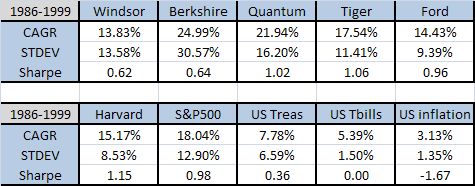
saupload_sharpes.jpg


While the above is just a small sample of Soros career, over this 13 year stretch he did no better then the S&P 500 on a risk adjusted basis.
Thank you for your thoughtful reply. I noticed on a risk adjusted basis (Sharpe?) Buffett is not that great.

Question: Was Buffett lucky based on risk adjusted return?

Another question, if you are an investor, in 1999, would you pick Buffett's vs the others and why, without hindsights?

Appreciate your coaching.
 
Sori to go against a few people here.

But I view here losses as a done deal.

There is no "rolling" onto the new month / 56 days. Each time she enters a new trade month / trade it is a completely new trade.

What I mean is if she had a losing month those losses are completely fixed. She said on her TT vids that she "gave up" the previous few months returns to "get herself in a better position".

I don't view it that way at all.... what happened was she lost $$ and then opened up completely new trades which were further OTM. You can't keep doing that forever. It sounds like a martingdale system to me. I don't view it as rolling onto the next month or further OTM. I believe she placed trades out there on the market and then lost money on those trade. Whatever she did after that has nothing to do with her original trades.
 

The writer has 30 years of options trading experience and was head of Risk Management on the ICE exchange. According to the article, the writer claims the following:

"It is likely that these substantial losses may have caused her to respond with deceptive trading practices. She may have made a common trading error, selling options and being unable to manage the losses. That’s my guess. To me it seems likely that she kept rolling her position hoping that eventually she would produce enough gains to cover the losses. She never got the chance. The SEC came knocking."

I'd say his guess is correct.
 
Back
Top