
You are using an out of date browser. It may not display this or other websites correctly.
You should upgrade or use an alternative browser.
You should upgrade or use an alternative browser.
Russia & Ukraine
- Thread starter UsualName
- Start date


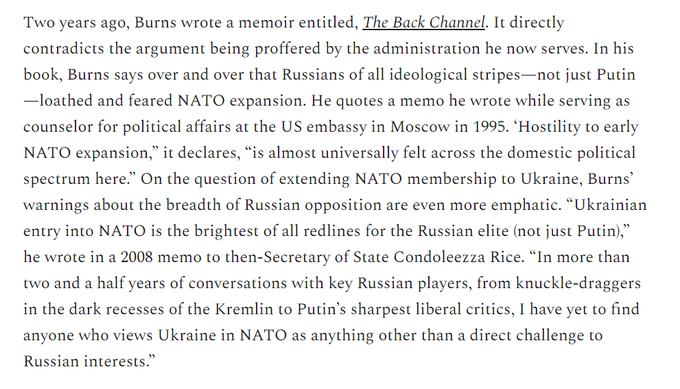
I've got dozens more of examples of scholars, foreign policy experts, heads of state, authors, politicians and so on and so forth. ALL who warned that our actions were pushing Russia to make a decision. Did we listen? No. Did we care then? Nope. Does that excuse Putin? Of course not. But it does make us culpable.
Unless, of course, your goal is to destroy Russia and Putin because they're the enemy of the West. If that is the case, then provoking Putin might be your end game. But don't fucking whine and carry on when what we put into place actually comes to be.
Unless, of course, your goal is to destroy Russia and Putin because they're the enemy of the West. If that is the case, then provoking Putin might be your end game. But don't fucking whine and carry on when what we put into place actually comes to be.
Prior to now, the deciding factor for NATO, The US, and Ukraine was whether or not they were willing to deal with the consequences of their inactions/actions regarding Ukraine's membership. Not whether it'll make Putin mad.
They made their decisions, and are dealing with the consequences. That's what sovereign nations do, and should do. Not respond simply out of fear ... especially if you're the world's superpower.
They made their decisions, and are dealing with the consequences. That's what sovereign nations do, and should do. Not respond simply out of fear ... especially if you're the world's superpower.
And this is quite possibly the best - balanced - explanation of why Russia is invading the Ukraine in video. Dumbed down and easy to understand.
Most of you won't watch it, because you're already FP experts in your own mind and not open to listening to anything other than your own point of view or your "side". That's OK. You can operate your whole lives under the pretense that you know everything.
Most of you won't watch it, because you're already FP experts in your own mind and not open to listening to anything other than your own point of view or your "side". That's OK. You can operate your whole lives under the pretense that you know everything.
People who warned us in advance.
#2: Henry Kissinger
Henry Kissinger: To settle the Ukraine crisis, start at the end
By Henry A. Kissinger
March 5, 2014
Henry A. Kissinger was secretary of state from 1973 to 1977.
Public discussion on Ukraine is all about confrontation. But do we know where we are going? In my life, I have seen four wars begun with great enthusiasm and public support, all of which we did not know how to end and from three of which we withdrew unilaterally. The test of policy is how it ends, not how it begins.
Far too often the Ukrainian issue is posed as a showdown: whether Ukraine joins the East or the West. But if Ukraine is to survive and thrive, it must not be either side’s outpost against the other — it should function as a bridge between them.
Russia must accept that to try to force Ukraine into a satellite status, and thereby move Russia’s borders again, would doom Moscow to repeat its history of self-fulfilling cycles of reciprocal pressures with Europe and the United States.
The West must understand that, to Russia, Ukraine can never be just a foreign country. Russian history began in what was called Kievan-Rus. The Russian religion spread from there. Ukraine has been part of Russia for centuries, and their histories were intertwined before then. Some of the most important battles for Russian freedom, starting with the Battle of Poltava in 1709 , were fought on Ukrainian soil. The Black Sea Fleet — Russia’s means of projecting power in the Mediterranean — is based by long-term lease in Sevastopol, in Crimea. Even such famed dissidents as Aleksandr Solzhenitsyn and Joseph Brodsky insisted that Ukraine was an integral part of Russian history and, indeed, of Russia.
Tom Toles goes global

The European Union must recognize that its bureaucratic dilatoriness and subordination of the strategic element to domestic politics in negotiating Ukraine’s relationship to Europe contributed to turning a negotiation into a crisis. Foreign policy is the art of establishing priorities.
The Ukrainians are the decisive element. They live in a country with a complex history and a polyglot composition. The Western part was incorporated into the Soviet Union in 1939 , when Stalin and Hitler divided up the spoils. Crimea, 60 percent of whose population is Russian , became part of Ukraine only in 1954 , when Nikita Khrushchev, a Ukrainian by birth, awarded it as part of the 300th-year celebration of a Russian agreement with the Cossacks. The west is largely Catholic; the east largely Russian Orthodox. The west speaks Ukrainian; the east speaks mostly Russian. Any attempt by one wing of Ukraine to dominate the other — as has been the pattern — would lead eventually to civil war or break up. To treat Ukraine as part of an East-West confrontation would scuttle for decades any prospect to bring Russia and the West — especially Russia and Europe — into a cooperative international system.
Ukraine has been independent for only 23 years; it had previously been under some kind of foreign rule since the 14th century. Not surprisingly, its leaders have not learned the art of compromise, even less of historical perspective. The politics of post-independence Ukraine clearly demonstrates that the root of the problem lies in efforts by Ukrainian politicians to impose their will on recalcitrant parts of the country, first by one faction, then by the other. That is the essence of the conflict between Viktor Yanukovych and his principal political rival, Yulia Tymoshenko. They represent the two wings of Ukraine and have not been willing to share power. A wise U.S. policy toward Ukraine would seek a way for the two parts of the country to cooperate with each other. We should seek reconciliation, not the domination of a faction.
Russia and the West, and least of all the various factions in Ukraine, have not acted on this principle. Each has made the situation worse. Russia would not be able to impose a military solution without isolating itself at a time when many of its borders are already precarious. For the West, the demonization of Vladimir Putin is not a policy; it is an alibi for the absence of one.
Putin should come to realize that, whatever his grievances, a policy of military impositions would produce another Cold War. For its part, the United States needs to avoid treating Russia as an aberrant to be patiently taught rules of conduct established by Washington. Putin is a serious strategist — on the premises of Russian history. Understanding U.S. values and psychology are not his strong suits. Nor has understanding Russian history and psychology been a strong point of U.S. policymakers.
Leaders of all sides should return to examining outcomes, not compete in posturing. Here is my notion of an outcome compatible with the values and security interests of all sides:
1. Ukraine should have the right to choose freely its economic and political associations, including with Europe.
2. Ukraine should not join NATO, a position I took seven years ago, when it last came up.
3. Ukraine should be free to create any government compatible with the expressed will of its people. Wise Ukrainian leaders would then opt for a policy of reconciliation between the various parts of their country. Internationally, they should pursue a posture comparable to that of Finland. That nation leaves no doubt about its fierce independence and cooperates with the West in most fields but carefully avoids institutional hostility toward Russia.
4. It is incompatible with the rules of the existing world order for Russia to annex Crimea. But it should be possible to put Crimea’s relationship to Ukraine on a less fraught basis. To that end, Russia would recognize Ukraine’s sovereignty over Crimea. Ukraine should reinforce Crimea’s autonomy in elections held in the presence of international observers. The process would include removing any ambiguities about the status of the Black Sea Fleet at Sevastopol.
These are principles, not prescriptions. People familiar with the region will know that not all of them will be palatable to all parties. The test is not absolute satisfaction but balanced dissatisfaction. If some solution based on these or comparable elements is not achieved, the drift toward confrontation will accelerate. The time for that will come soon enough.

Kissinger recycling the history of ancient Rus people etc. Puke.
Let's start to distinquish, Henry, what it is meant when it is said "Russia will never accept this or that." Just what the fuck we talking about- the Russian government or the Russian people? Because a lot of the Russian people dont appear to have the same decade after decade, century after century boner for making Ukraine a colony or killing them if they won;t marry Russia.
And yes, per this article and several others posted, it will piss the Russians off if we stand up to them and contain their expansion in any way, now, in the past or whenever- or as all these pundits put it "the U.S. is the cause."
Yeh, right. well lemme tell ya, Henry. Arguments were made that King George the Turd and the British people will never accept the fact that Americans are not British and will always be part of Britain. Not necessarily so. And lots of the British people did not necessarily have the same boner for killing and oppressing Americans as the government/monarchy did.
I am still not in favor of American troops in Ukraine but I am not goiing to start cheering for the Russians either because of the usual long, sad stories about how America caused everything because we failed to understand this or that. Problem is we did understand what the motherfuckers were up to, and yes, it will piss the chinese off too if we stand up to them and we have to listen to long posts and pundits who say we fail to understand the Who Flung A Dung Dynasty in year 1120 or the like.
"Can't we all just get along" - Rodney King.
Last edited:
Unsure what you're vomiting at.

Prior to now, the deciding factor for NATO, The US, and Ukraine was whether or not they were willing to deal with the consequences of their inactions/actions regarding Ukraine's membership. Not whether it'll make Putin mad.
They made their decisions, and are dealing with the consequences. That's what sovereign nations do, and should do. Not respond simply out of fear ... especially if you're the world's superpower.
The Putin NATO excuse is absolute bullshit and basically the Kremlin line for dupes in the west. Vlad himself essentially fessed up to it when giving his imperialist reasons for this action.
The Putin NATO excuse is absolute bullshit and basically the Kremlin line for dupes in the west. Vlad himself essentially fessed up to it when giving his imperialist reasons for this action.
Its ok, Cuddles. You can take me off ignore for a while to debate it without having to sneak a look at my posts through other means.
I'm happy to discuss it if you bring anything of solid evidence to the table other than the Cuddles4Money take.
Great read - and spot on. The way you take down Putin is financial, not war. MY emphasis, last sentence.
Blain’s Morning Porridge 1st March: Financial Blitzkrieg – It Works!
“Sometimes life played with him, sometimes it hung on him like a stone round the neck of a drowned man.”
This Morning: Russia thought it would roll over Ukraine, but the West’s Financial Blitzkrieg now threatens to trigger the unravelling of Putin’s autocracy. Excellent! The West needs Russia and Russia needs the West. It’s Putin’s kleptocracy we could all do without…
Dydd Dewi Sant Hapus! Happy Saint David’s Day to my Welsh Readers… (And she-who-is-Mrs-Blain)
Well, this is new and exciting… We’ve invented a whole new way to wage war! And it might even work.
It only took a day – but what we’ve already learnt about Financial Blitzkrieg is you can’t have half-measures. You need to go in brutal, all-out and nasty from the get-go. Don’t worry how messy it gets – go in hard and don’t stop punching. Don’t bring a knife to a financial fight – bring machine guns and lots of sanctions.
Messy it will get. Citicorp’s $10 bln exposure to Russia is a rounding error, but Austria’s Raiffeisen’s $9 bln number will hurt. (Austria is also 100% dependent on Russian energy.) Not surprisingly, French and Italian banks are on the hook for some $25 bln – no surprises there – but even that is “acceptable” blue-on-blue collateral damage.
The Aviation industry will take a potential pasting from aircraft leased to Russian operators – with some $5 bln of planes at risk. BP will take a thumping divesting from Rosnef, but they should be talking to the UAE – which is holding firm on its Russian positions, waiting to see what happens – while sending clear signals about where they see themselves in the future as neutral geopolitical ground. Londongrad property? Ouch.
The West surprised everyone – especially ourselves – with the scale of the weekend financial assault on Russia. The crunch moment that swung Europe behind stronger sanctions was a call with Ukrainian President Volodymyr Zelensky. He told them he didn’t expect to survive to speak to them again. Even the Germans were moved. Zelensky is that good.
Europe and the West should now go much further.
Completely freeze all Russian access to Swift. Worry not about Energy in Europe – it might be short-term painful, but the long-range weather forecast is for a mild European spring. Seize any and all Russian assets, including the half-sunken Oligarch gin-palace a Ukrainian engineer tried to sink. Squeeze the pips till the b*st*rds choke.
And make sure the Russian people know why. Make clear to every Russian how they behave today determines their personal future tomorrow. The West is watching – which is why oligarchs like Abramovich are trying to play both ends and their kids are breaking ranks. Better to lose $1 bln, keep $100mm, than be a head on a spike with nothing.
Yesterday conclusively demonstrated no nation exists on its own when it comes to global money. Especially an intrinsically weak and suspicious state like Russia. Nations remain interconnected. What use is Russia’s Fortress-economy when it ends up under economic siege? Its carefully rebuilt foreign reserves neutralised on a pen-stroke. Millions of Russians finding their savings blocked. And asking why… and for what..? Maybe they aren’t aware its Ukrainian cities their Katyusha rocket artillery is flattening…
And some point soon, a leading oligarch or a general will be on the phone to one of Russia’s most successful new business enterprises, the Wagner Group, to offer them a new contract. In Moscow. Perhaps they will reassign their operatives currently in Kyiv looking to assassinate Ukrainian President Zelensky.
If I can figure that might happen.. imagine how Vladimir Putin feels this morning… looking around, wondering who will betray him? Belarus hackers mounted a cyber-attack on their own nation’s infrastructure yesterday.
The reality is simple. The West needs Russia’s commodity resources. Russia needs the West’s open markets. That’s a win/win trade.
The alternative for Russia is bleak: become a price taker from China, which will prove entirely sub-optimal. China will treat them abysmally, and probably seek to integrate mineral-rich Siberia into their co-prosperity sphere. The alternative upside is to stop trying to f*ck with the West – and become part of it. Share the mutual prosperity… access to Western goods, tech and services.. or become China’s serf? Russia – You Choose.
Russia still has a chance to make this good. The chances… who knows?
I got a panicked call yesterday asking what I knew about Russian default. Wow. That triggered some memories. Russia has broken itself before. It’s doing it again. Yesterday, someone in the Kremlin announced Russian borrowers would stop repaying foreign loans, triggering immediate speculation it was an “event of default”. The comment was swiftly withdrawn. But it was an interesting moment…
Somewhere in a box up in my loft are some defaulted Tsarist bonds I bought back in the 1980s. I bought Russian bonds again in 1998. But, I couldn’t get my hands on the definitive bonds because unlike Tzar Nicholas’ debt, they actually matured and paid out! Which was a most pleasant surprise.
Russia managed to conclusively wreck their economy during the 1990s as the excesses and corruption of communism we replaced by naked financial banditry. According to the numpties on the extreme right in the USA – who for some curious reason seem to love Putin – it was entirely the West’s fault. Sovereign responsibility – just like personal responsibility – is naebody’s responsibility but yer own!
The Russians have historically demonstrated an extreme talent for fiscal, monetary and political instability for centuries. (Don’t get me wrong – I love Russians, they are charming, funny and passionate people. I love the culture, even their dark and melancholy souls. My favourite authors include Tolstoy, Sholokov (Quiet Flows the Don), and Pasternak… but they do have a talent for picking bad leaders.)
The 1998 Russian collapse occurred because Russia was broke, over-extended, exhausted by the costs of invading Chechyna, facing a chronic funding imbalance just as liquidity dried up as investors lost confidence in the pace of reform. Does that sound familiar? The country was under pressure all round – striking miners, transport workers and an increasing sense of grievance at Boris Yeltsin’s chronically mismanaged, ineffectual government and his blind eye to corruption and the state capture by oligarchs. Ring any bells?
It was Boris that brought in the relatively unknown former spook (and occasional St Petersberg taxi driver) Vladimir Putin as the new head of Federal Security.
The crunch came when the Ruble was devalued, the country defaulted and a moratorium was announced. Yeltsin was gone by the Autumn. History is kind of circular.
Trump recently said Putin was a genius. Unusually, there is an element of truth in that. Putin leveraged his position into the Presidency, inserted himself into every pie, and ensured he got the bulk of every kopek the kleptocracy ripped out of the Russian peoples’ soul. Evil genius indeed.
I remember the Russia default well. Back in August 1998 I was on holiday in Greece with two very young kids when LTCM, the “smartest hedge fund on the planet” with more Nobel prize winners than you could point the proverbial sharp-pointy stick at, collapsed in a liquidity storm. It was floored by a tidal wave of collateral mayhem triggered by a succession of “3-Sigma” market events – at least that was their excuse. At the core was the Russian Debt Crisis.
My then wife was singularly unimpressed as I spent days on my phone trying to fathom our positions, exposures and opportunities.. This was back in the days when phones were relatively new and simple things.. mine was dead modern – it could store and memorise up to 100 numbers! You definitely could not send emails or access the internet from it. Myself and half-a-dozen other bankers at the same resort ran out of fax-paper.
Among other things.. LTCM collapsed because they’d bought Russian domestic debt. As Russia unwound, LTCM got caught in a cascade of exits triggering a one-way market that crushed asset prices across multiple global markets. (Russia was not the only trade they got badly wrong – their losses on Russia were a fraction of what the collapsing swap market cost them, but it was all broadly interconnected and there are always consequences.)
As the Fed desperately tried to stop LTCM’s collapse becoming a run on the global financial system, the big US banks met to discuss a rescue. Apparently, the hold-out was my firm, Bear Stearns. The tensions in that room in 1998 apparently set the tone for 10-years later when the same banks let Lehman go to the wall… but that’s a story for another day..
Today, the west can weather whatever the coming, dare-I-say inevitable, Russian default and financial denouement throws up. What will be more interesting is how the West ensures it doesn’t happen again by making sure Russian V.3.1 is more honest, more liberal and less kleptocratic than what’s gone before. The Russians are good people. Their leaders are not..
Blain’s Morning Porridge 1st March: Financial Blitzkrieg – It Works!
“Sometimes life played with him, sometimes it hung on him like a stone round the neck of a drowned man.”
This Morning: Russia thought it would roll over Ukraine, but the West’s Financial Blitzkrieg now threatens to trigger the unravelling of Putin’s autocracy. Excellent! The West needs Russia and Russia needs the West. It’s Putin’s kleptocracy we could all do without…
Dydd Dewi Sant Hapus! Happy Saint David’s Day to my Welsh Readers… (And she-who-is-Mrs-Blain)
Well, this is new and exciting… We’ve invented a whole new way to wage war! And it might even work.
It only took a day – but what we’ve already learnt about Financial Blitzkrieg is you can’t have half-measures. You need to go in brutal, all-out and nasty from the get-go. Don’t worry how messy it gets – go in hard and don’t stop punching. Don’t bring a knife to a financial fight – bring machine guns and lots of sanctions.
Messy it will get. Citicorp’s $10 bln exposure to Russia is a rounding error, but Austria’s Raiffeisen’s $9 bln number will hurt. (Austria is also 100% dependent on Russian energy.) Not surprisingly, French and Italian banks are on the hook for some $25 bln – no surprises there – but even that is “acceptable” blue-on-blue collateral damage.
The Aviation industry will take a potential pasting from aircraft leased to Russian operators – with some $5 bln of planes at risk. BP will take a thumping divesting from Rosnef, but they should be talking to the UAE – which is holding firm on its Russian positions, waiting to see what happens – while sending clear signals about where they see themselves in the future as neutral geopolitical ground. Londongrad property? Ouch.
The West surprised everyone – especially ourselves – with the scale of the weekend financial assault on Russia. The crunch moment that swung Europe behind stronger sanctions was a call with Ukrainian President Volodymyr Zelensky. He told them he didn’t expect to survive to speak to them again. Even the Germans were moved. Zelensky is that good.
Europe and the West should now go much further.
Completely freeze all Russian access to Swift. Worry not about Energy in Europe – it might be short-term painful, but the long-range weather forecast is for a mild European spring. Seize any and all Russian assets, including the half-sunken Oligarch gin-palace a Ukrainian engineer tried to sink. Squeeze the pips till the b*st*rds choke.
And make sure the Russian people know why. Make clear to every Russian how they behave today determines their personal future tomorrow. The West is watching – which is why oligarchs like Abramovich are trying to play both ends and their kids are breaking ranks. Better to lose $1 bln, keep $100mm, than be a head on a spike with nothing.
Yesterday conclusively demonstrated no nation exists on its own when it comes to global money. Especially an intrinsically weak and suspicious state like Russia. Nations remain interconnected. What use is Russia’s Fortress-economy when it ends up under economic siege? Its carefully rebuilt foreign reserves neutralised on a pen-stroke. Millions of Russians finding their savings blocked. And asking why… and for what..? Maybe they aren’t aware its Ukrainian cities their Katyusha rocket artillery is flattening…
And some point soon, a leading oligarch or a general will be on the phone to one of Russia’s most successful new business enterprises, the Wagner Group, to offer them a new contract. In Moscow. Perhaps they will reassign their operatives currently in Kyiv looking to assassinate Ukrainian President Zelensky.
If I can figure that might happen.. imagine how Vladimir Putin feels this morning… looking around, wondering who will betray him? Belarus hackers mounted a cyber-attack on their own nation’s infrastructure yesterday.
The reality is simple. The West needs Russia’s commodity resources. Russia needs the West’s open markets. That’s a win/win trade.
The alternative for Russia is bleak: become a price taker from China, which will prove entirely sub-optimal. China will treat them abysmally, and probably seek to integrate mineral-rich Siberia into their co-prosperity sphere. The alternative upside is to stop trying to f*ck with the West – and become part of it. Share the mutual prosperity… access to Western goods, tech and services.. or become China’s serf? Russia – You Choose.
Russia still has a chance to make this good. The chances… who knows?
I got a panicked call yesterday asking what I knew about Russian default. Wow. That triggered some memories. Russia has broken itself before. It’s doing it again. Yesterday, someone in the Kremlin announced Russian borrowers would stop repaying foreign loans, triggering immediate speculation it was an “event of default”. The comment was swiftly withdrawn. But it was an interesting moment…
Somewhere in a box up in my loft are some defaulted Tsarist bonds I bought back in the 1980s. I bought Russian bonds again in 1998. But, I couldn’t get my hands on the definitive bonds because unlike Tzar Nicholas’ debt, they actually matured and paid out! Which was a most pleasant surprise.
Russia managed to conclusively wreck their economy during the 1990s as the excesses and corruption of communism we replaced by naked financial banditry. According to the numpties on the extreme right in the USA – who for some curious reason seem to love Putin – it was entirely the West’s fault. Sovereign responsibility – just like personal responsibility – is naebody’s responsibility but yer own!
The Russians have historically demonstrated an extreme talent for fiscal, monetary and political instability for centuries. (Don’t get me wrong – I love Russians, they are charming, funny and passionate people. I love the culture, even their dark and melancholy souls. My favourite authors include Tolstoy, Sholokov (Quiet Flows the Don), and Pasternak… but they do have a talent for picking bad leaders.)
The 1998 Russian collapse occurred because Russia was broke, over-extended, exhausted by the costs of invading Chechyna, facing a chronic funding imbalance just as liquidity dried up as investors lost confidence in the pace of reform. Does that sound familiar? The country was under pressure all round – striking miners, transport workers and an increasing sense of grievance at Boris Yeltsin’s chronically mismanaged, ineffectual government and his blind eye to corruption and the state capture by oligarchs. Ring any bells?
It was Boris that brought in the relatively unknown former spook (and occasional St Petersberg taxi driver) Vladimir Putin as the new head of Federal Security.
The crunch came when the Ruble was devalued, the country defaulted and a moratorium was announced. Yeltsin was gone by the Autumn. History is kind of circular.
Trump recently said Putin was a genius. Unusually, there is an element of truth in that. Putin leveraged his position into the Presidency, inserted himself into every pie, and ensured he got the bulk of every kopek the kleptocracy ripped out of the Russian peoples’ soul. Evil genius indeed.
I remember the Russia default well. Back in August 1998 I was on holiday in Greece with two very young kids when LTCM, the “smartest hedge fund on the planet” with more Nobel prize winners than you could point the proverbial sharp-pointy stick at, collapsed in a liquidity storm. It was floored by a tidal wave of collateral mayhem triggered by a succession of “3-Sigma” market events – at least that was their excuse. At the core was the Russian Debt Crisis.
My then wife was singularly unimpressed as I spent days on my phone trying to fathom our positions, exposures and opportunities.. This was back in the days when phones were relatively new and simple things.. mine was dead modern – it could store and memorise up to 100 numbers! You definitely could not send emails or access the internet from it. Myself and half-a-dozen other bankers at the same resort ran out of fax-paper.
Among other things.. LTCM collapsed because they’d bought Russian domestic debt. As Russia unwound, LTCM got caught in a cascade of exits triggering a one-way market that crushed asset prices across multiple global markets. (Russia was not the only trade they got badly wrong – their losses on Russia were a fraction of what the collapsing swap market cost them, but it was all broadly interconnected and there are always consequences.)
As the Fed desperately tried to stop LTCM’s collapse becoming a run on the global financial system, the big US banks met to discuss a rescue. Apparently, the hold-out was my firm, Bear Stearns. The tensions in that room in 1998 apparently set the tone for 10-years later when the same banks let Lehman go to the wall… but that’s a story for another day..
Today, the west can weather whatever the coming, dare-I-say inevitable, Russian default and financial denouement throws up. What will be more interesting is how the West ensures it doesn’t happen again by making sure Russian V.3.1 is more honest, more liberal and less kleptocratic than what’s gone before. The Russians are good people. Their leaders are not..