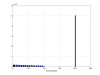
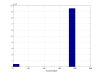
This is not quite right, either. Your calculated expectancy is positive, while the "intuitive" expectancy is negative (i.e. a near certainty of losing your entire account, given sufficiently many spins). The actual expectancy in this game is a function of the number of spins.
The OP wants to determine the degree of risk aversion of the traders, that is, a shape of the traders' utility function in term of its curvature. This is indeed an interesting topic, much discussed and written about. The problem is, the OP chose a rather esoteric game to explore this field. A much more illustrative game would be along the lines of, "given a game where you have 40% chance to make 5% return on your bet, and a 60% chance to lose 2% of your bet, how do you manage your position (bet) size relative to your account size". This formulation actually relates to real world trading, and the corresponding responses would indicate the responders' risk aversion levels in quantitave form, which is apparenly what the OP is looking for.