Chicago has already been replacing their
lead pipelines. Lead in people's drinking water has been severely damaging the health of many people who live in Urban communities. In the state of Illinois...they're replacing lead pipelines in the entire state but are
prioritizing Urban communities first before doing the same in suburban & rural communities in Illinois.
They aren't the only ones, South Dakota, Kentucky, and many other states doing the same damn thing. The strange aspect, the Federal government BANNED the use of lead pipelines several decades ago but they didn't have the funding to remove the lead pipelines for several decades...
Now they have the funding after several decades of complaints by health officials about America's declining health. Simply, the country has been getting sicker and many believe it's due to the contamination of our drinking water.
What Health Problems ?
- High blood pressure.
- Joint and muscle pain.
- Difficulties with memory or concentration.
- Headache.
- Abdominal pain.
- Mood disorders/Mental Illness.
- Reduced sperm count and abnormal sperm.
- Miscarriage, stillbirth, or premature birth in pregnant women.
- Learning disabilities
- Kidney problems/behavioural problems
All of the above have been
increasing health problems in America. Costing the government billions of dollars every year
beyond just health problems.
Every state has at least a few thousand lead pipes, but two states stand out for their estimated numbers. Florida leads the nation with an estimated 1.16 million lead pipes, accounting for 12.62% of the country's total makeup. Illinois ranks second, with a little over 1 million pipes.
Lead pipes are known to pose a health hazard to those who rely on them for water, and are "typically the most significant source of lead in the water," according to the EPA...
Children, babies and fetuses are most at risk of being impacted by lead exposure, with even low levels being linked to nervous system damage, learning disabilities, hearing impairment and other complications. Adults who are exposed could see cardiovascular, kidney and reproductive problems.
If you're curious, the
Republicans have been opposing the funding for lead pipeline replacement for
several decades even when they know that Urban communities are hit the hardest with the above-mentioned health problems in comparison to suburban & rural communities...
Lead is neurotoxic and will erode brain cells after it enters the body. As such, there is no safe level of exposure at any point in life, health experts say. Young children are especially vulnerable to lead's ability to impair brain development and lower cognitive ability.
Impacting minorities the most.

Democrats know and understand that one day these will be their voters
many years from now because statistically...the Urban voter are the fastest growing voting group...protecting the help of their future voters.
View attachment 329412
wrbtrader
As a kid...our family moved from a rural town in Kentucky to the north suburbs of Chicago.
My old man noticed the increasing use of "water bottles" at businesses and corporate offices but not the same in homes and schools. As a shrewd investor...he saw an investment opportunity...
Water Bottle Companies
https://www.baytechlabel.com/blogs/news/reason-water-bottle-sales-increasing
https://www.modernretail.co/retailers/the-resiliency-is-terrific-why-water-bottle-sales-are-on-fire/
Unfortunately, the enormous growing success of Water Bottle companies comes at a huge environmental, climate, and social cost.
https://www.cnn.com/2023/03/16/world/plastic-water-bottles-un-report-climate/index.html
Read below the history of lead poison pipelines and what the Trump administration knew & understood...one of his last official acts as a U.S. President...the revision took place as he was going out the door. 
Seriously, why would a losing U.S. President be occupied (on his way out of the White House) with lead pipelines in America ???
Regardless, over 22 million Americans are poisoned by their water each day.
-----
The U.S. Environmental Protection Agency (EPA) Lead and Copper Rule Improvements proposal, to be released in November 2023, is the culmination of a struggle that has lasted nearly 50 years to get the agency to meaningfully tackle the nation’s widespread lead in drinking water crisis. What follows is a summary of the decades of weak EPA rules and congressional efforts to force action to address the problem of millions of people drinking water contaminated with lead, a potent toxin unsafe for human health at any level of exposure.
Early provisions of the Safe Drinking Water Act and 1991 Lead and Copper Rule
The Safe Drinking Water Act (SDWA), originally enacted nearly a half century ago
in 1974, required the EPA to set interim drinking water standards within six months and then to promptly update them with final standards. In 1975, the EPA set a 50 parts per billion (ppb)
interim Maximum Contaminant Level (MCL) for lead. More than a decade later, Congress was frustrated by the EPA’s inadequate “interim” standards and amended the SDWA
in 1986. Those amendments required the EPA to quickly issue additional standards and ordered the agency to review the adequacy of health protection provided by its interim standards, including the lead rule, and to strengthen them if feasible. The 1986 law also prohibited the new installation or sale of lead pipes for use in drinking water.
In response, the EPA issued the now-infamous Lead and Copper Rule (LCR) in 1991 (the full rule as issued in 1991 can be found
here; EPA’s summary as it has been revised over the years is
here). The LCR was supposed to reduce the levels of lead in tap water, in part by requiring corrosion control treatment and the removal of some lead pipes that carry water from the water main in the street to homes called lead service lines. Removal of these lead pipes is only required when 10 percent of tested taps in a water system exceed the “lead action level” of 15 ppb. This EPA-invented action level is
not an enforceable standard like an MCL. Rather, it is only supposed to trigger certain additional steps, such as improved corrosion control and removal of lead service lines, until the action level is no longer exceeded. In the same rule, the EPA also set an MCL goal of zero, acknowledging that there is no safe level of lead in drinking water.
In 1991, NRDC sued to challenge that rule as failing to adequately protect the public. The water utility trade association, the American Water Works Association (AWWA) also sued, challenging the rule as burdensome. The court
mostly upheld the rule, though it told the EPA that it had failed to adequately address one of NRDC’s many concerns: the exemption of some noncommunity water systems (like motels, gas stations, restaurants, and parks that have their own water system). The court also went along with AWWA’s argument that the EPA did not provide the industry with sufficient opportunity to comment on its requirement to replace full lead service lines in some circumstances, including in cases where the utility controls but doesn’t fully own a lead pipe.
Responding to the court’s decision, the EPA later caved to AWWA’s pressure and issued a rule saying utilities only needed to pay for replacing the portion of lead service lines that they owned. The EPA made that decision even though these same utilities often required or encouraged and approved the use of lead pipes, frequently without the property owners’ knowledge. As a result of this fateful EPA decision, water utilities have only been required to conduct partial lead service line replacements, where they only replace the portion of a lead pipe that they own, even when lead levels at the taps they serve are extremely high. These partial lead service line replacements
can increase lead levels for a time by dislodging lead particles from the remaining lead pipe and causing galvanic corrosion that can result when two different metals such as lead and copper touch (see my colleague Cyndi Roper’s excellent
blog discussing the risks posed by partial replacements). Because of the weak LCR, AWWA’s pressure, and the agency’s regrettable decision allowing water utilities to dump much of the cost for lead service line removals on homeowners and landlords, few of these lead pipes have been fully replaced.
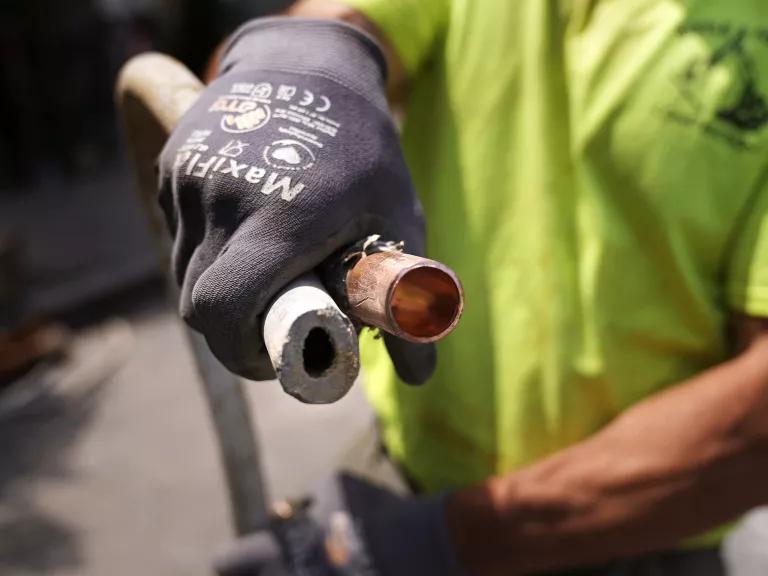
A worker shows the cross section of an original lead residential water service line (left), and the replacement copper line (right) outside a home in Providence, Rhode Island.
Credit:
Charles Krupa/Associated Press
Lead crises highlight inadequate protection against lead, prompting congressional action
Congress has repeatedly updated the SDWA to tighten requirements for lead. The
1996 SDWA Amendments required new plumbing fittings and fixtures to comply with previously voluntary lead-leaching standards and prohibited sales of any of these items that failed to meet the law’s definition of “lead free.” In 2011, Congress passed
another law that tightened the definition of “lead free,” lowering the maximum lead content of the wetted surfaces of pipes, fittings, and fixtures from 8 percent down to a weighted average of 0.25 percent.
Despite these laws, it became clear that the public was not being protected from lead in drinking water after numerous crises occurred, including in
Washington, D.C., in the early 2000s and later in
Flint, Michigan, and
Newark, New Jersey. Even when there are supposedly no lead service lines, water that is inadequately treated for corrosion can cause serious lead contamination, as it does in
Portland, Oregon, where it is an ongoing problem. As the EPA’s former head of enforcement
has said, the LCR is difficult to enforce, and its implementation has long been “broken.” Indeed,
NRDC’s analysis has found that tens of millions of Americans continue to be served by water systems that are significantly contaminated with lead, and according to the
EPA’s latest estimate, 9.2 million homes are served by lead service lines.
In recognition of the continuing lead in drinking water problem, Congress again
revised the SDWA in 2016, adding a grant program for the replacement of lead service lines, especially targeting disadvantaged households. Soon thereafter, seeing that this was still insufficient, and with strong support from the Biden administration, Congress amended the law yet again in the
Bipartisan Infrastructure Law in 2021 to strengthen the lead service line replacement grant program and provide an unprecedented $15 billion exclusively for replacement of lead pipes.
Thus, Congress has repeatedly sought to strengthen protections of the public from lead in tap water, and specifically from lead pipes, but with only modest success—primarily due to the woefully inadequate LCR.
Recent history: Updating the Lead and Copper Rule
On January 15, 2021, in one of its last official actions, the Trump administration issued a revision to the LCR that would allow continued widespread use of lead service lines and lead contamination of tap water (summary of the Trump administration’s rule can be found here; the full rule text, here).
The EPA asserted at the time that the rule would modestly increase lead service line replacements, though its analysis showed that most would remain in use. NRDC, the NAACP, frontline community groups represented by Earthjustice, and 10 states
challenged what NRDC called the “weak and illegal” Trump administration rule. Ultimately, the EPA decided in December 2022 to
no longer defend the Trump administration rule in court and promised a strengthened LCR by October 2024.
We hope that the EPA will at last
meaningfully tackle the lead in drinking water problem when it finalizes an overhauled LCR in 2024. The health of tens of millions of people living in America depends on it.
https://www.nrdc.org/bio/erik-d-ols...one-americas-worst-water-contamination-crises
-----
The
Trump virus knows & understands the increasing health problems in the urban communities...the growing health problems of individuals who can vote against him.
Trump wants the Democratic voters in Urban communities to continue to be poisoned by the lead pipelines in their communities...
Simply, the Trump virus is
not protecting the health of America as a whole. In contrast, he's protecting a certain group of voters by getting rid of another group of voters.
wrbtrader