
You are using an out of date browser. It may not display this or other websites correctly.
You should upgrade or use an alternative browser.
You should upgrade or use an alternative browser.
Ridin' with Biden
- Thread starter Cuddles
- Start date


However, I think that result has more to do with other factors than Biden...
Yet, I was surprised to learn that a talking point by several key Republicans and ETs wannabe Republicans had implied (suggested) that the American average household income (corrected with inflation) had fallen below 70k when in reality it only dropped from $78,250 to $76,660 (Americans still felt the $1590 drop in household income)...
Yet, not as bad as Republicans and others dissing on Democrats wants you to believe.
Why so many Americans are unhappy about the economy
...As the census report shows, the 2022 decline is part of a longer trend. After surging to $78,250 in 2019, household income corrected for inflation fell to $76,660, reflecting the impact of the pandemic, and stabilized in 2021 before falling again in 2022. The purchasing power of average households was 4.7% lower at the end of 2022 than it had been three years earlier (see Census Bureau report, Table A-2).
The stabilization that occurred in 2021 was the result of massive government subsidies — the American Rescue Plan enacted by Democrats early in the Biden administration as well as the continuing impact of waves of economic assistance supported across party lines during the final year of the Trump administration. These subsidies, many of which were delivered through the tax code, dwindled in 2022, adding additional downward pressure on household income. As a result, household income after taxes fell by a stunning 8.8% in 2022 — 8.5% for white Americans, 8.6% for Black Americans, and 10.9% for Hispanics (see Census Bureau report, Table B-1).
There is reason to believe that the worst is over for American households. Based on trends over the past 12 months, the rate of inflation for 2023 will be significantly lower than in 2022. Meanwhile, the pace of wage increases has remained relatively robust at 4.3%, outstripping inflation in recent months for the first time since the spring of 2021. In addition, the impact of declining government subsidies will be much smaller in 2023 than in 2022, and workers may begin to feel the impact of economic legislation that until now has seemed abstract and remote.
History suggests that voters are sensitive to changes in their purchasing power. If household incomes corrected for inflation continue to increase during the next 12 months, the public will probably give President Biden higher marks for economic management than he is receiving right now...
Reducing though not removing a major obstacle to his reelection. If this does not happen, his Republican opponent will have an argument that he will have a hard time rebutting, which could prove decisive if the election remains as close as recent polls indicate.
Another issue very important to myself and relatives living in Kentucky, Illinois, South Dakota, Iowa, Arizona, and New Mexico...the $470 billion in private sector investments across five key segments: semiconductors and electronics; clean energy; electric vehicles and batteries; biomanufacturing; and heavy industry such as chemicals, metals, and appliances investments that was announced by the Biden administration in 2021...
We'll begin to see the blooming of those seeds (investment) in the U.S. economy in 2024. Without it, Electric vehicle ownership will continue to be out of reach for most Americans. Unfortunately, again, Republicans bragging (taking credit) about what it brings to the economy of their state while still dismissing Biden...
They're not able to admit such a huge investment into the U.S. economy would not have occurred under a Trump administration.
While the majority of the announced investments are committed to semiconductors, energy technologies also loom large. Roughly 48% of new investment announcements are energy-related, with $140 billion in new private capital committed to electric vehicle and battery manufacturing and $82 billion committed to clean energy production. Electric vehicles and batteries account for the largest number of projects.
wrbtrader
Yet, not as bad as Republicans and others dissing on Democrats wants you to believe.
History suggests that voters are sensitive to changes in their purchasing power. If household incomes correctedfor inflation continue to increase during the next 12 months, the public will probably give President Biden higher marks for economic management than he is receiving right now...
wrbtrader

Last edited:
You meant to say that Marjorie Taylor Greene and Gang wished upon a star (stated) that the average household income dropped below 70k when in reality... it was a lie.
Only dropped from $78,250 to $76,660
Yet, I will enjoy watching them brag about the economic investments in their state that they will be receiving a piece of the 470 billion dollar investment in the economy of their state...in a prior recent message post, I called their behavior...Tubervillism.

A politician that brags to their state about economic benefits while not (refusing) to give credit to the White House administration that funded the economic benefits in the politician's state.
wrbtrader
Last edited:

However, I think that result has more to do with other factors than Biden...
Yet, I was surprised to learn that a talking point by several key Republicans and ETs wannabe Republicans had implied (suggested) that the American average household income (corrected with inflation) had fallen below 70k when in reality it only dropped from $78,250 to $76,660 (Americans still felt the $1590 drop in household income)...
Yet, not as bad as Republicans and others dissing on Democrats wants you to believe.
Why so many Americans are unhappy about the economy
...As the census report shows, the 2022 decline is part of a longer trend. After surging to $78,250 in 2019, household income corrected for inflation fell to $76,660, reflecting the impact of the pandemic, and stabilized in 2021 before falling again in 2022. The purchasing power of average households was 4.7% lower at the end of 2022 than it had been three years earlier (see Census Bureau report, Table A-2).
The stabilization that occurred in 2021 was the result of massive government subsidies — the American Rescue Plan enacted by Democrats early in the Biden administration as well as the continuing impact of waves of economic assistance supported across party lines during the final year of the Trump administration. These subsidies, many of which were delivered through the tax code, dwindled in 2022, adding additional downward pressure on household income. As a result, household income after taxes fell by a stunning 8.8% in 2022 — 8.5% for white Americans, 8.6% for Black Americans, and 10.9% for Hispanics (see Census Bureau report, Table B-1).
There is reason to believe that the worst is over for American households. Based on trends over the past 12 months, the rate of inflation for 2023 will be significantly lower than in 2022. Meanwhile, the pace of wage increases has remained relatively robust at 4.3%, outstripping inflation in recent months for the first time since the spring of 2021. In addition, the impact of declining government subsidies will be much smaller in 2023 than in 2022, and workers may begin to feel the impact of economic legislation that until now has seemed abstract and remote.
History suggests that voters are sensitive to changes in their purchasing power. If household incomes corrected for inflation continue to increase during the next 12 months, the public will probably give President Biden higher marks for economic management than he is receiving right now...
Reducing though not removing a major obstacle to his reelection. If this does not happen, his Republican opponent will have an argument that he will have a hard time rebutting, which could prove decisive if the election remains as close as recent polls indicate.
Another issue very important to myself and relatives living in Kentucky, Illinois, South Dakota, Iowa, Arizona, and New Mexico...the $470 billion in private sector investments across five key segments: semiconductors and electronics; clean energy; electric vehicles and batteries; biomanufacturing; and heavy industry such as chemicals, metals, and appliances investments that was announced by the Biden administration in 2021...
We'll begin to see the blooming of those seeds (investment) in the U.S. economy in 2024. Without it, Electric vehicle ownership will continue to be out of reach for most Americans. Unfortunately, again, Republicans bragging (taking credit) about what it brings to the economy of their state while still dismissing Biden...
They're not able to admit such a huge investment into the U.S. economy would not have occurred under a Trump administration.
While the majority of the announced investments are committed to semiconductors, energy technologies also loom large. Roughly 48% of new investment announcements are energy-related, with $140 billion in new private capital committed to electric vehicle and battery manufacturing and $82 billion committed to clean energy production. Electric vehicles and batteries account for the largest number of projects.
View attachment 328775
wrbtrader
The public's easily propagandized (see below). What wallstreet sees doesn't necessarily translate into what main street will get but the very real danger of a recession appears to be in the rear view mirror. It hasn't reflected in spending either, even accounting for inflation.
You meant to say that Marjorie Taylor Greene and Gang wished upon a star (stated) that the average household income dropped below 70k when in reality... it was a lie.
Only dropped from $78,250 to $76,660
Yet, I will enjoy watching them brag about the economic investments in their state that they will be receiving a piece of the 470 billion dollar investment in the economy of their state...in a prior recent message post, I called their behavior...Tubervillism.
wrbtrader
33-37 % approval rating is the reality.
33-37 % approval rating is the reality.
You and I both know the reality of my message post has nothing to do with the reality of your message post.
Simply, no argument from me because we're both following topics that are different...not important to the other.

wrbtrader
History suggests that voters are sensitive to changes in their purchasing power. If household incomes corrected for inflation continue to increase during the next 12 months, the public will probably give President Biden higher marks for economic management than he is receiving right now...
Historically no 1st term president has gone from the 30's to a 50% approval in Gallup polling the final 11 months of their first term.
Not only is Bidens approval in Gallup in the 30's,he has the highest disapproval at this point of any first term president on Gallup,even higher than Trumps and Carter,making his climb to the net positive approval needed to win even higher than Trump and Carter.
Last edited:
The public's easily propagandized (see below). What wallstreet sees doesn't necessarily translate into what main street will get but the very real danger of a recession appears to be in the rear view mirror. It hasn't reflected in spending either, even accounting for inflation.
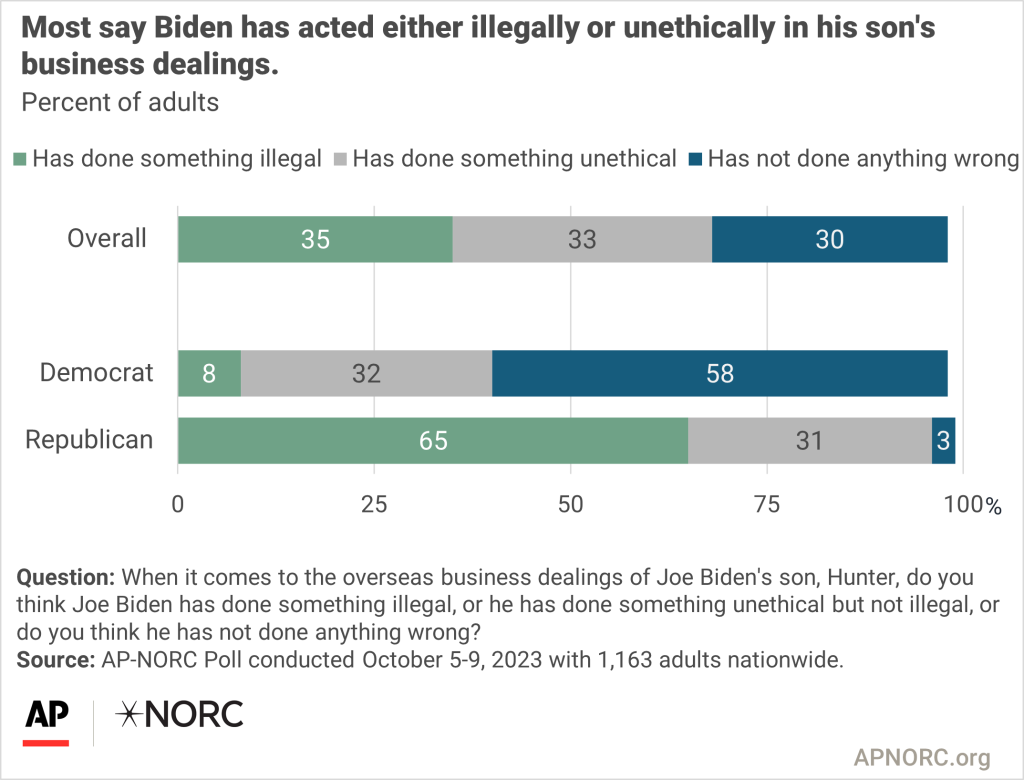
Considering there's a history of congressional members with drug-addicted children or drug-addicted adult children...
It's deserving distraction propaganda and intentional from what is occurring with the real criminal...
The former President Donald Trump while others around him have been convicted of crimes/sent to prison or making deals with prosecutors to stay out of prison.
P.S. I still think Hunter Biden and Donald Trump will end up in the same prison. Yet, I will not bet that they'll become prison cell mates.
wrbtrader