
You are using an out of date browser. It may not display this or other websites correctly.
You should upgrade or use an alternative browser.
You should upgrade or use an alternative browser.
Regret’: JPMorgan chief rushes to stop China fallout after quip
- Thread starter themickey
- Start date
Imagine China Bank setting up business in the UShttps://www.ft.com/content/e5426438-bf91-4f64-9b93-067e81925d29
Global banks have bet on ‘big bang’ in China but will it pay off?
World’s biggest financial institutions hope to profit from Beijing’s move to loosen regulations after years of setbacks.
Just days after sweeping into Hong Kong on a surprise visit, JPMorgan Chase chief executive Jamie Dimon was desperately trying to make amends for boasting that the US bank might outlast China’s Communist party.
As well as overshadowing last week’s visit, Wednesday’s public apology underlined that the lender — and its major Wall Street and European rivals — believe they still need to work hard to chase a big prize in China. For western banks, this prize has proved to be elusive so far.
Plagued by operational setbacks and prohibitive regulations that have capped investment, JPMorgan’s efforts at investment banking in China have involved large costs for meagre returns.
Despite investing millions of dollars and hiring dozens of bankers, the company reported a $40m (Rmb255.5m) total loss over the past two years, according to figures reported to Chinese regulators and seen by the Financial Times. The banks are keen to cast their losses in mainland China as a necessary price to pay for a lucrative future.
They also point to the fees already reaped from advising Chinese companies on listings in New York and Hong Kong — rewards that would be much harder for the banks to secure without a base on the mainland.
But as Beijing threatens to put an end to that revenue stream while at the same time opening up the mainland, Wall Street is hoping its bigger bet will pay off and it can finally make some real money in China itself. “We are building for the future,” Filippo Gori, JPMorgan’s chief executive for Asia-Pacific, told the FT. “We are not worried if it takes us one year or 25.”
JPMorgan is far from alone in having failed to capitalise on its investments in China. Morgan Stanley’s mainland investment bank made profits of just $160,000 in China last year and a combined $33m of losses in the two years previously.
Meanwhile, Goldman Sachs — whose mainland investment bank is 15 years older than JPMorgan’s — has made profits of about $30m in total since 2018. In fact, of the seven global banks that own investment banking operations in mainland China, just three — Goldman, UBS and Deutsche Bank — have been profitable in the last three years. The businesses controlled by JPMorgan, Morgan Stanley, Credit Suisse and HSBC are all in the red.......
The seven banks’ Chinese operations made a combined $140m in revenue from investment banking services in 2020, according to the figures reported to regulators. JPMorgan contributed around $600,000 of that.
All of the lenders are quick to point out that the domestic reported revenue for their investment banks does not fully represent their wider China banking businesses, such as bond underwriting and advisory work that is booked through different onshore entities, in Hong Kong or elsewhere.
None of them disclose total revenues for mainland China. But no matter the caveats, the numbers illustrate that — even after decades in China — global banks have far to go to capture a significant slice of the enormous domestic deals market.
4 of the world's largest banks are Chinese, yet none are in the US or Europe. Wonder why?https://www.ft.com/content/e5426438-bf91-4f64-9b93-067e81925d29
Global banks have bet on ‘big bang’ in China but will it pay off?
World’s biggest financial institutions hope to profit from Beijing’s move to loosen regulations after years of setbacks.
Just days after sweeping into Hong Kong on a surprise visit, JPMorgan Chase chief executive Jamie Dimon was desperately trying to make amends for boasting that the US bank might outlast China’s Communist party.
As well as overshadowing last week’s visit, Wednesday’s public apology underlined that the lender — and its major Wall Street and European rivals — believe they still need to work hard to chase a big prize in China. For western banks, this prize has proved to be elusive so far.
Plagued by operational setbacks and prohibitive regulations that have capped investment, JPMorgan’s efforts at investment banking in China have involved large costs for meagre returns.
Despite investing millions of dollars and hiring dozens of bankers, the company reported a $40m (Rmb255.5m) total loss over the past two years, according to figures reported to Chinese regulators and seen by the Financial Times. The banks are keen to cast their losses in mainland China as a necessary price to pay for a lucrative future.
They also point to the fees already reaped from advising Chinese companies on listings in New York and Hong Kong — rewards that would be much harder for the banks to secure without a base on the mainland.
But as Beijing threatens to put an end to that revenue stream while at the same time opening up the mainland, Wall Street is hoping its bigger bet will pay off and it can finally make some real money in China itself. “We are building for the future,” Filippo Gori, JPMorgan’s chief executive for Asia-Pacific, told the FT. “We are not worried if it takes us one year or 25.”
JPMorgan is far from alone in having failed to capitalise on its investments in China. Morgan Stanley’s mainland investment bank made profits of just $160,000 in China last year and a combined $33m of losses in the two years previously.
Meanwhile, Goldman Sachs — whose mainland investment bank is 15 years older than JPMorgan’s — has made profits of about $30m in total since 2018. In fact, of the seven global banks that own investment banking operations in mainland China, just three — Goldman, UBS and Deutsche Bank — have been profitable in the last three years. The businesses controlled by JPMorgan, Morgan Stanley, Credit Suisse and HSBC are all in the red.......
The seven banks’ Chinese operations made a combined $140m in revenue from investment banking services in 2020, according to the figures reported to regulators. JPMorgan contributed around $600,000 of that.
All of the lenders are quick to point out that the domestic reported revenue for their investment banks does not fully represent their wider China banking businesses, such as bond underwriting and advisory work that is booked through different onshore entities, in Hong Kong or elsewhere.
None of them disclose total revenues for mainland China. But no matter the caveats, the numbers illustrate that — even after decades in China — global banks have far to go to capture a significant slice of the enormous domestic deals market.
Oh shucks!! Another company that doesn't get to bend over backwards to cater to every single whim and wish of the Chinese government; another company that doesn't get to invest in China. Oh no, what are we going to do? We are going to be living on the streets soon...
I was thinking the same thing, what a bunch of wimps they are...
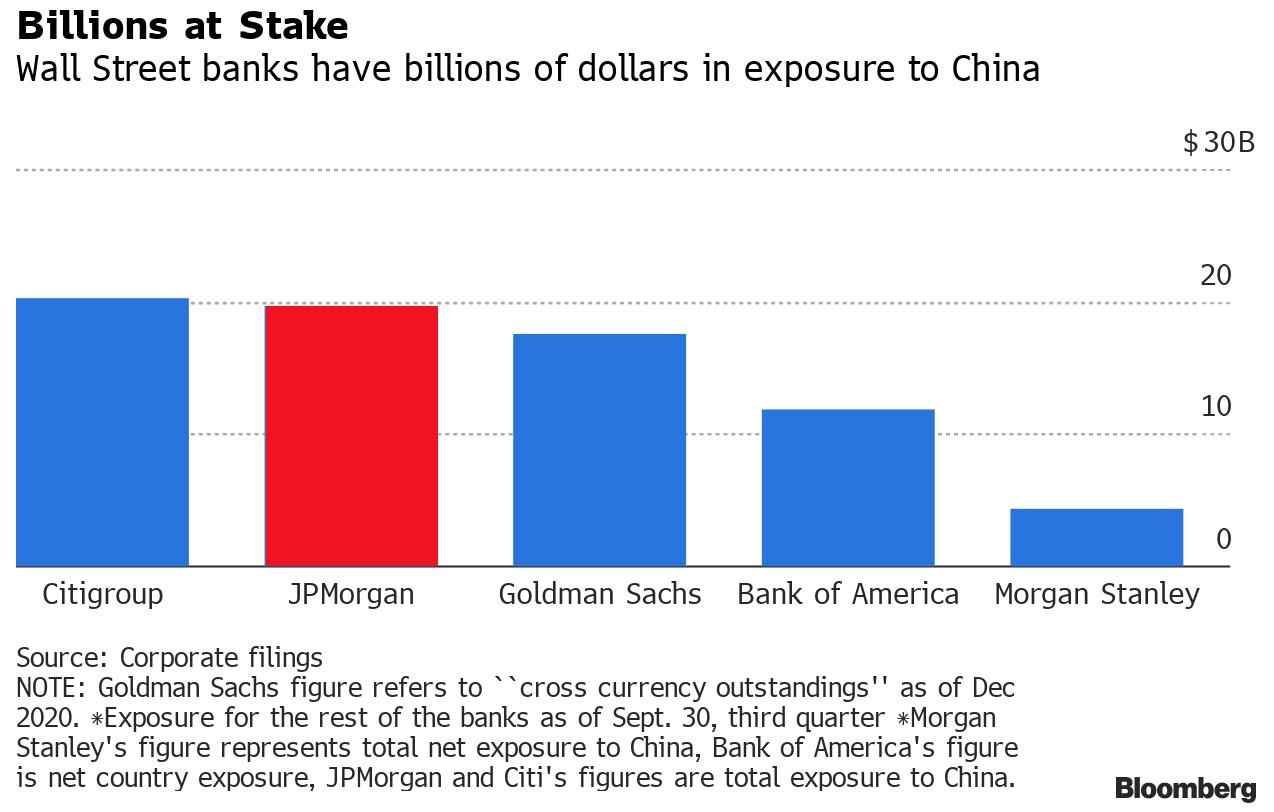
Imagine China Bank setting up business in the US
4 of the world's largest banks are Chinese, yet none are in the US or Europe. Wonder why?
Good!! Let's keep it that way. It's enough that our exchanges are littered with Chinese companies.


In case you too, like me, missed what's really going on in this thread:
https://www.bbc.com/news/business-59409508
"
JPMorgan boss regrets saying bank will outlast Chinese Communist Party
JP Morgan boss Jamie Dimon has apologised after saying his Wall Street bank would outlast China's Communist Party.
The comments, made at a US event, sparked anger in China, with experts warning they could jeopardise the bank's ambitions in the country.
Mr Dimon said: "I regret and should not have made that comment," in a statement issued on Wednesday.
He added he was only to trying to "emphasise the strength" of the bank.
Academics suggested the quick apology was aimed at containing the fallout.
In August, JP Morgan won approval to become the first full foreign owner of a securities brokerage in China.
...
"
https://www.bbc.com/news/business-59409508
"
JPMorgan boss regrets saying bank will outlast Chinese Communist Party
JP Morgan boss Jamie Dimon has apologised after saying his Wall Street bank would outlast China's Communist Party.
The comments, made at a US event, sparked anger in China, with experts warning they could jeopardise the bank's ambitions in the country.
Mr Dimon said: "I regret and should not have made that comment," in a statement issued on Wednesday.
He added he was only to trying to "emphasise the strength" of the bank.
Academics suggested the quick apology was aimed at containing the fallout.
In August, JP Morgan won approval to become the first full foreign owner of a securities brokerage in China.
...
"

A person of that stature will not say anything that would jeopardize his position. Or maybe it's a trial balloon for "glass heart" aka "玻璃心".

/cdn.vox-cdn.com/uploads/chorus_image/image/61138291/Screen_Shot_2018_09_04_at_4.30.23_PM.0.png)