
You are using an out of date browser. It may not display this or other websites correctly.
You should upgrade or use an alternative browser.
You should upgrade or use an alternative browser.
Re-opening Schools in the era of COVID
- Thread starter gwb-trading
- Start date

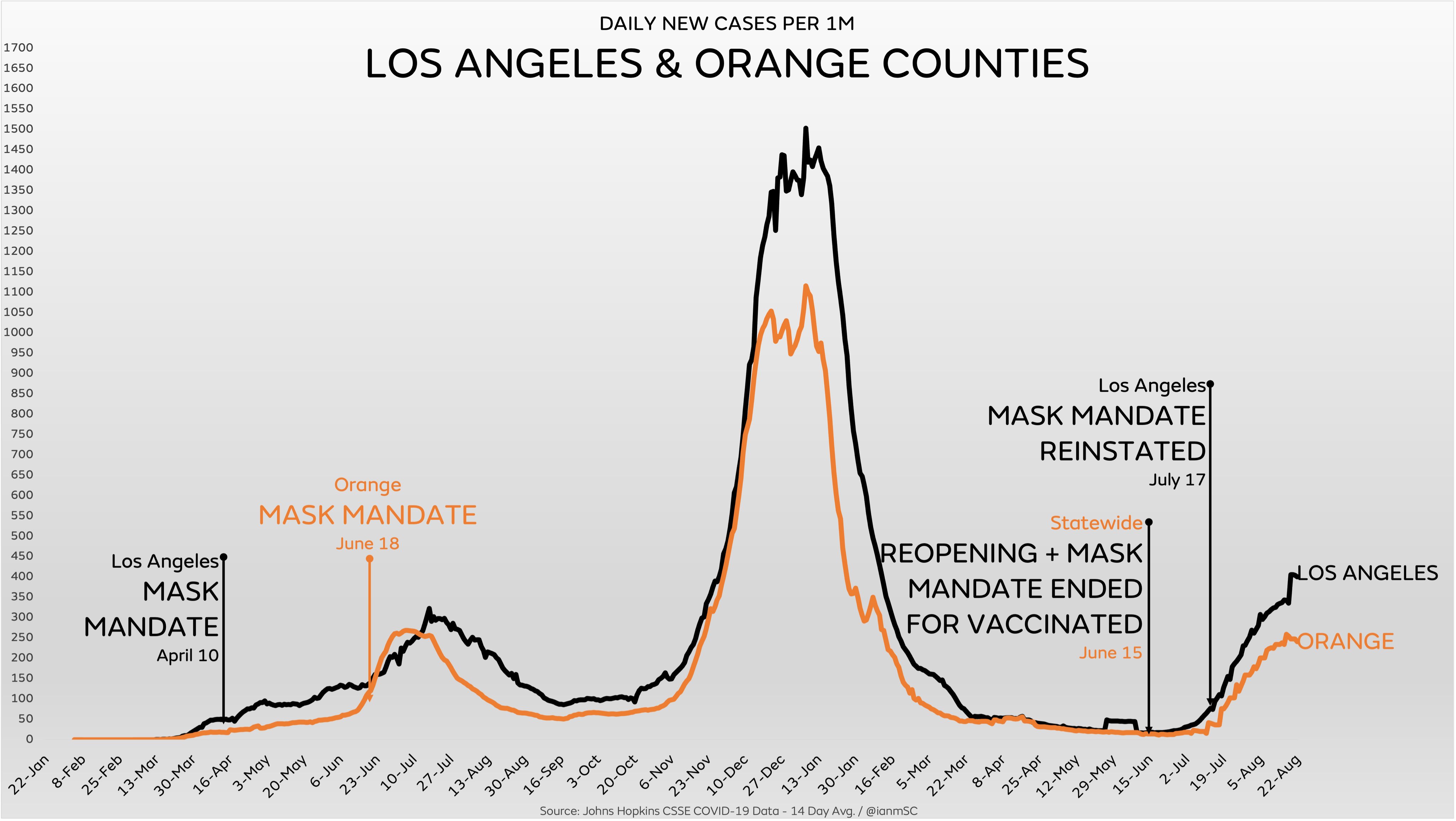
Yet you ignore studies which compare schools which mask and don't mask. Here's a reminder...
Mask Use and Ventilation Improvements to Reduce COVID-19 Incidence in Elementary Schools — Georgia, November 16–December 11, 2020
https://www.cdc.gov/mmwr/volumes/70/wr/mm7021e1.htm
Yet you ignore my question about whether this is the same CDC that said masks don't work, or some other CDC?
Back to posting nonsense charts again --- since you cannot factually defend your dismal of many studies from respected scientists showing that masks work in schools.
Why don't your create a chart for LA showing when restrictions were added and removed -- and then post proper information in meaningful context.
absolutely useless for drawing any useful conclusions.
your second link is called a report... and that is all it is a report with statements. not a study. nothing useful.
and the first study... found .. ventilation is important... which it could be if there is indoor aerosol transmission. (And there may be with delta... we need to see real studies on that.)
But for those studies to come to conclusions about masks you would have to hold all sorts of things steady with respect to other factors... I did not see that being done. How could you when ventilation would change for each school. And positivity rates would be a big influence.
Summary...
Please prove with data and contact tracing that airborne transmission occurs.
Then maybe we can determine how spread happens in schools.
your second link is called a report... and that is all it is a report with statements. not a study. nothing useful.
and the first study... found .. ventilation is important... which it could be if there is indoor aerosol transmission. (And there may be with delta... we need to see real studies on that.)
But for those studies to come to conclusions about masks you would have to hold all sorts of things steady with respect to other factors... I did not see that being done. How could you when ventilation would change for each school. And positivity rates would be a big influence.
Summary...
Please prove with data and contact tracing that airborne transmission occurs.
Then maybe we can determine how spread happens in schools.
Let's provide an article which provides full context on this study. Note the article includes videos with more details.
Here are some very important points regarding the study made in the article:
Study: Mask type really matters, ventilation may matter more
- The study only covers aerosols. Much of Covid is spread by large droplets exhaled from people -- Non-N95 masks are effective at stopping large droplets but less effective at stopping aerosols. Any study fully digging into masks in regards to COVID will need to cover both aerosols and large droplets.
- The study is more focused on ventilation in context of using the masks. The final figures arrived at assume a particular level of ventilation -- not direct efficiency of the masks along.
- It's not a surprise that N95 masks are best -- other studies have shown this. However they are only effective when used properly with a tight seal.
- As noted in the study - proper ventilation using HEPA filters is much more important indoors than the masks.
https://www.wral.com/coronavirus/st...matters-ventilation-may-matter-more/19844289/
A recent study out of Canada shows wide disparities in the effectiveness of different types of masks and suggests ventilation improvements can do better than common cloth and surgical masks in reducing transmission of COVID-19.
University of Waterloo researchers used a sealed room, a masked mannequin and atomized olive oil to simulate breathing in their study. They used lasers to measure the aerosols, tiny particles that can float in the air, getting past masks and circulating in the room.
Then they added ventilation, courtesy of an air purifier equipped with the sort of high-powered HEPA filters used in labs and on airplanes.
Though the virus behind COVID-19 is present in larger droplets, which all masks help block, it's also thought to transmit through these much smaller aerosols. In fact a separate study released last week suggests airborne/aerosol transmission may be the dominant form of transmission.
The University of Waterloo study reached several conclusions:
"Indeed, our research shows that fresh air exchange or air purification can be very effective in controlling aerosol buildup indoors," Professor Serhiy Yarusevych, one of the researchers, told WRAL News via email. "The most beneficial strategy would be to employ both masks and ventilation to minimize the risk of virus transmission. However, given the relatively low efficiency of cloth and surgical masks in aerosol control, it is essential to complement their use by adequate ventilation for prolonged indoor occupancy."
- N95 masks and similar masks filter exhaled air much better than cloth and surgical masks. Cloth and surgical masks caught 10 to 12 percent of aerosols breathed out in the experiment. Various N95, KN95 and R95 masks stopped 46 to 60 percent.
- Even N95 masks leak, primarily around the nose, allowing aerosols to circulate. This led to "notably higher" concentrations of aerosols more than six feet away from the mannequin.
- N95 masks with valves lost half their ability to stop aerosols. N95's without valves remain the recommended choice, "if worn correctly," but a loose-fitting N95 "provides a negligible" filtration efficiency.
- The study found "increased ventilation/air-cleaning capacity significantly reduces the transmission risk in an indoor environment, surpassing the apparent mask filtration efficacy." The university put that another way in a press release on the study: "Even modest ventilation rates were found to be as effective as the best masks in reducing the risk of transmission."
"Other studies have shown before"
WRAL News shared this study with four experts here in North Carolina: A virologist, an epidemiologist, a chemist who previously tested masks in his own experiments and a mechanical engineer who studies fluid dynamics.
"This paper confirms with a more controlled set-up (and more math) what other studies have shown before," said Dirk Dittmer, director of virology and global oncology programs at the UNC Lineberger Comprehensive Cancer Center. "N95 is much better than anything else."
Dittmer said that, in Germany, the government routinely sends his parents and others N95 masks. He also said ventilation is important, along with mask fit. Because he works in a lab with coronaviruses, Dittmer said he gets annual fitting lessons.
Pia MacDonald, a UNC professor of epidemiology and senior director of applied health research for RTI International, said ventilation should be considered crucial.
"While masking is one strategy for reducing risk of transmission indoors, the combination with ventilation (air exchange) is a critical strategy to reducing risk of SARS-CoV-2 transmission," she said.
Tarek Echekki, a professor of mechanical and aerospace engineering at N.C. State, noted that the Waterloo study had an average droplet size of one micron.
"A human exhalation may involve larger droplets as well," he said. "It is not clear if the use of smaller droplets is placing the more common face masks (surgical and cloth) at a disadvantage and thus reducing their efficacy."
Echekki noted that the study doesn't account for any protection you get for your self in wearing a mask, it only measures aerosols exhaled. He said the experiment deviates from normal life in a number of ways, but he called it "a nice addition to the available literature."
Martin Fischer, a Duke University chemistry professor who compared masks in his own experiment last year, said the Waterloo study shows yet again the complexity of evaluating masks.
"I would take this study with a grain of salt," Fischer said. "How many of the super-spreader events involved a bunch of folks sitting still doing nothing but steady breathing in a room with absolutely no air movement? Nevertheless, the message as far as masks and ventilation should be: Wear a mask, try to make it fit to avoid gaps, and exchange your air (filter or exchange the air in a room, or go outside). And go get vaccinated!"
Ventilation efforts limited
Ventilation has gotten less attention during this pandemic in part because the U.S. Centers for Disease Control and World Health Organization went back-and-forth last year on whether the virus was likely it was to transmit as an aerosol, in spite of growing scientific consensus.
A study published last week in Science argues that "unequivocal evidence indicates that airborne transmission is a major pathway for the spread of SARS-CoV-2." It makes a number of recommendations, including a focus on mask fit and increased focus on ventilation.

A number of other studies have concluded ventilation deserves more attention, including several that found plastic barriers may increase transmission by impeding airflow.
Asked about the Waterloo study, North Carolina's Department of Health and Human Services called ventilation "part of a layered strategy to reduce exposure to the virus that causes COVID-19."
"Increasing the amount of outdoor air into a building, increasing filtration, and enhanced air cleaning, such as using HEPA filtration systems, are important factors to improving indoor air quality and reducing exposure to viruses," DHHS spokeswoman Catie Armstrong said in a statement. "Improving indoor air quality and using a properly fitted mask are additive – they work better together to help control the spread of COVID-19."
It's difficult to pin down how much, out of the billions in federal coronavirus dollars that flowed to North Carolina in the last year, has been spent on ventilation. The state Department of Public Instruction, for example, said Monday it couldn't provide a figure for schools. It's online COVID money tracker lists only a single HVAC contract totaling $1.78 million, but it's likely more has been spent, just identified differently or bundled with other projects.
Wake County schools spokeswoman Lisa Luten said the system upgraded its HVAC filters to MERV-13's and plans to spend about $940,000 this year on filters alone. That sort of filter captures at least 75 percent of particles below 1 micron in size and at least 90 percent of particles above that, according to Yarusevych, one of the researchers in the Waterloo University study.
HEPA filters used in the study catch at least 99 percent of particles across this entire range, he said in an email.
A few days into the school year last week, both Wake and Durham public schools moved toward getting students outside more often for lunch. Before that, parents in Durham raised their own money to buy tents for lunch and air purifiers for classrooms.
Luten said the system couldn't point to any spending to move students outside, or to improve ventilation, beyond the filter improvements. But she also said school HVAC systems are tested every year and meet higher standards than, say, a home. She said system leadership has reviewed a number of studies on ventilation and COVID.
"It’s hard to read those studies and compare them to our schools," she said.
Whatever the ventilation needs in schools around the state, they're not limited to COVID. In the state's latest facility needs survey, schools listed nearly $700 million in desired HVAC work.
Yet you have nothing to say about the many other papers -- let's provide a reminder.
Mask Use and Ventilation Improvements to Reduce COVID-19 Incidence in Elementary Schools — Georgia, November 16–December 11, 2020
https://www.cdc.gov/mmwr/volumes/70/wr/mm7021e1.htm
Research Finds Masks Can Prevent COVID-19 Transmission in Schools
“With masking, the schools clearly can safely deliver face-to-face education for children and adults"
https://today.duke.edu/2021/06/research-finds-masks-can-prevent-covid-19-transmission-schools
As well as - Research done in North Carolina, Wisconsin, Utah and Missouri has shown mask mandates effectively stymie coronavirus transmission rates in schools
Last edited:
show a study with real science and data that masks work in schools which is superior to the charts that Tsing is posting.
I challenge you to put up such a study... and we will break it down and see if they came up with any useful science.
I will bet ... at best you show correlations which is basically the point of Tsings charts.
I challenge you to put up such a study... and we will break it down and see if they came up with any useful science.
I will bet ... at best you show correlations which is basically the point of Tsings charts.
Back to posting nonsense charts again --- since you cannot factually defend your dismal of many studies from respected scientists showing that masks work in schools.
Why don't your create a chart for LA showing when restrictions were added and removed -- and then post proper information in meaningful context.
show a study with real science and data that masks work in schools which is superior to the charts that Tsing is posting.
I challenge you to put up such a study... and we will break it down and see if they came up with any useful science.
I will bet ... at best you show correlations which is basically the point of Tsings charts.
I just posted a set of studies on this thread -- all today -- all from respected scientists which show masks work in schools. Go read them.

EXCELLENT POSTINGshow a study with real science and data that masks work in schools which is superior to the charts that Tsing is posting.
I challenge you to put up such a study... and we will break it down and see if they came up with any useful science.
I will bet ... at best you show correlations which is basically the point of Tsings charts.
Here is the list of studies in classrooms once again -- go read them and educate yourselves.
CDC Study examined 169 schools in Georgia and found that schools with student mask requirements had a 37% lower COVID rate among students than schools without mandates. This study was from late 2020 before Delta was prevalent.
Mask Use and Ventilation Improvements to Reduce COVID-19 Incidence in Elementary Schools — Georgia, November 16–December 11, 2020
https://www.cdc.gov/mmwr/volumes/70/wr/mm7021e1.htm
Summary
What is already known about this topic?
Kindergarten through grade 5 schools educate and address the students’ physical, social, and emotional needs. Preventing SARS-CoV-2 transmission in schools is imperative for safe in-person learning.
What is added by this report?
COVID-19 incidence was 37% lower in schools that required teachers and staff members to use masks and 39% lower in schools that improved ventilation. Ventilation strategies associated with lower school incidence included dilution methods alone (35% lower incidence) or in combination with filtration methods (48% lower incidence).
What are the implications for public health practice?
Mask requirements for teachers and staff members and improved ventilation are important strategies in addition to vaccination of teachers and staff members that elementary schools could implement as part of a multicomponent approach to provide safer, in-person learning environments.
(More at above url)
Research Finds Masks Can Prevent COVID-19 Transmission in Schools
“With masking, the schools clearly can safely deliver face-to-face education for children and adults"
https://today.duke.edu/2021/06/research-finds-masks-can-prevent-covid-19-transmission-schools
The widespread use of masks in schools can effectively prevent COVID-19 transmission and provide a safe learning environment, two Duke scholars said Wednesday.
Danny Benjamin, M.D., and Kanecia Zimmerman, M.D., were co-chairs of the Duke-led ABC Science Collaborative, which issued a new report Wednesday showing that North Carolina schools were highly successful in preventing the transmission of COVID-19 within school buildings.
The report found in part that masks effectively prevented COVID-19 transmission even without physical distancing in schools and on buses.
Benjamin and Zimmerman spoke to reporters Wednesday in a virtual media briefing. Watch the briefing on YouTube. Read a news story about the collaborative's findings on Duke Health's website.
Here are excerpts:
(More at above url)
Researchers from NC State, UNC study effectiveness of masks, random testing in schools
https://www.wavy.com/news/north-car...ctiveness-of-masks-random-testing-in-schools/
Aug 19, 2021
A local research team is looking at how COVID-19 spreads in school settings and how much mask-wearing and testing can help.
The study found without masks and random testing, more than 75 percent of students would get COVID-19 over a semester.
The study looked at “susceptible students,” those who are not vaccinated, and did not already have COVID-19.
Maria Mayorga, a personalized medicine professor at North Carolina State University, is part of the research team.
This is what the study found for elementary school students, who are too young to be vaccinated.
“By the end of the semester if we do not mask, 90 percent of the students who were not already infected would become infected with the virus,” Mayorga said. “So that’s way too many students and it would not be possible for the students to stay in school, probably something would happen before then where they would be sent home or to a virtual environment.”
Graphs from the study show masks reduce it to around 50 percent of students, and masks combined with random testing reduces it to just under 25 percent of elementary school students susceptible to the virus contracting COVID-19.
That’s without going virtual due to outbreaks.

Those numbers are lower in older grades because the study accounts for vaccinated students and those who already had COVID-19 (listed as incoming protection).
“If you introduce the mask requirements in the school you can reduce the number of infections by more than 50 percent,” Mayorga said.
Most central North Carolina school districts now have mask mandates.
This study has not been peer-reviewed. The team is comprised of researchers from N.C. State, UNC-Chapel Hill, Eastern Carolina University, and Georgia Tech.
You can read the full study here and see a slideshow of the presentation here.
Mayorga said the next step in their research is measuring the effect school mask policies can have on communities.
===================================
Research done in North Carolina, Wisconsin, Utah and Missouri has shown mask mandates effectively stymie coronavirus transmission rates in schools.
CDC Study examined 169 schools in Georgia and found that schools with student mask requirements had a 37% lower COVID rate among students than schools without mandates. This study was from late 2020 before Delta was prevalent.
Mask Use and Ventilation Improvements to Reduce COVID-19 Incidence in Elementary Schools — Georgia, November 16–December 11, 2020
https://www.cdc.gov/mmwr/volumes/70/wr/mm7021e1.htm
Summary
What is already known about this topic?
Kindergarten through grade 5 schools educate and address the students’ physical, social, and emotional needs. Preventing SARS-CoV-2 transmission in schools is imperative for safe in-person learning.
What is added by this report?
COVID-19 incidence was 37% lower in schools that required teachers and staff members to use masks and 39% lower in schools that improved ventilation. Ventilation strategies associated with lower school incidence included dilution methods alone (35% lower incidence) or in combination with filtration methods (48% lower incidence).
What are the implications for public health practice?
Mask requirements for teachers and staff members and improved ventilation are important strategies in addition to vaccination of teachers and staff members that elementary schools could implement as part of a multicomponent approach to provide safer, in-person learning environments.
(More at above url)
Research Finds Masks Can Prevent COVID-19 Transmission in Schools
“With masking, the schools clearly can safely deliver face-to-face education for children and adults"
https://today.duke.edu/2021/06/research-finds-masks-can-prevent-covid-19-transmission-schools
The widespread use of masks in schools can effectively prevent COVID-19 transmission and provide a safe learning environment, two Duke scholars said Wednesday.
Danny Benjamin, M.D., and Kanecia Zimmerman, M.D., were co-chairs of the Duke-led ABC Science Collaborative, which issued a new report Wednesday showing that North Carolina schools were highly successful in preventing the transmission of COVID-19 within school buildings.
The report found in part that masks effectively prevented COVID-19 transmission even without physical distancing in schools and on buses.
Benjamin and Zimmerman spoke to reporters Wednesday in a virtual media briefing. Watch the briefing on YouTube. Read a news story about the collaborative's findings on Duke Health's website.
Here are excerpts:
(More at above url)
Researchers from NC State, UNC study effectiveness of masks, random testing in schools
https://www.wavy.com/news/north-car...ctiveness-of-masks-random-testing-in-schools/
Aug 19, 2021
A local research team is looking at how COVID-19 spreads in school settings and how much mask-wearing and testing can help.
The study found without masks and random testing, more than 75 percent of students would get COVID-19 over a semester.
The study looked at “susceptible students,” those who are not vaccinated, and did not already have COVID-19.
Maria Mayorga, a personalized medicine professor at North Carolina State University, is part of the research team.
This is what the study found for elementary school students, who are too young to be vaccinated.
“By the end of the semester if we do not mask, 90 percent of the students who were not already infected would become infected with the virus,” Mayorga said. “So that’s way too many students and it would not be possible for the students to stay in school, probably something would happen before then where they would be sent home or to a virtual environment.”
Graphs from the study show masks reduce it to around 50 percent of students, and masks combined with random testing reduces it to just under 25 percent of elementary school students susceptible to the virus contracting COVID-19.
That’s without going virtual due to outbreaks.
Those numbers are lower in older grades because the study accounts for vaccinated students and those who already had COVID-19 (listed as incoming protection).
“If you introduce the mask requirements in the school you can reduce the number of infections by more than 50 percent,” Mayorga said.
Most central North Carolina school districts now have mask mandates.
This study has not been peer-reviewed. The team is comprised of researchers from N.C. State, UNC-Chapel Hill, Eastern Carolina University, and Georgia Tech.
You can read the full study here and see a slideshow of the presentation here.
Mayorga said the next step in their research is measuring the effect school mask policies can have on communities.
===================================
Research done in North Carolina, Wisconsin, Utah and Missouri has shown mask mandates effectively stymie coronavirus transmission rates in schools.
Here is the list of studies in classrooms once again -- go read them and educate yourselves.
CDC Study examined 169 schools in Georgia and found that schools with student mask requirements had a 37% lower COVID rate among students than schools without mandates. This study was from late 2020 before Delta was prevalent.
Mask Use and Ventilation Improvements to Reduce COVID-19 Incidence in Elementary Schools — Georgia, November 16–December 11, 2020
https://www.cdc.gov/mmwr/volumes/70/wr/mm7021e1.htm
Summary
What is already known about this topic?
Kindergarten through grade 5 schools educate and address the students’ physical, social, and emotional needs. Preventing SARS-CoV-2 transmission in schools is imperative for safe in-person learning.
What is added by this report?
COVID-19 incidence was 37% lower in schools that required teachers and staff members to use masks and 39% lower in schools that improved ventilation. Ventilation strategies associated with lower school incidence included dilution methods alone (35% lower incidence) or in combination with filtration methods (48% lower incidence).
What are the implications for public health practice?
Mask requirements for teachers and staff members and improved ventilation are important strategies in addition to vaccination of teachers and staff members that elementary schools could implement as part of a multicomponent approach to provide safer, in-person learning environments.
(More at above url)
Research Finds Masks Can Prevent COVID-19 Transmission in Schools
“With masking, the schools clearly can safely deliver face-to-face education for children and adults"
https://today.duke.edu/2021/06/research-finds-masks-can-prevent-covid-19-transmission-schools
The widespread use of masks in schools can effectively prevent COVID-19 transmission and provide a safe learning environment, two Duke scholars said Wednesday.
Danny Benjamin, M.D., and Kanecia Zimmerman, M.D., were co-chairs of the Duke-led ABC Science Collaborative, which issued a new report Wednesday showing that North Carolina schools were highly successful in preventing the transmission of COVID-19 within school buildings.
The report found in part that masks effectively prevented COVID-19 transmission even without physical distancing in schools and on buses.
Benjamin and Zimmerman spoke to reporters Wednesday in a virtual media briefing. Watch the briefing on YouTube. Read a news story about the collaborative's findings on Duke Health's website.
Here are excerpts:
(More at above url)
Researchers from NC State, UNC study effectiveness of masks, random testing in schools
https://www.wavy.com/news/north-car...ctiveness-of-masks-random-testing-in-schools/
Aug 19, 2021
A local research team is looking at how COVID-19 spreads in school settings and how much mask-wearing and testing can help.
The study found without masks and random testing, more than 75 percent of students would get COVID-19 over a semester.
The study looked at “susceptible students,” those who are not vaccinated, and did not already have COVID-19.
Maria Mayorga, a personalized medicine professor at North Carolina State University, is part of the research team.
This is what the study found for elementary school students, who are too young to be vaccinated.
“By the end of the semester if we do not mask, 90 percent of the students who were not already infected would become infected with the virus,” Mayorga said. “So that’s way too many students and it would not be possible for the students to stay in school, probably something would happen before then where they would be sent home or to a virtual environment.”
Graphs from the study show masks reduce it to around 50 percent of students, and masks combined with random testing reduces it to just under 25 percent of elementary school students susceptible to the virus contracting COVID-19.
That’s without going virtual due to outbreaks.
Those numbers are lower in older grades because the study accounts for vaccinated students and those who already had COVID-19 (listed as incoming protection).
“If you introduce the mask requirements in the school you can reduce the number of infections by more than 50 percent,” Mayorga said.
Most central North Carolina school districts now have mask mandates.
This study has not been peer-reviewed. The team is comprised of researchers from N.C. State, UNC-Chapel Hill, Eastern Carolina University, and Georgia Tech.
You can read the full study here and see a slideshow of the presentation here.
Mayorga said the next step in their research is measuring the effect school mask policies can have on communities.
===================================
Research done in North Carolina, Wisconsin, Utah and Missouri has shown mask mandates effectively stymie coronavirus transmission rates in schools.
All flawed because of the comments I've posted earlier today - the first two times you posted them.
Hey, I've got an idea! Maybe you can make another post with the same links, the way Futurecurrents used to do over and over again before the mods told him to knock it off?
All flawed because of the comments I've posted earlier today - the first two times you posted them.
Hey, I've got an idea! Maybe you can make another post with the same links, the way Futurecurrents used to do over and over again before the mods told him to knock it off?
Your comments and attempts to poke holes in the studies are laughable and have all been responded to.
You should just be happy that your local schools now require masks so the your children can spend a longer time with in-person learning without being forced to remote as your schools get overwhelmed with Covid.