
Poor Man's Covered Call vs traditional long stock portfolio

As a fairly new options trader, I am drawn to the covered call, due to its simplicity. I specifically like the "Poor Man's Covered Call" (PMCC), which is simply a diagonal call spread. To trade the PMCC, you buy a deep ITM long call (LEAP) with an expiration "far" in the future. You then sell shorter-dated calls, using the long call as collateral.

I like the PMCC for the purposes of simulating a diversified conventional portfolio. I have a $25K test account. If I wanted to sell covered calls against 100 shares of SPY, the long shares would eat up more than all investible capital! An 80 delta SPY LEAP with ~120 DTE (Jan 21 2022 408 call) only costs $47.60, or 10.6% the cost of one share. Of the $47.60, only ~$6.50 (14% of option price) is intrinsic value.

PMCC "orthodoxy" dictates that you sell 30 delta calls, but I instead sell 50 delta calls, because these have maximum extrinsic value. For instance, in the Oct 15 SPY options chain, the ATM 50 delta call (448) has $5.88 in extrinsic value. The 35 delta call (453) has $2.38 in extrinsic value. The 70 delta call (439) has $4.36 in extrinsic value. So regardless of which way the underlying moves, when I close the trade, I am buying back less extrinsic value than I received in premium when opened the trade. I typically buy back the short call when it goes lower than 35 delta, higher than 70 delta, or is < 10 DTE.

Time decay also works in the option seller's favor. I sell 30 DTE short calls to harvest the steepest part of the theta decay, but wuss out at 10 DTE, when things get squirrely.

I manage risk by managing the net delta of the PMCC. Say that I want $10K (~22 shares = 22 delta) of SPY exposure in a traditional long stock. Since I want to sell 50 delta calls, my LEAP should therefore be 72 delta. If I instead bought an 80 delta LEAP, I would hold 30 net delta, accepting higher leverage/risk.

In a panic, volatility should spike, so if I can(?) sell the LEAPs on the way down as they hit 50 delta, I should at least get a small pop from the increase in IV.

The $25K test account consists of PMCCs on the 11 SPDR sector ETFs, international stocks (EEM/VGK/FXI), bonds (TLT), and GLD. I try to manage risk as stated above, but still end up having more leverage (1.3-1.5x) than "parity". I hold about 55% cash.

I benchmark the portfolio against the SPY and a 60/40 SPY/AGG portfolio. I had a setback in June when GLD took a one-day (3 sigma?) nosedive, and I wasn't managing the risk "correctly" until mid-August. Since then, I've done pretty well, though by observation, my volatility before mid-August was a bit higher than the SPY.

upload_2021-9-15_14-14-2.png


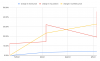
I have found that the PMCC performs very well in a sideways market (3 months of XLI). Synthetic means the LEAP.

upload_2021-9-15_14-22-7.png


The PMCC seems to more or less track the synthetic when it's marching steadily upward (3 months of XLC):

upload_2021-9-15_14-25-23.png


The PMCC has problems for large and abrupt (relative to the premiums collected) moves up or down (GLD through the big drop):

upload_2021-9-15_14-27-26.png


How am I being an idiot?
How am I doing it wrong?
Is this a valid alternative to a traditional portfolio?
Do I have an angle?
Is this a waste of time?
 

Attachments

  • upload_2021-9-15_14-23-44.png
    upload_2021-9-15_14-23-44.png
    89.2 KB · Views: 8
So you want to short vega by buying a ton of vega... these don't work. Mkt moves against you and now you're sitting on a loss in the deferred and rushing to roll lower (call) strikes in the fronts. It's dumb. Really dumb.
 
It's dumb

Really dumb

All complex options strategies are dumb. That delivers essentially zero performance.

A random person would have better luck for returns by simply placing bets on both sides at the end of the day, and selling them the next.

Timing and future prediction is everything with trading. You can know everything there is about trading, but if your timing is off...it don't mean nothing.
 
Last edited:
So you want to short vega by buying a ton of vega... these don't work. Mkt moves against you and now you're sitting on a loss in the deferred and rushing to roll lower (call) strikes in the fronts. It's dumb. Really dumb.

OK, so humor me here, and I will be testing your humor before you just say screw it!

I have a PMCC on SPY.
LEAP: 12/17 exp, 420 call, price=$34.31 - vega of 0.7
short: 10/15 exp, 448 call, price=$5.87 - vega of 0.5

If vol rises, then doesn't my LEAP increase more in value than the short? Isn't this an angle in my favor?

And as the delta of the LEAP approaches 50, the LEAP will have more extrinsic value for me to sell if I decide to roll it.

You are right - when the market moves against you, you need to roll the short early and often. And sometimes you can't roll fast enough to avoid big losses (see my GLD experience above). But from what I've seen, the loss is cushioned relative to simply holding the equivalent delta in long shares.
 
All complex options strategies are dumb. That delivers essentially zero performance.

A random person would have better luck for returns by simply placing bets on both sides at the end of the day, and selling them the next.

Dude, you're supposed to tell my WHY I'm dumb. No doubt you'll get to take your cracks at me, but you'll have to earn it. :D
 
Dude,
you're supposed to tell my WHY I'm dumb :D

Seriously.
Do those complex butterflies, spreads, frogs, elephants, crocodile leaps, strategies deployed over a week, two weeks, a month, two months time frames.
And then buy both sides at the end of the day, and sell them the next day,

See which method delivers you, some, money,
 
As a fairly new options trader, I am drawn to the covered call, due to its simplicity. I specifically like the "Poor Man's Covered Call" (PMCC), which is simply a diagonal call spread. To trade the PMCC, you buy a deep ITM long call (LEAP) with an expiration "far" in the future. You then sell shorter-dated calls, using the long call as collateral.

I like the PMCC for the purposes of simulating a diversified conventional portfolio. I have a $25K test account. If I wanted to sell covered calls against 100 shares of SPY, the long shares would eat up more than all investible capital! An 80 delta SPY LEAP with ~120 DTE (Jan 21 2022 408 call) only costs $47.60, or 10.6% the cost of one share. Of the $47.60, only ~$6.50 (14% of option price) is intrinsic value.

PMCC "orthodoxy" dictates that you sell 30 delta calls, but I instead sell 50 delta calls, because these have maximum extrinsic value. For instance, in the Oct 15 SPY options chain, the ATM 50 delta call (448) has $5.88 in extrinsic value. The 35 delta call (453) has $2.38 in extrinsic value. The 70 delta call (439) has $4.36 in extrinsic value. So regardless of which way the underlying moves, when I close the trade, I am buying back less extrinsic value than I received in premium when opened the trade. I typically buy back the short call when it goes lower than 35 delta, higher than 70 delta, or is < 10 DTE.

Time decay also works in the option seller's favor. I sell 30 DTE short calls to harvest the steepest part of the theta decay, but wuss out at 10 DTE, when things get squirrely.

I manage risk by managing the net delta of the PMCC. Say that I want $10K (~22 shares = 22 delta) of SPY exposure in a traditional long stock. Since I want to sell 50 delta calls, my LEAP should therefore be 72 delta. If I instead bought an 80 delta LEAP, I would hold 30 net delta, accepting higher leverage/risk.

In a panic, volatility should spike, so if I can(?) sell the LEAPs on the way down as they hit 50 delta, I should at least get a small pop from the increase in IV.

The $25K test account consists of PMCCs on the 11 SPDR sector ETFs, international stocks (EEM/VGK/FXI), bonds (TLT), and GLD. I try to manage risk as stated above, but still end up having more leverage (1.3-1.5x) than "parity". I hold about 55% cash.

I benchmark the portfolio against the SPY and a 60/40 SPY/AGG portfolio. I had a setback in June when GLD took a one-day (3 sigma?) nosedive, and I wasn't managing the risk "correctly" until mid-August. Since then, I've done pretty well, though by observation, my volatility before mid-August was a bit higher than the SPY.

View attachment 267960

I have found that the PMCC performs very well in a sideways market (3 months of XLI). Synthetic means the LEAP.

View attachment 267961

The PMCC seems to more or less track the synthetic when it's marching steadily upward (3 months of XLC):

View attachment 267963

The PMCC has problems for large and abrupt (relative to the premiums collected) moves up or down (GLD through the big drop):

View attachment 267964

How am I being an idiot?
How am I doing it wrong?
Is this a valid alternative to a traditional portfolio?
Do I have an angle?
Is this a waste of time?

I prefer verticals in the same month. Why spend more to buy the leap when you can spend less to buy the near month with less premium?
https://www.elitetrader.com/et/threads/best-stocks-for-covered-call.360982/page-3#post-5446419
 
OK, so humor me here, and I will be testing your humor before you just say screw it!

I have a PMCC on SPY.
LEAP: 12/17 exp, 420 call, price=$34.31 - vega of 0.7
short: 10/15 exp, 448 call, price=$5.87 - vega of 0.5

If vol rises, then doesn't my LEAP increase more in value than the short? Isn't this an angle in my favor?

And as the delta of the LEAP approaches 50, the LEAP will have more extrinsic value for me to sell if I decide to roll it.

You are right - when the market moves against you, you need to roll the short early and often. And sometimes you can't roll fast enough to avoid big losses (see my GLD experience above). But from what I've seen, the loss is cushioned relative to simply holding the equivalent delta in long shares.

Shorting a put (synthetic CC) is short g/v. Mostly gamma. You're swapping gamma for vega as you add time.

Vol moves inversely proportional to index price. Within that, pskew increases with call moneyness, but that won't help you as your sens-drops.

Yes, you will earn a bit on skew as the mkt rallies, but the vega drops bc of moneyness. Terminally (Oct15) you're BE is around 443 -> 476. Upside is fine but can be improved with a cheap OTM bull vert, and you earn a ton on stickiness; up/out strikes earn on vol as strike gains deltas (Derman delta). LVLD is a thing (long v; long d).

1) You drop -> earn a bit on vol killed on delta.
2) We rally -> lose on vol earn on delta.

Structure in these should be either 1) explicitly short gamma or 2) LVLD. You can't have both. Bro, just model the thing out to Oct15. You're happy with 4-5 pts of downside prot?
 
Shorting a put (synthetic CC) is short g/v. Mostly gamma. You're swapping gamma for vega as you add time.

Vol moves inversely proportional to index price. Within that, pskew increases with call moneyness, but that won't help you as your sens-drops.

Yes, you will earn a bit on skew as the mkt rallies, but the vega drops bc of moneyness. Terminally (Oct15) you're BE is around 443 -> 476. Upside is fine but can be improved with a cheap OTM bull vert, and you earn a ton on stickiness; up/out strikes earn on vol as strike gains deltas (Derman delta). LVLD is a thing (long v; long d).

1) You drop -> earn a bit on vol killed on delta.
2) We rally -> lose on vol earn on delta.

Structure in these should be either 1) explicitly short gamma or 2) LVLD. You can't have both. Bro, just model the thing out to Oct15. You're happy with 4-5 pts of downside prot?

I don't get why you don't like the structure. He's giving up some edge on his short call with his long downside call but in exchange for that he's long some gap protection.

It's not strictly superior to a covered call, but its not strictly inferior either.
 
I don't get why you don't like the structure. He's giving up some edge on his short call with his long downside call but in exchange for that he's long some gap protection.

It's not strictly superior to a covered call, but its not strictly inferior either.

You know that I trade a ton of diagonals but he's long vol when he's looking to short vol. He's better off trading a long cs(short ps), ATM short wing.

This makes more sense. A true vert so you're not needlessly adding vega. Skew is meaningless as the deep is an 85D.

OPs trade has better upside, but then go with an ATM bull vert. I don't see why he would buy vol in this scenario.

2021-09-15_15-46-04.png
 
Last edited:
Back
Top