+1 for Evolution
I'm a theist by decision
I'm a theist by decision


...The accepted belief among evolutionists is that the earliest forms of life were bacteria and all living things evolved from bacteria...
This sciencey makes me thinky, OK then, I lived to see the answer to that question.
https://www.studyfinds.org/missing-link-origins-of-life/
Missing link finally unlocked? Non-living ‘droplet’ spontaneously evolves into molecule of life
OCTOBER 30, 2021
by Allarium
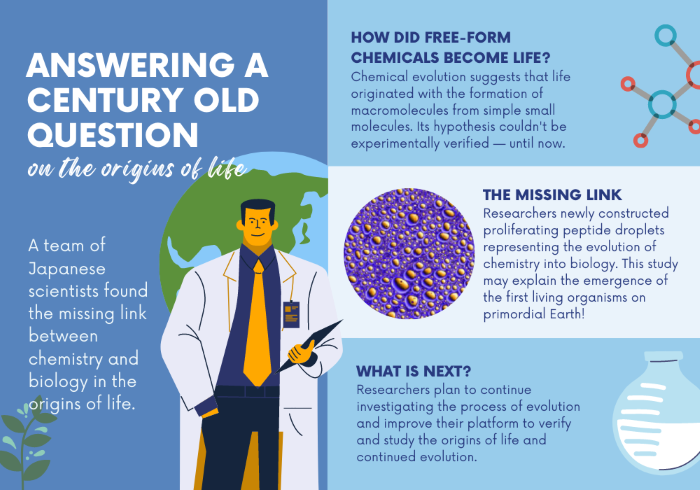
HIROSHIMA, Japan — For many years, scientists have studied the biological evolutionary theory. Genetic sequencing and the geologic column have enabled biologists to produce the phylogenetic tree, spanning from the most complex organisms all the way down to the simplest, single-celled lifeform that gave rise to all living things. But the question is, how did the first living organism come to be? This gap between chemical evolution and the beginning of biological evolution may be a little smaller according to recent findings.
Two Japanese scientists created a microscopic particle capable of replicating itself. Known as a “coacervate droplet,” it depicts the transition from chemistry to life.
“Chemical evolution was first proposed in the 1920s as the idea that life first originated with the formation of macromolecules from simple small molecules, and those macromolecules formed molecular assemblies that could proliferate,” says the study’s first author, Muneyuki Matsuo, an assistant professor of chemistry in the Graduate School of Integrated Sciences for Life at Hiroshima University, in a statement.
“Since then, many studies have been conducted to verify the RNA world hypothesis — where only self-replicating genetic material existed prior to the evolution of DNA and proteins — experimentally,” Matsuo continues. “However, the origin of molecular assemblies that proliferate from small molecules has remained a mystery for about a hundred years since the advent of the chemical evolution scenario. It has been the missing link between chemistry and biology in the origin of life.”
Kensuke Kurihara works at Kyocera Corporation and is one of Matsuo’s first collaborators. The two were looking for an explanation for how the primitive molecules became living organisms. Researchers first believed the environment caused this change. Components were produced under extreme pressure and heat, then became molecules essential to life after temperatures dropped and livable conditions were established. Still, the problem was with explaining reproduction. “Proliferation requires spontaneous polymer production and self-assembly under the same conditions,” said Matsuo.
(Credit: Hiroshima University)
Matsuo and Kurihara created a non-living building block capable of replicating itself using amino acids (the basic components of proteins) which acted as the progenitor. The researchers then applied water (at normal temperature) to the molecules, which then joined together and formed proteins under standard pressure. The proteins then became globules on their own, expanding and replicating as additional amino acids were given.
The scientists say the globules were capable of gathering nucleic acids (DNA and RNA) which enabled them to withstand certain environmental stressors. In other words, not only could these globules proliferate, they could combine with other components of living cells, which actually improves their survivability!
“A droplet-based protocell could have served as a link between ‘chemistry’ and ‘biology’ during the origins of life,” says Matsuo. “This study may serve to explain the emergence of the first living organisms on primordial Earth.”
The team’s goal is to broaden their foundation for testing and analyzing the origins of living organisms and the future trajectory of human development. They hope this will help them better comprehend how chemicals transform into life’s building blocks.
“By constructing peptide droplets that proliferate with feeding on novel amino acid derivatives, we have experimentally elucidated the long-standing mystery of how prebiotic ancestors were able to proliferate and survive by selectively concentrating prebiotic chemicals,” says Matsuo. “Rather than an RNA world, we found that ‘droplet world’ may be a more accurate description, as our results suggest that droplets became evolvable molecular aggregates — one of which became our common ancestor.”
This study is published in Nature Communications.
The answer could be two Japanese scientists.
Self-Replicating Droplets: Evidence or a Shot in the Dark?
Sarah Chaffee
January 10, 2017, 9:52 AM
When scientists judge explanations for the origin of life that employ strictly chemical means, the evidentiary bar often seems notably low. For example, consider a new article on the Chemistry World website, published by the Royal Society of Chemistry. It claims, “Key riddle of life’s origin may be answered by primitive protocells that can divide,” and references a study in Nature Physics.
Generally, chemical evolution theorists assume that three components must have been necessary for the first living cell: 1) metabolism, 2) RNA/DNA, and 3) a containment structure or primitive cell wall to separate the first two components from the outside world. This study aims to address the third issue.
Researchers found that droplets, when influenced by an energy source, grow by absorbing moisture from their surroundings and then divide when they reach a critical size. Supposedly, if RNA was contained in one of these droplets, the system could have sparked life.
The article goes on to note:
Evolutionary biologist William Martin of Heinrich Heine University of Düsseldorf, who advocates the idea that life originated in pores in hydrothermal vents, says: ‘It’s not clear to me what real biological system based on observations from nature that this might be emulating.’ However, he adds: ‘If we assume that hydrothermal vents provide a system of organic micro-compartments, and that these have collected hydrophobics, then it’s certainly imaginable that there might have been properties of these droplets in the aqueous phase within a hydrophobic phase that might have been relevant. You never know.’
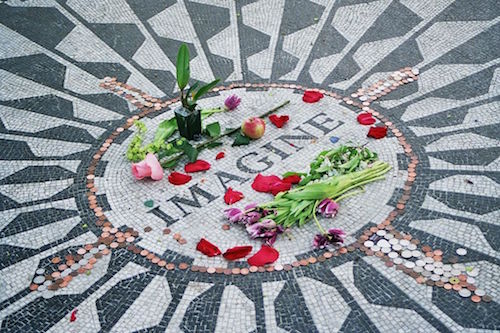
In origin-of-life theories the term “imagine” appears quite often to cover a giant gulf between what can be demonstrated and what is required to produce the first viable cell.
In this case, the differences between a chemical-rich droplet and a functional cell membrane are numerous. For instance, the latter must distinguish between fuel and waste, allowing only the right molecules to pass into the cell and the right molecules to exit. Even the most generous calculations indicate that the likelihood of droplets coalescing with the needed properties around an extremely rare (nonexistent?) RNA molecule are essentially nil.
In contrast, the appearance of a fantastically improbable set of molecules carefully configured together to achieve a function goal shows the unmistakable signs of intelligent design, a source of causation we know well from daily experience. Design, unlike unguided chemical processes, requires no strenuous exercise in imagination.
Photo: Strawberry Fields, Central Park, NYC, by Damzow (Own work) [GFDL or CC BY-SA 4.0-3.0-2.5-2.0-1.0], via Wikimedia Commons.
SARAH CHAFFEE
"Matsuo and Kurihara ...."
There is clearly a creator, a designer involved in this study.

https://evolutionnews.org/2017/01/self-replicatin/
I think her conclusion sums up the matter very well:
In this case, the differences between a chemical-rich droplet and a functional cell membrane are numerous. For instance, the latter must distinguish between fuel and waste, allowing only the right molecules to pass into the cell and the right molecules to exit. Even the most generous calculations indicate that the likelihood of droplets coalescing with the needed properties around an extremely rare (nonexistent?) RNA molecule are essentially nil.
In contrast, the appearance of a fantastically improbable set of molecules carefully configured together to achieve a function goal shows the unmistakable signs of intelligent design, a source of causation we know well from daily experience. Design, unlike unguided chemical processes, requires no strenuous exercise in imagination.
Clearly you did not get what I was intimating in my last post to you.
Maybe this will make the same point but with more clarity?
Not exactly...


