
You are using an out of date browser. It may not display this or other websites correctly.
You should upgrade or use an alternative browser.
You should upgrade or use an alternative browser.
Polar Temps... warming... all guesswork
- Thread starter jem
- Start date

We don't get to adjust the historical prices in trading to make it look like there's a trend where there isn't one.
And that's not why they adjusted the temps of some stations......for the umpteenth time. They did it to make the data more accurate. Do you ever read anything other than right wing propaganda? Do facts even matter to you?
"Having worked with many of the scientists in question, I can say with certainty that there is no grand conspiracy to artificially warm the earth; rather, scientists are doing their best to interpret large datasets with numerous biases such as station moves, instrument changes, time of observation changes, urban heat island biases, and other so-called inhomogenities that have occurred over the last 150 years. Their methods may not be perfect, and are certainly not immune from critical analysis, but that critical analysis should start out from a position of assuming good faith and with an understanding of what exactly has been done."
Judith Curry
The reason you're worried about this is that you haven't crunched the numbers. Sure the chart looks worrisome. Here's the wikipedia version (if you want the peer reviewed sources for this, click around and you'll easily get them.)
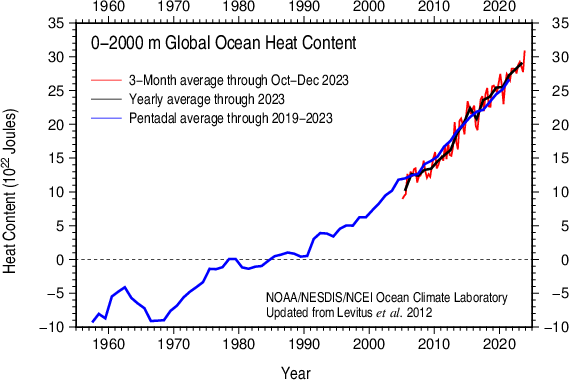
So the change in heat is about 2x10^23 Joules over a period of around 20 years.
The global warming folks tell us that the real global warming problems begin when we get the earth's temperature to rise by 2C. So let's use that as our temperature. Now they're worried about a 2 degree C change over the next 100 years or so which is 100 = 20x5 or 5x longer than the 20 year rise shown above. If the ocean heat continues to rise at the above rate, we're talking about a heat increase of about 5x(2x10^23) = 10^24 Joules = 1,000,000,000,000,000,000,000,000 Joules.
That's a lot of heat. One of the things alarmists like to do is to use units of "Hiroshima bombs". I think this is a rude disrespect but we can do the conversion as they never bother to do it for this situation. One Hiroshima bomb is about 6x10^13 Joules or 60,000,000,000,000 Joules. Doing the long division, we find that the energy stored in the oceans over the next 100 years is about 1.7x10^10 Hiroshima bombs or 17,000,000,000 bombs, that is, 17 billion Hiroshima bombs and the amount stored in the last 20 years was about 3 billion Hiroshima bombs.
Over the course of a century, all that heat will be distributed over the entire oceans. But just for the moment, let's see how much water we can heat 2C higher using 10^24 Joules. Of course if the heat is used exclusively to melt ice, or to evaporate water, the temperature will change by nothing (if you think otherwise, try learning a little thermodynamics, the subject here is a "phase change") but let's make the worst case assumption that the heat is absorbed by liquid water which stays liquid.
Turns out it takes 4.1813 Joules to raise the temperature of 1 gram of water by 1 degree C. Thus it takes twice this or about 8.36 Joules to raise a gram of water by 2C. And so the 10^24 Joules are enough to raise about (10^24)/8.8 = 1.2x10^23 grams of water by 2C. Converting to kilograms this gives 1.2x10^20 kilograms of water.
So what percentage of the oceans will we have raised in temperature (over the next 100 years) by 2C? It turns out that mass of the world's oceans are about 1.4x10^21 kilograms. This is about 12x larger than the amount of water that will be increased in temperature by 2C. And if we are to warm all the world's oceans by those 2C, then, at the present rate, it's going to take about 12x those 100 years.
So the final result is this:
If the CO2 heat goes into the oceans, it will take about 1200 years to warm the oceans by 2C.
If I were a betting man, I'd say that fossil fuel usage drops to near zero *before* those 1200 years go by.
So the bottom line is that the earth continues to gain heat at rapid pace and without pause. 90% of the earth's heat is in the oceans. And the heat of the ocean largely controls the climate and sea levels will rise about three feet in a hundred years.
There is no such person as Steve Goddard. That should tell anyone with a brain what he is all about. Of course, that still leaves you clueless.
There is no such person as 'futurecurrents'. I guess that should tell anyone with a brain what you're all about.

And the reason the fraud/whore "Steven Goddard" chose that name? Any guesses? Are the denier dummies smart enough to realize why? (rhetorical question, of course they are not)
http://www.giss.nasa.gov/
http://www.giss.nasa.gov/
So the bottom line is that the earth continues to gain heat at rapid pace and without pause. 90% of the earth's heat is in the oceans.
The oceans have been gaining heat for thousands of years and will continue to do so until the next ice age starts. The process is not at all alarming. In fact, as I showed, it's stunningly slow.
And the heat of the ocean largely controls the climate ...
Whoa, this is quite a divergence from the usual cant that the climate is controlled by CO2!
...and sea levels will rise about three feet in a hundred years.
More of us would believe this estimate except that it came from the same people who blew the pause.
The oceans have been gaining heat for thousands of years and will continue to do so until the next ice age starts. The process is not at all alarming. In fact, as I showed, it's stunningly slow.
Whoa, this is quite a divergence from the usual cant that the climate is controlled by CO2!
More of us would believe this estimate except that it came from the same people who blew the pause.
No, they have NOT been warming for thousands of years. They have been cooling - along with atmosphere - for the last thousand years until about 150 years ago when man's 40% increase in the important greenhouse gas caused temps to suddenly rise. One can clearly see this man made global warming on the following chart...
And there is/was no pause in the heat gain of earth. At all. Zero. None. You really seem hung up on this "pause", like it's all you have. Like a typical deluded, ignorant AGW-denying righty.


Wow! Your display of stupidity never ceases to surprise me.Sure, why not? The sooner we have a world government the better. No more wars. No more artificial divisions among man. Just like Jesus would like.
No, they have NOT been warming for thousands of years. They have been cooling - along with atmosphere - for the last thousand years until about 150 years ago when man's 40% increase in the important greenhouse gas caused temps to suddenly rise. One can clearly see this man made global warming on the following chart...
And there is/was no pause in the heat gain of earth. At all. Zero. None. You really seem hung up on this "pause", like it's all you have. Like a typical deluded, ignorant AGW-denying righty.
Just how many times have the moderators told Futurecurrents to stop continually reposting this chart. He has posted it over 200 times.