Which government?Arctic sea ice hit a record low this winter. Here's why it matters.
In time the government will step in the way they did with the lead in the gasoline debate many moons ago.

You are using an out of date browser. It may not display this or other websites correctly.
You should upgrade or use an alternative browser.
You should upgrade or use an alternative browser.
Polar Temps... warming... all guesswork
- Thread starter jem
- Start date

Arctic sea ice hit a record low this winter. Here's why it matters.
In time the government will step in the way they did with the lead in the gasoline debate many moons ago.
"In time" we'll all be dead . . .
Then there is the problem of how comparatively slowly they give that heat up--once they're warmed they stay that way for a long time. But, I'll be long gone. Some other Self's worry.
Don't forget about the Atlantic Conveyor. And the possibility of tipping points.
It's clear that you don't read the science literature. You get your information from websites that cater to your beliefs. Here are some peer reviewed articles about the pause that you deny exists, LOL. I pulled these off of the Nature website which is probably the most authoritative journal in science. The debate goes on whether you take notice of it or not:
Indian Ocean may be key to global warming 'hiatus'
18 May, 2015, Julia Rosen, Nature News
The Indian Ocean may be the dark horse in the quest to explain the puzzling pause in global warming, researchers report on 18 May in Nature Geoscience1.
http://www.nature.com/news/indian-ocean-may-be-key-to-global-warming-hiatus-1.17505
Seasonal Aspects of the recent Pause in Surface Warming
20 May, 2014, Trenberth, Fasullo, Branstator, Phillips, Nature Climate Change
Factors involved in the recent pause in the rise of global mean temperatures are examined seasonally.
http://www.nature.com/nclimate/journal/v4/n10/full/nclimate2341.html
Climate Change: The Case of the Missing Heat
15 January 2014, Tollefson, Nature News Feature
For several years, scientists wrote off the stall as noise in the climate system: the natural variations in the atmosphere, oceans and biosphere that drive warm or cool spells around the globe. But the pause has persisted, sparking a minor crisis of confidence in the field. Although there have been jumps and dips, average atmospheric temperatures have risen little since 1998, in seeming defiance of projections of climate models and the ever-increasing emissions of greenhouse gases.
http://www.nature.com/news/climate-change-the-case-of-the-missing-heat-1.14525
Atlantic Ocean Key to Global-Warming Pause
21 August, 2014, Lovett, Nature News
An apparent slowdown in global warming since the late 1990s may be due to changes in circulation patterns in the Atlantic and Southern oceans, suggests a study published in the 22 August Science1.
http://www.nature.com/news/atlantic-ocean-key-to-global-warming-pause-1.15755
Contribution of Natural Decadal Variability to Global Warming Acceleration and Hiatus
23 May 2014, Watanabe, Shiogama, Tateve, Hayashi, Ishii and Kimoto, Nature Climate Change
Reasons for the apparent pause in the rise of global-mean surface air temperature (SAT) after the turn of the century has been a mystery, undermining confidence in climate projections.
http://www.nature.com/nclimate/journal/v4/n10/full/nclimate2355.html
Recent Slowdown in Global Warming
Focus, Nature Climate Change & Nature Geoscience
From the industrial revolution onwards, greenhouse gas emissions resulting from human activities such as the burning of fossil fuel and changes in land use have caused the planet to warm. However, since 1998 — a year of record warmth — the rate of warming has been lower than in the late twentieth century. In this joint web focus, Nature Climate Change and Nature Geoscience present original research and opinion pieces that discuss the causes of the slowdown in surface warming and examine how the science has been communicated by researchers and the media.
http://www.nature.com/ngeo/focus/slowdown-global-warm/index.html
There are two take-away points from the above. The first is that the pause is so widely discussed in the peer reviewed literature that the prestigious journal Nature Geoscience devotes a webpage to it. If you're going to rely on the authority of science, you have to allow for the fact that the pause exists.
Instead of denying the existence of the pause, you would do better by claiming that the pause is understood and has been explained. (It's too late to claim that the pause was predicted. The fact that it was not shows that recent claims that global warming is settled science were at least untrue and, given the evidence from the scandalous emails, probably a deliberate fraud.)
Of course the problem with claiming that the pause has been explained is that when you actually read the above literature, you will discover that the pause has too many daddies. It seems that every climate scientist has an explanation for the pause but their many explanations are not compatible with each other. Those us whose brains have not been degraded by years of cannabis abuse understand that this is only to be expected from a den of thieves. They can't agree on their explanation for why they've been caught red handed with stolen merchandise. The only reasonable response is to put them all in jail. Certainly there is no certainty in climate science and the science is not at all settled.
First off, it is you who is the deluded one. There WERE no scandalous E mails and there was no fraud. Stop repeating lies.
Second, I can look at a chart. In terms of trading the trend is broken when there are lower highs AND lower lows. There are no lower lows. The trend remains intact. To say that there is pause is making way too much of expected deviations around the trend line. IMO. This is like what we tech traders call a consolidation pattern within an uptrend. I know climatologists speak of the "pause". But that was then. Last year was a new high. So there is no more pause. Yes,the climate models did not predict the ocean influence very well. They are really not expected to have that resolution. Their value is in longer range trend prediction and in that regard they are still doing fine.
So there was no fraud with the E mail thing, there is no fraud now, and the warming trend is intact, and science has never been more sure about the fact of AGW, and basics of it are settled. "Den of thieves"? LOL... Who here is smoking the good stuff? Aside from all of those things that you got wrong, you are right.

Last edited:

The science is not settled, but compelling. I have a suggestion that will help the climate and the economy. No more trade with China, Russia or India until they clean up their act to the degree that we have. Probably starts WWIII, but carbon emissions will be down. Radiation? Not so much.
First off, it is you who is the deluded one. There WERE no scandalous E mails and there was no fraud. Stop repeating lies.
Second, I can look at a chart. In terms of trading the trend is broken when there are lower highs AND lower lows. There are no lower lows. The trend remains intact. To say that there is pause is making way too much of expected deviations around the trend line. IMO. This is like what we tech traders call a consolidation pattern within an uptrend. I know climatologists speak of the "pause". But that was then. Last year was a new high. So there is no more pause. Yes,the climate models did not predict the ocean influence very well. They are really not expected to have that resolution. Their value is in longer range trend prediction and in that regard they are still doing fine.
So there was no fraud with the E mail thing, there is no fraud now, and the warming trend is intact, and science has never been more sure about the fact of AGW, and basics of it are settled. "Den of thieves"? LOL... Who here is smoking the good stuff? Aside from all of those things that you got wrong, you are right.
We don't get to adjust the historical prices in trading to make it look like there's a trend where there isn't one.
Second, I can look at a chart. In terms of trading the trend is broken when there are lower highs AND lower lows. There are no lower lows. The trend remains intact. To say that there is pause is making way too much of expected deviations around the trend line. IMO. This is like what we tech traders call a consolidation pattern within an uptrend. I know climatologists speak of the "pause". But that was then. Last year was a new high. So there is no more pause. Yes,the climate models did not predict the ocean influence very well. They are really not expected to have that resolution. Their value is in longer range trend prediction and in that regard they are still doing fine.
You're arguing that you know more about the climate than the climate scientists who have published hundreds of papers about the pause. I think that this is a hilarious retreat from your previous opinion that climate science is settled and that we should listen to the climate scientists and respect their professional opinions. Obviously their opinions change with the weather, LOL, in this case a single year's temperature.
But let's go with your meme that stock analysis can be applied to climate science.
I see the climate scientists as the science equivalent of stock analysts at Goldman Sachs who send out reports on companies. They always do the same thing. When the price has been rising for a long time, they upgrade the stock and predict that it's going to go even higher. And they downgrade stocks too, but only after they've already crashed. If you follow their advice you end up buying the highs and selling the lows.
The same thing happens with global temperatures. The earth goes through long cycles of higher and lower temperatures. The longest periods are the ice ages which last tens of thousands of years. And just like the stock market, there are climate cycles at shorter periods of thousands of years, hundreds of years, decades, yearly cycles, monthly, weekly and the temperature also changes daily.
So the scientists/analysts upgrade their estimates of the earth's climate typically right at the peak. And when the climate comes back down, they'll be predicting we'll see another ice age (just like they did in the 1960s). Just like the stock cycles, the climate cycles have been here for hundreds of years and they will continue on into the future. And no one has yet figured out how to (a) predict them AND (b) show other people why they should believe their predictions.
And just like the analysts at Goldman Sachs, the climate scientists know who pays their paycheck and they know what kind of news those paymasters expect. In particular, the best thing for your scientific career is to be noticed by the press and the press loves a story which scares the public. And so we end up seeing scary climate stories from most of the climate scientists (who naturally are the ones who sought media attention), while the quiet ones give much calmer assessments and the ones who are retired give candid opinions that the whole thing is a joke.
Just stopping at your first one... If the rest of the planet's warming is paused, but the Indian Ocean is warming, then the planet is warming.
First, I'm not suggesting that the many articles on the pause are correct. I'm quoting these papers to show that the consensus climate science is that the pause did happen (and therefore needs explaining). This is in contradiction to future's claim that there was no pause.
Second, my point is that the many excuses for the pause are incompatible with each other. This is evidence that the science is not at all settled.
And if the climate scientists had made predictions in 1990 that "Oh no! The Indian Ocean is going to warm slightly!" they'd have been ignored. The problem is that the world's average temperature has not increased nearly as much as they predicted.
Fred Singer provides yet more cogent analysis of the inner workings of the scam.
The climate warming pause goes AWOL
http://www.americanthinker.com/articles/2015/06/the_climate_warming_pause_goes_awol.html
The climate warming pause goes AWOL
http://www.americanthinker.com/articles/2015/06/the_climate_warming_pause_goes_awol.html
Longer term I think it's troubling that the oceans are storing the heat. Of course they had to warm eventually if the atmosphere is warming, but for them to act as big sinks up front and "hide" warming from us surface dwellers, many will think there's no warming, or think, "who cares? It's the ocean." Then there is the problem of how comparatively slowly they give that heat up--once they're warmed they stay that way for a long time. But, I'll be long gone. Some other Self's worry.
The reason you're worried about this is that you haven't crunched the numbers. Sure the chart looks worrisome. Here's the wikipedia version (if you want the peer reviewed sources for this, click around and you'll easily get them.)
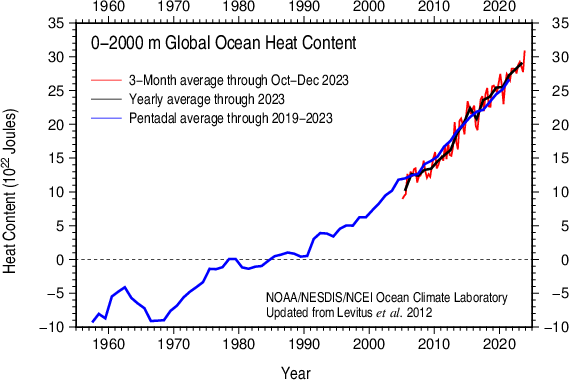
So the change in heat is about 2x10^23 Joules over a period of around 20 years.
The global warming folks tell us that the real global warming problems begin when we get the earth's temperature to rise by 2C. So let's use that as our temperature. Now they're worried about a 2 degree C change over the next 100 years or so which is 100 = 20x5 or 5x longer than the 20 year rise shown above. If the ocean heat continues to rise at the above rate, we're talking about a heat increase of about 5x(2x10^23) = 10^24 Joules = 1,000,000,000,000,000,000,000,000 Joules.
That's a lot of heat. One of the things alarmists like to do is to use units of "Hiroshima bombs". I think this is a rude disrespect but we can do the conversion as they never bother to do it for this situation. One Hiroshima bomb is about 6x10^13 Joules or 60,000,000,000,000 Joules. Doing the long division, we find that the energy stored in the oceans over the next 100 years is about 1.7x10^10 Hiroshima bombs or 17,000,000,000 bombs, that is, 17 billion Hiroshima bombs and the amount stored in the last 20 years was about 3 billion Hiroshima bombs.
Over the course of a century, all that heat will be distributed over the entire oceans. But just for the moment, let's see how much water we can heat 2C higher using 10^24 Joules. Of course if the heat is used exclusively to melt ice, or to evaporate water, the temperature will change by nothing (if you think otherwise, try learning a little thermodynamics, the subject here is a "phase change") but let's make the worst case assumption that the heat is absorbed by liquid water which stays liquid.
Turns out it takes 4.1813 Joules to raise the temperature of 1 gram of water by 1 degree C. Thus it takes twice this or about 8.36 Joules to raise a gram of water by 2C. And so the 10^24 Joules are enough to raise about (10^24)/8.8 = 1.2x10^23 grams of water by 2C. Converting to kilograms this gives 1.2x10^20 kilograms of water.
So what percentage of the oceans will we have raised in temperature (over the next 100 years) by 2C? It turns out that mass of the world's oceans are about 1.4x10^21 kilograms. This is about 12x larger than the amount of water that will be increased in temperature by 2C. And if we are to warm all the world's oceans by those 2C, then, at the present rate, it's going to take about 12x those 100 years.
So the final result is this:
If the CO2 heat goes into the oceans, it will take about 1200 years to warm the oceans by 2C.
If I were a betting man, I'd say that fossil fuel usage drops to near zero *before* those 1200 years go by.