Quote from GordonTheGekko:
Doubtful
Five years later: "Ever heard of the new thing called the desktop? Faster than the cloud, you can store videos and unlimited large files, and its all yours!"
They call things Public Cloud and Private Clouds today. Really what I have is a couple of multi-node servers that are identical (same as lining up 16-24 i7 desktops next to each other) and it would be called a small private-cloud.
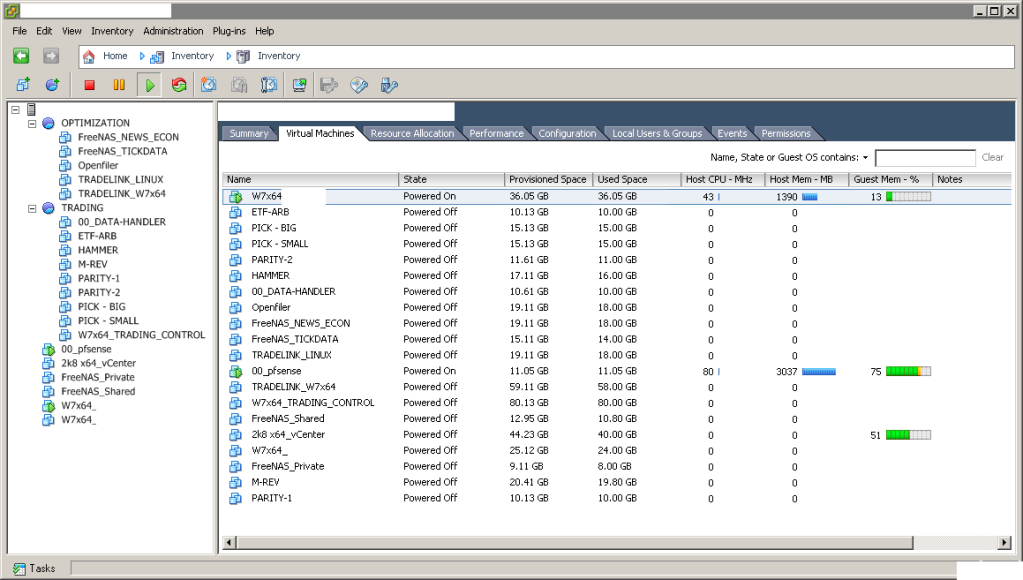
Apple basterdized the cloud with their iCloud campaign so badly that no one knows or understands exactly what it is. Technically the industry calls what I have a Private Cloud but really what I have is multiple operating systems running on the same machine thanks to a thing called a Hypervisor.
http://en.wikipedia.org/wiki/Hypervisor
I personally own and built one of these and I'm in the process of building a 2.0 box (but modified):
http://blog.backblaze.com/2009/09/01/petabytes-on-a-budget-how-to-build-cheap-cloud-storage/
^^^ I don't have any worries about storing DVDs or my iTunes media. A couple members on here have seen it so before you call BS send me a PM. I'm happy to put my driver's license + the wall street journal next to it the next time I go inside the datacenter.
We already have 10-core CPUs. The majority of CPUs I own are 6-cores with 12 threads. Intel and AMD have 10-core machines and 4-socket motherboards - that's 40 physical cores and 80 threads. GPU technology has come a log way too (using video cards for short bursts of computational power)... You can now use video cards to emulate physical CPU processors.... So I can take a GPU with 1024 cores and allocate that to over 1000 processes or have it focus in on one task.
What you don't understand is that today it costs $6k to buy a machine that can do all of this. In 10 years it'll cost $600 tops and everyone can have only one desktop in their house that can accomplish what you now consider to be "super computer" type computing.
I had an interview/consulting meeting with Apple today - even Apple of all companies (who has a business model that gives away software but makes you pay for the hardware) is dedicating R&D money into phasing out the desktop. They see the mobile device, thin client (or zero client... which will look like an iPad keyboard) and tablet as the future. Voice recognition will mature to the point that your car will nag you to slow down just like your wife does today - your cell phone will nag you to wake up in the morning or take out the trash before you go to to work.
Do you know that we have flexible LCD screens now? Literally flexible to the point that a pair of ski goggles (or infantry tactical goggles) can display powered by a few AA batteries - you will see within the next 10 years that the "star trek" type holograms in combination with semi-transparent screens the thickness of a business card will be the norm.
We have this stuff - it just takes a few downed drones in Iran to push a few new military contracts and before long those plastic layers they use in your car's windshield to temper it and make it stronger - will be showing you traffic patterns and interacting with you.
Mercedes has test vehicles - Spend 5min on Google.
Apple's new iOS already takes voice commands...
The ONLY reason why the desktop still exists is because we don't have a mature infrastructure to support long-distance, high-bandwidth, low-latency connectivity.
When we built homes our solution was the power grid - we have massive resources that can be allocated here & there as needs see fit (watch any Enron documentary). In the next few years we will optimize heterogeneous clusters and resource pools. Just like if you had a windmill at your house you could sell resources back to the grid... You'll be able to sell spare computing power back to the grid. A home will have one modest device that has capacity to handle about 50% of max computational draw... everything from cars stopped at a stoplight in front of a starbucks to your neighbor's computational resources or your cell phone when you aren't talking on it will be used to contribute to the overall work.
Its energy and as of now we don't have an efficient way of distributing or focusing work. Once that is sorted your desktop will live in the basement, look like a 12V car battery or a dehumidifier, etc. and it'll just sit there idle and you'll never understand what's going on inside because you can hang on to your i7 and keep "unlimited amounts" of whatever on your desktop.