I have tried repeatedly, but have given up. It's rare that you and I agree on anything, lol.Your fanciful notion of "we don't need to have any income taxes"... is so far fetched, it defies rebuttal.
Perhaps someone else will chime in on this, but not me.

You are using an out of date browser. It may not display this or other websites correctly.
You should upgrade or use an alternative browser.
You should upgrade or use an alternative browser.
Pick your poison, social unrest, or...
- Thread starter Ricter
- Start date
Businesses on Main Street will not be shutting down because the owner(s) pay more taxes on the top tier or two of their income (assuming they reach it). They will shut down if their customers are broke, i.e. they can't make sales.
And it's not "regulations!", either. The history of American business growth has been accompanied by a growth of regulation! Not because of, but in spite of. And lately, regulations have increased on primarily... food imports and pharmaceuticals. Is your local grocery store or pharmacy closed?
With strong sales I can overcome everything else the economy throws at me (so long as I don't blow it in admin and marketing).
Americans are starting fewer businesses, new companies are going out of business more quickly, and the new firms that do get off the ground are creating fewer jobs.
None of that bodes very well for an economy still trying to find its footing.
“America’s entrepreneurs need help,” John Dearie, executive vice president of the Financial Services Forum, a trade organization in Washington, D.C., said during a recent hearing before members of the House Small Business Committee. In terms of the start-up economy, he added, all vital signs “are flashing red alert.”
Dearie cited research in his testimony showing that new firms — rather than, as is so often argued, small businesses in general — historically account for virtually all net new jobs generated each year in the United States. However, their annual hiring contributions have dropped about 40 percent since 2000, accelerating a downward trend that has been going on for the past three decades.
In part, that’s because the number of new businesses has steadily declined. Data from 2011 showed that only 8 percent of companies are less than one year old, down from 15 percent of all firms back in the late 1970s, with a particularly sharp decline taking place during and in the years immediately following the Great Recession.
Meanwhile, the number of young firms going under within the first few years has increased. Consequently, for the first time in 30 years, business deaths now outnumber business births, according to the U.S. Census Bureau.
http://www.washingtonpost.com/busin...576cb8-385a-11e4-8601-97ba88884ffd_story.html


What's the problem? It's the best time ever from a poverty perspective...
/cdn0.vox-cdn.com/uploads/chorus_asset/file/3964280/roser_poverty_shares.png-large)
http://www.vox.com/2015/8/13/9145467/extreme-poverty-global-poverty
The problem is "inequality" is a perfect bullsh!t tool for the left to stir up division and envy in society, as it is always present. If every one was a millionaire and 10 billionaires existed there would be inequality, they dont focus on absolute poverty and living standards, raising the bottom, their entire fixation is the "injustice" of the rich.
The french moron calling for 80% taxes to fix the world was debunked if I remember correctly
Why We Need Regulatory Reform in Two Charts
Patrick McLaughlin, Richard Williams | May 27, 2014
The Problem: The American regulatory system has no working, systematic process for reviewing regulations for obsolescence or poor performance, facilitating the accumulation of a vast stock of regulations. A recent study found that the accumulation of federal regulations slowed economic growth by an average of two percent per year between 1949 and 2005. Several earlier studies using broad indexes, such as those produced by the World Bank and OECD, have permitted cross-country comparisons of the effects of certain types of regulations. These studies have also found that regulations can slow growth when they impede innovation and entrepreneurship.
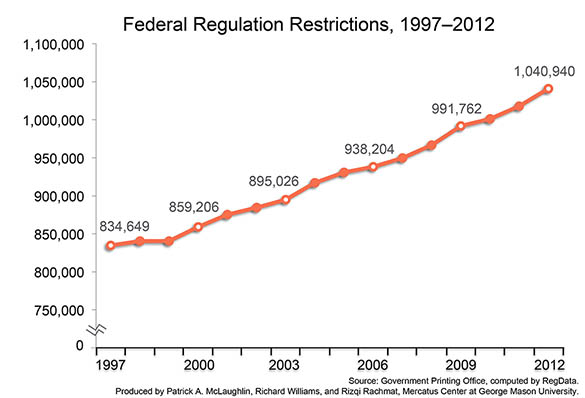
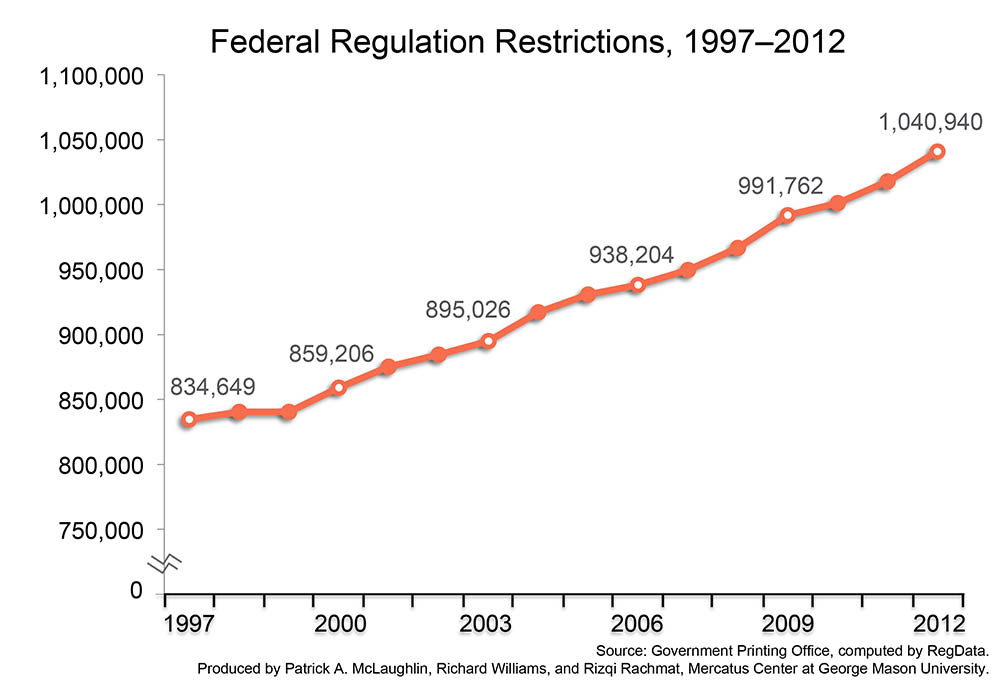
In its most basic definition, a regulation is a law that “seeks to change behavior in order to produce desired outcomes,” and it does this by requiring or forbidding certain actions. Figure 1 shows the growth of federal regulations from 1997 to 2012, as measured by counting the number of restricting words, such as “shall,” “must,” or “required,” that are printed in the Code of Federal Regulations each year. (For information on the methodology behind this chart, see our paper.) The total number of restrictions in federal regulations has grown from about 835,000 in 1997 to over 1 million by 2010. Over time, these accumulated restrictions can either directly foreclose paths to innovation or entrepreneurship or add up to the point where their cumulative cost makes certain actions prohibitively expensive.
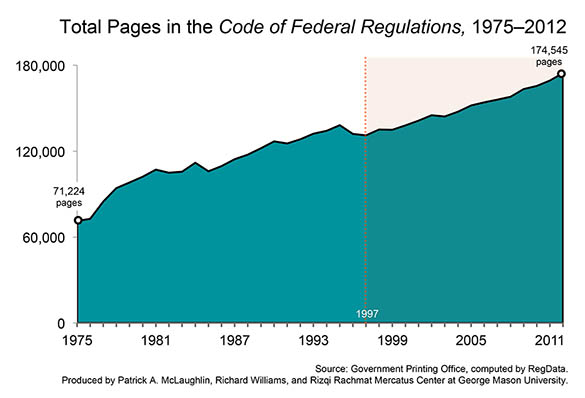
Every administration since Jimmy Carter’s has undertaken efforts to modify or eliminate nonfunctioning regulations. Notably, none of these efforts resulted in either substantial reductions relative to the total size of the Code of Federal Regulations or sustained changes in the rate of adding new regulations to the Code of Federal Regulations. Figure 2 shows that the stock of regulations, as measured by the number of pages published annually in the Code of Federal Regulations, never substantially declined, and in fact has consistently grown over the same time frame that these administrations attempted to retrospectively modify or eliminate nonfunctioning regulations. To date, there has been neither large-scale retrospective analysis nor the creation of a process that would eliminate failing regulations.
Every attempt by presidents to direct agencies to review their own regulations in order to eliminate nonfunctional ones has yielded poor results. Agencies, despite direction from the president, have incentives to maintain and grow their regulations in order to maximize their budgets. In turn, in order to retain regulations that would be eliminated otherwise, agencies may either hide or fail to produce information that would help identify obsolete regulations in the first place. These and other obstacles must be overcome before retrospective review and elimination or modification of nonfunctional regulations can be accomplished in the United States.
The Solution: In contrast to the repeated failures of the United States to clean up regulations, there are two successful government reforms that overcame similar obstacles: the Base Realignment and Closure Commission (BRAC Commission) and the Dutch Administrative Burden Reduction Programme (the Dutch Programme). Based on the success of these programs and our research, it is possible to devise principles for a successful solution.
Given the consequences of regulatory accumulation and the repeated failures of agency- and president-led attempts at reform, congressional action may be required to address this problem. A successful regulatory reform act will include most or all of the following characteristics:
Patrick McLaughlin, Richard Williams | May 27, 2014
The Problem: The American regulatory system has no working, systematic process for reviewing regulations for obsolescence or poor performance, facilitating the accumulation of a vast stock of regulations. A recent study found that the accumulation of federal regulations slowed economic growth by an average of two percent per year between 1949 and 2005. Several earlier studies using broad indexes, such as those produced by the World Bank and OECD, have permitted cross-country comparisons of the effects of certain types of regulations. These studies have also found that regulations can slow growth when they impede innovation and entrepreneurship.
In its most basic definition, a regulation is a law that “seeks to change behavior in order to produce desired outcomes,” and it does this by requiring or forbidding certain actions. Figure 1 shows the growth of federal regulations from 1997 to 2012, as measured by counting the number of restricting words, such as “shall,” “must,” or “required,” that are printed in the Code of Federal Regulations each year. (For information on the methodology behind this chart, see our paper.) The total number of restrictions in federal regulations has grown from about 835,000 in 1997 to over 1 million by 2010. Over time, these accumulated restrictions can either directly foreclose paths to innovation or entrepreneurship or add up to the point where their cumulative cost makes certain actions prohibitively expensive.
Every administration since Jimmy Carter’s has undertaken efforts to modify or eliminate nonfunctioning regulations. Notably, none of these efforts resulted in either substantial reductions relative to the total size of the Code of Federal Regulations or sustained changes in the rate of adding new regulations to the Code of Federal Regulations. Figure 2 shows that the stock of regulations, as measured by the number of pages published annually in the Code of Federal Regulations, never substantially declined, and in fact has consistently grown over the same time frame that these administrations attempted to retrospectively modify or eliminate nonfunctioning regulations. To date, there has been neither large-scale retrospective analysis nor the creation of a process that would eliminate failing regulations.

Every attempt by presidents to direct agencies to review their own regulations in order to eliminate nonfunctional ones has yielded poor results. Agencies, despite direction from the president, have incentives to maintain and grow their regulations in order to maximize their budgets. In turn, in order to retain regulations that would be eliminated otherwise, agencies may either hide or fail to produce information that would help identify obsolete regulations in the first place. These and other obstacles must be overcome before retrospective review and elimination or modification of nonfunctional regulations can be accomplished in the United States.
The Solution: In contrast to the repeated failures of the United States to clean up regulations, there are two successful government reforms that overcame similar obstacles: the Base Realignment and Closure Commission (BRAC Commission) and the Dutch Administrative Burden Reduction Programme (the Dutch Programme). Based on the success of these programs and our research, it is possible to devise principles for a successful solution.
Given the consequences of regulatory accumulation and the repeated failures of agency- and president-led attempts at reform, congressional action may be required to address this problem. A successful regulatory reform act will include most or all of the following characteristics:
- The process should entail independent assessment of whether regulations are nonfunctional.
- The process should ensure there is no special treatment of any group or stakeholder.
- The process should use a standard method of assessment that is difficult to subvert.
- Whatever the procedure for assessment, assessments of specific regulations or regulatory programs should focus on whether and how they lead to the outcomes desired.
- Regulatory agencies should be recognized as another important stakeholder, with incentives to keep and increase regulation.
- Congressional action—such as a joint resolution of disapproval—should be required in order to stop the recommendations, as opposed to a vote to enact or not enact.
- The review process should repeat indefinitely.
This chart is something i've wondered about for awhile.
The bls uses a birth death model to adjust the employment numbers every month. It's a theoretical number that comes from their model that is added to the actual data, and supposed to reflect the new businesses created less the businesses that fold.
But during Obama's term, the chart shows that more businesses are dying. But the bls is still adding, not subtracting new employees to the data.
all they know is they need money and others have itThe problem is "inequality" is a perfect bullsh!t tool for the left to stir up division and envy in society, as it is always present. If every one was a millionaire and 10 billionaires existed there would be inequality, they dont focus on absolute poverty and living standards, raising the bottom, their entire fixation is the "injustice" of the rich.
The french moron calling for 80% taxes to fix the world was debunked if I remember correctly
all they know is they need money and others have it
Who needs money? Who are they?
My notion is that we don't know if we need income taxes to balance the budget because was have not idea how much money the Fed has created or is creating. For instance the Fed does not even report M3 anymore. Without that knowledge how can anyone tell us how important it is to raise income taxes....
ricter if you have ever answered that question let me know.
https://en.wikipedia.org/wiki/Money_supply
The Federal Reserve previously published data on three monetary aggregates, but on November 10, 2005 announced that as of March 23, 2006, it would cease publication of M3.[15] Since the Spring of 2006, the Federal Reserve only publishes data on two of these aggregates. The first, M1, is made up of types of money commonly used for payment, basically currency (M0) and checking account balances. The second, M2, includes M1 plus balances that generally are similar to transaction accounts and that, for the most part, can be converted fairly readily to M1 with little or no loss of principal. The M2 measure is thought to be held primarily by households. As mentioned, the third aggregate, M3 is no longer published. Prior to this discontinuation, M3 had included M2 plus certain accounts that are held by entities other than individuals and are issued by banks and thrift institutions to augment M2-type balances in meeting credit demands; it had also included balances in money market mutual funds held by institutional investors. The aggregates have had different roles in monetary policy as their reliability as guides has changed. The following details their principal components:[28]
When the Federal Reserve announced in 2005 that they would cease publishing M3 statistics in March 2006, they explained that M3 did not convey any additional information about economic activity compared to M2, and thus, "has not played a role in the monetary policy process for many years." Therefore, the costs to collect M3 data outweighed the benefits the data provided.[15] Some politicians have spoken out against the Federal Reserve's decision to cease publishing M3 statistics and have urged the U.S. Congress to take steps requiring the Federal Reserve to do so. Congressman Ron Paul (R-TX) claimed that "M3 is the best description of how quickly the Fed is creating new money and credit. Common sense tells us that a government central bank creating new money out of thin air depreciates the value of each dollar in circulation."[29] Modern Monetary Theory disagrees. It holds that money creation in a free-floating fiat currency regime such as the U.S. will not lead to significant inflation unless the economy is approaching full employment and full capacity. Some of the data used to calculate M3 are still collected and published on a regular basis.[15] Current alternate sources of M3 data are available from the private sector.[30]
As of April 2013, the monetary base was $3 trillion[31] and M2, the broadest measure of money supply, was $10.5 trillion.[32]
ricter if you have ever answered that question let me know.
https://en.wikipedia.org/wiki/Money_supply
The Federal Reserve previously published data on three monetary aggregates, but on November 10, 2005 announced that as of March 23, 2006, it would cease publication of M3.[15] Since the Spring of 2006, the Federal Reserve only publishes data on two of these aggregates. The first, M1, is made up of types of money commonly used for payment, basically currency (M0) and checking account balances. The second, M2, includes M1 plus balances that generally are similar to transaction accounts and that, for the most part, can be converted fairly readily to M1 with little or no loss of principal. The M2 measure is thought to be held primarily by households. As mentioned, the third aggregate, M3 is no longer published. Prior to this discontinuation, M3 had included M2 plus certain accounts that are held by entities other than individuals and are issued by banks and thrift institutions to augment M2-type balances in meeting credit demands; it had also included balances in money market mutual funds held by institutional investors. The aggregates have had different roles in monetary policy as their reliability as guides has changed. The following details their principal components:[28]
- M0: The total of all physical currency including coinage. M0 = Federal Reserve Notes + US Notes + Coins. It is not relevant whether the currency is held inside or outside of the private banking system as reserves.
- MB: The total of all physical currency plus Federal Reserve Deposits (special deposits that only banks can have at the Fed). MB = Coins + US Notes +Federal Reserve Notes + Federal Reserve Deposits
- M1: The total amount of M0 (cash/coin) outside of the private banking system plus the amount of demand deposits, travelers checks and other checkable deposits
- M2: M1 + most savings accounts, money market accounts, retail money market mutual funds, and small denomination time deposits (certificates of deposit of under $100,000).
- MZM: 'Money Zero Maturity' is one of the most popular aggregates in use by the Fed because its velocity has historically been the most accurate predictor of inflation. It is M2 – time deposits + money market funds
- M3: M2 + all other CDs (large time deposits, institutional money market mutual fund balances), deposits of eurodollars and repurchase agreements.
- M4-: M3 + Commercial Paper
- M4: M4- + T-Bills (or M3 + Commercial Paper + T-Bills)
- L: The broadest measure of liquidity that the Federal Reserve no longer tracks. Pretty much M4 + Bankers' Acceptance
- Money Multiplier: M1 / MB. Currently as of June 14, 2012 it is .85[citation needed]. While a multiplier under one is historically an oddity, this is a reflection of the popularity of M2 over M1 and the massive amount of MB the government has created since 2008.
When the Federal Reserve announced in 2005 that they would cease publishing M3 statistics in March 2006, they explained that M3 did not convey any additional information about economic activity compared to M2, and thus, "has not played a role in the monetary policy process for many years." Therefore, the costs to collect M3 data outweighed the benefits the data provided.[15] Some politicians have spoken out against the Federal Reserve's decision to cease publishing M3 statistics and have urged the U.S. Congress to take steps requiring the Federal Reserve to do so. Congressman Ron Paul (R-TX) claimed that "M3 is the best description of how quickly the Fed is creating new money and credit. Common sense tells us that a government central bank creating new money out of thin air depreciates the value of each dollar in circulation."[29] Modern Monetary Theory disagrees. It holds that money creation in a free-floating fiat currency regime such as the U.S. will not lead to significant inflation unless the economy is approaching full employment and full capacity. Some of the data used to calculate M3 are still collected and published on a regular basis.[15] Current alternate sources of M3 data are available from the private sector.[30]
As of April 2013, the monetary base was $3 trillion[31] and M2, the broadest measure of money supply, was $10.5 trillion.[32]
Your fanciful notion of "we don't need to have any income taxes"... is so far fetched, it defies rebuttal.
Perhaps someone else will chime in on this, but not me.