
Every week that passes China is doing something new and just off the charts to charge up their failing markets and economy, this is the warning sign, I'm telling you now if you think the crisis of 2008 was bad the world has not seen anything yet....this is a telling sign of desperation, the world financial markets are going to collapse making the last crisis look like nothing ever happened.
China OKs pension funds to pour $97B into market
2 Hours AgoReuters
China Daily | Reuters
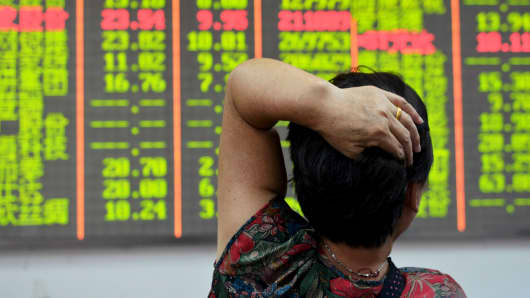
An investor looks at an electronic board showing stock information in Hangzhou, China, on Aug. 18, 2015.
China on Sunday allowed pension funds managed by local governments to invest in the stock market for the first time, potentially channeling hundreds of billions of yuan into the country's struggling equity market.
China published a draft rule on the move for public consultation on June 30, at the height of a recent stock market rout. The State Council, or cabinet, published the finalized rules on Sunday after shares slumped nearly 12 percent last week, the worst weekly performance since June.
The Wall Street Journal also reported Sunday that the People's Bank of China is preparing to add liquidity to its banking system, adding that the move could come before the end of the month.
Despite a series of official measures aimed at supporting the market, investor sentiment has remained fragile amid continued signs of slowing economy.
Pension funds will now be able to invest up to 30 percent of their net assets in the country's stocks, equity funds and balanced funds, according to rules published on the State Council's website.
Previously, the pension funds could only invest in bank deposits and treasuries.
Together the funds have assets of more than 2 trillion yuan ($322 billion) that can be invested, meaning about 600 billion yuan ($97 billion) could theoretically go into the stock market, state media has estimated.
According to the new rules, pension funds can also invest in convertible bonds, money-market instruments, asset-backed securities, index futures and bond futures in China, as well as the country's major infrastructure projects.
Local governments can mandate institutions authorized by the central government to manage the pension funds.
China OKs pension funds to pour $97B into market
2 Hours AgoReuters
China Daily | Reuters
An investor looks at an electronic board showing stock information in Hangzhou, China, on Aug. 18, 2015.
China on Sunday allowed pension funds managed by local governments to invest in the stock market for the first time, potentially channeling hundreds of billions of yuan into the country's struggling equity market.
China published a draft rule on the move for public consultation on June 30, at the height of a recent stock market rout. The State Council, or cabinet, published the finalized rules on Sunday after shares slumped nearly 12 percent last week, the worst weekly performance since June.
The Wall Street Journal also reported Sunday that the People's Bank of China is preparing to add liquidity to its banking system, adding that the move could come before the end of the month.
Despite a series of official measures aimed at supporting the market, investor sentiment has remained fragile amid continued signs of slowing economy.
Pension funds will now be able to invest up to 30 percent of their net assets in the country's stocks, equity funds and balanced funds, according to rules published on the State Council's website.
Previously, the pension funds could only invest in bank deposits and treasuries.
Together the funds have assets of more than 2 trillion yuan ($322 billion) that can be invested, meaning about 600 billion yuan ($97 billion) could theoretically go into the stock market, state media has estimated.
According to the new rules, pension funds can also invest in convertible bonds, money-market instruments, asset-backed securities, index futures and bond futures in China, as well as the country's major infrastructure projects.
Local governments can mandate institutions authorized by the central government to manage the pension funds.
