Paving the road for Inflation

Radical thoughts on 19th Street
A higher inflation target for central banks would be a bad idea

Feb 18th 2010 | From The Economist print edition

EVEN in economics, the guardians of orthodoxy are not given to capricious changes of mind. So when economists at the IMF question received wisdom and the fund’s established views twice in a week, it is no small matter. Two new papers have done exactly that. The first reversal, on inflation targets, makes less sense than the second, on capital controls.

The initial firecracker came on February 12th, with an analysis of the lessons of the financial crisis for macroeconomic policy, led by Olivier Blanchard, the IMF’s chief economist. The report called for several bold innovations. The most radical of these is that central banks should raise their inflation targets—perhaps to 4% from the standard 2% or so.

REST OF THE ARTICLE

http://www.economist.com/opinion/displaystory.cfm?story_id=15545904
 
Who says they will be successful? The Japanese have been trying to create inflation for 20 years with not much to show for.
 
Quote from jueco2005:

"... The report called for several bold innovations. The most radical of these is that central banks should raise their inflation targets—perhaps to 4% from the standard 2% or so.


Didn't Nixon install "wage and price controls" because inflation rose to 4%? Now they want us to accept that as an "operating norm"... WTF??
 
From Krugman's blog:

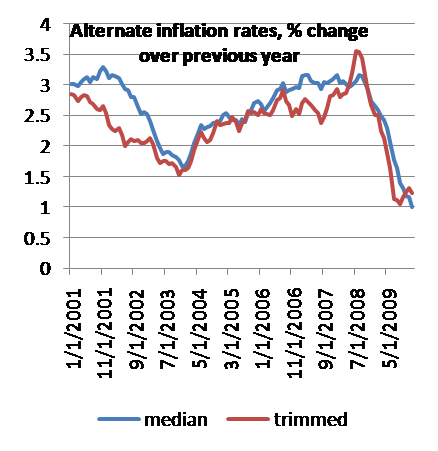
"What I find myself looking at these days are the Cleveland Fed 'trimmed' inflation measures, which exclude outlying large price movements; the ultimate trim is the median, the rise in the price of the median category. And these indicators tell a story of dramatic disinflation in the face of a week weak economy:"

coredeflate.png


-------------

Even if there is significant inflation, the gubbamint will never report it.
 
Quote from Covertibility:

From Krugman's blog:

"What I find myself looking at these days are the Cleveland Fed 'trimmed' inflation measures, which exclude outlying large price movements; the ultimate trim is the median, the rise in the price of the median category. And these indicators tell a story of dramatic disinflation in the face of a week weak economy:"

coredeflate.png


-------------

Even if there is significant inflation, the gubbamint will never report it.

The government has much to gain by reporting inflation. And much to lose by reporting deflation. Why wouldn't they report inflation?
 
Quote from BarneyFrank:

that's a silly assumption, what do you have, to back your statement with, the level of debt the government is in?

the gov has been increasing the budget by more than 7% for the last few years, they increased the budget by 14.3% for 2010 and they plan on increasing it by at least 8% for 2011, and all of that in the face of declining revenues from taxes

source: http://en.wikipedia.org/wiki/2010_United_States_federal_budget

yes the government is rapidly growing, but since governments are nonproductive entities, their main source of income after taxes is the printing of money, and if you don't know what printing money amounts to, then whatever

my assumption is that the US government is fairly aware of the possibility of a run on the USD, they want to spend like crazy and build as much military and infrastructure as possible before it all blows up

As someone who sincerely has no respect at all for you or what you say due to your comments in a different thread regarding Canada, as well as the overall clear indication that you are not very well educated, I will still do you the favor of responding.

There is one thing the USA should worry about given it's insane debt levels:

deflation

Deflation would bring about absolute and certain default. Protect against deflation, protect against default. This won't help solve the USA government's spending binge or budget deficits, but it protects against debt owed from getting into an even worse situation by itself.
 
Back
Top