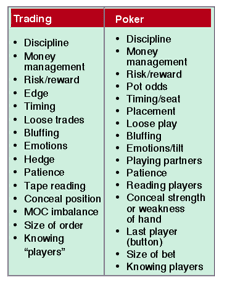
With all due respect, to me it sounds that many puzzle pieces are being forced into place. Though they vaguely fit, they do not truly belong in those places.
Too many would-be similarities between poker and trading sound a lot like pale analogies of one another, rather than solid, actual similarities.
Yes, BOTH poker and trading involve the assessment of odds. BOTH involve the risk-controlled allocation of capital in situations that by design call for such action. And BOTH rely on the discipline (emotional control) to allocate capital only in situations where reward outweighs the risk on a dollar-for-dollar basis. But the similarities end there, I think.
Ok, controlling emotions is critical in both trading and poker, but the main problem with using this as a comparison is that trading can be compared to so many other things, like sports. So can poker. In truth, emotions are inhibitions in all fields--not just trading or poker or sports. When debating the similarities or differences in poker, it makes sense to discuss things that would generally apply only to trading and only to poker, or both, but not things that would apply to many, many other things. For example, I could say that trading AND playing poker can be done on a computer, and call that a similarity. Yes, it's a similarity, but come on... editing graphics or writing music can be done on a computer. See my point?
Outs and hedging? I think that's comparing apples to oranges. Once a deck is shuffled, what cards will come, will come. But unless you have X-ray vision, you can only assume the well-published, well-known, mathematically correct odds of certain cards coming. Hedging isn't the only way of increasing the odds in your favor in trading. Though both, playing hands with many potential outs, and hedging increase the odds in your favor, to say that outs are poker's equivalent to hedging in trading is, again, forcing an analogy in an attempt to create the illusion of similarity.
"Table talk" does not change the cards which will fall in the deck or those which have already been dealt, true. But what table talk in poker does is attempt to manipulate the decisions of those still involved in the hand. In the markets, down- or upgrading a stock is merely the same thing. Sometimes it works, sometimes it doesn't. How many times have you heard bad news about a stock on TV, and yet the prices are still going up? But again, these aren't the respective counterparts of poker in trading, or trading in poker. These are just factoids that might be casually, vaguely, possibly similar in appearance to the untrained eye. Table talk in poker is done to change the actions of individual players. Table talk in the markets is done to "alter the order or the cards in the deck."
Varying your bets? Huh? C'mon!
This comparison makes littlest sense as of yet, and if I dare say it, is outright incorrect and misleading! In poker you vary your bet sizes (not possible in fixed limit games, by the way) in an effort to produce a different reaction from those who are still yet to act. The size of your bet is a factor taken into account by others when they attempt to decide on their course of action. In Blackjack, you vary your bet size only because to do so is in accordance with a positive expectancy card-counting system. Simply, you keep the bets as small as you can while the cards most likely to come are unfavorable, while you then bet more as the deck runs out of those and instead "is rich in" cards that are favorable. In trading, the ONLY reason to vary your "bet size" is to increase your dollar-amount exposure to either favorable or unfavorable moves. In other words, when you trade in small dollar amounts, you are doing so only because to go any higher would be too big a chunk of your overall trading capital. Poker has this equivalent, and it's called playing at lower or higher limits. So does Blackjack! But varying bet sizes in either poker or blackjack has nothing to do with the size of your bankroll.
Betting for information?
Now you're just looking for filler text with which to plump up your articles. In poker, a bet is used for information. Big OR small. The same reaction to a smaller bet says a different thing than the same reaction to a bigger bet. The size of your bet, in effect, influences action of other players still in the hand. Sometimes you gain information by checking, which is actually making a bet of exactly zero dollars. No, making a small trade in a stock does not reveal to you information that you don't already have through the Level II or OpenBook (extremely illiquid stocks are a whole different animal).
Pot odds? Again, yes it's true, but what you say can be simplified through what was already covered: the fact that to be successful in any risk-reward endeavor, the risk taken needs to be outweighed by the reward provided. There's no difference between having a 50% chance at a $100 dollar pot having to call only $25, and having a 10% chance at a $1000 pot having to call only $50. Each scenario doubles your money. This is not a unique similarity. It's covered by the concept of making sure your dollars risked are less than your dollars gained.
Play online, trade online? Hmmm... sounds familiar.
Discipline and patience? Again, covered in my second paragraph of this post.
To have fun while doing it? Eh... I don't know. If you're playing poker to "have fun," or you're trading to "have fun," you're doing something wrong. If I had to stake someone who told me he will "have fun" playing poker or trading, my eyes would pop out. It's all about the money. Trading isn't supposed to be fun. Poker isn't supposed to be fun. When played correctly, poker tends to be a bit boring for most personalities. When trading in a way that is profitable, most are bored.
So, Don, were you honestly trying to answer killthesunshine's question, or were you just trying to advertise your website on which you sell stuff? 
All the best,
Me