Pandemic panic preperation

they didn't have NetFlix shows to binge watch.
"According to the state health board, influenza arrived in Colorado on or about 20 September 1918.....

By early February, with state-wide flu cases ebbing, Gunnison lifted restriction.."

A little over 3 months of binge watching should suffice...
 
"According to the state health board, influenza arrived in Colorado on or about 20 September 1918.....

By early February, with state-wide flu cases ebbing, Gunnison lifted restriction.."

A little over 3 months of binge watching should suffice...

Warmer weather should help.
 
Warmer weather should help.

As I stated before, the end of the current flu season will help considerably even if the coronavirus does not follow a similar cycle- because they share a lot of similar symptoms and it makes early diagnosis more difficult. Right now if a person in the seattle area goes into a local clinic with flu-like symptoms there are probably 50 other people in there that day with regular flu systems, and another 50 who did not come in because they figured they were just in the early stages of the regular flu. Give it another month or month and a half or so and most of the regular seasonal flu traffic will let up.
 
Gunnison, Colorado: the town that dodged the 1918 Spanish flu pandemic


A century on, what can we learn from how US mountain community dealt with viral outbreak

Rory-Carroll,-L.png

Rory Carroll

@rorycarroll72
Sun 1 Mar 2020 03.00 ESTLast modified on Sun 1 Mar 2020 03.03 EST

Shares
1453
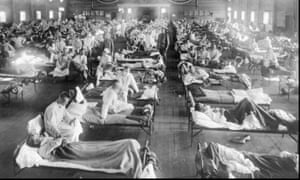

Spanish influenza victims crowd into an emergency hospital at Camp Funston, Kansas, US in 1918. Photograph: Associated Press
In late 1918 the world’s greatest killer – Spanish flu – roared towards Gunnison, a mountain town in Colorado.

The pandemic was infecting hundreds of millions of people in Europe, Africa, Asia and across the United States, overwhelming hospitals and morgues in Boston and Philadelphia before sweeping west, devastating cities, villages and hamlets from Alaska to Texas.

Gunnison, a farming and mining town of about 1,300 people, had special reason to fear. Two railroads connected it to Denver and other population centers, many badly hit. “The flu is after us” the Gunnison News-Champion warned on 10 October. “It is circulating in almost every village and community around us.”

What happened next is instructive amid a new global health emergency a century later as the world struggles react to the emergence of a new coronavirus. Gunnison declared a “quarantine against all the world”. It erected barricades, sequestered visitors, arrested violators, closed schools and churches and banned parties and street gatherings, a de facto lockdown that lasted four months.

It worked. Gunnison emerged from the pandemic’s first two waves – by far the deadliest - without a single case. It was one of a handful of so-called “escape communities” that researchers have analysed for insights into containing the apparently uncontainable.

“Gunnison’s management of the influenza situation, one hallmarked by the application of protective sequestration, is particularly impressive when one considers that nearly every nearby town and county was severely affected by the pandemic,” the University of Michigan Medical School said in a 2006 report for the Pentagon’s Defense Threat Reduction Agency. “The town of Gunnison was exceptional.”

Now it is the turn of coronavirus to race around the world, rattling governments and stock markets and prompting a desperate scramble to contain and control. Tourists stuck in Spanish hotels, Italian streets eerily empty, schools shuttered in Japan, pilgrimages to Islam’s holiest sites banned, international sporting fixtures suspended – a multiplying list of measures amid confusion over how to respond.

The experience of a small town in the Rockies at the end of the first world war does not provide a failsafe blueprint for a different disease in a far more populous, and far more interconnected era. It does however offer tantalising nuggets about about eluding a cataclysm that infected about a third of the global population and killed between 50 million and 100 million people.

Instead of face masks and anti-bacterial hand gels, Gunnsion relied on the guidance and authority of local newspapers, doctors and police – a trust in institutions that may now seem quaint – and on people’s capacity for patience. And on luck.

According to the state health board, influenza arrived in Colorado on or about 20 September 1918 when 250 soldiers from Montana – 13 of them seriously ill - arrived in the city of Boulder. The deadly flu – mistakenly sourced to Spain - swiftly spread.

On 5 October health officials issued a warning and on 16 October the governor, Julius Gunter, issued an executive order banning public and private gatherings across the state. By then towns near Gunnison were already reeling.

Gunnison moved swiftly thanks partly to the News-Champion, which from late September carried at least one front page article on influenza, including practical advice on avoidance and treatment, in each weekly edition.

Dr FP Hanson, the county physician, took a leading role. “An epidemic, terrible in proportions and resultant deaths, is sweeping over the country,” he wrote. “I have caused a strict quarantine to be placed on Gunnison county against the world. Barricades and fences have been erected on all main highways near the county lines.”

Lanterns and signs warned motorists to drive straight through or submit to quarantine. Train passengers who disembarked were quarantined. “Any person may leave the county at his will; none may return except those who will go into voluntary quarantine,” said Hanson. Any violators would be be “dealt with to the fullest extent of the law, and to this we promise our personal attention”, he added.

Officials fortified defences by giving another physician, Dr JW Rockerfeller, “entire charge of both town and county to enforce a quarantine against all the world”. He meant business. When residents reported two motorists and a rail passenger who tried to evade quarantine the sheriff jailed them. “This little instance should show outsiders what Gunnison county’s stand is. We have no flu, and we do not intend to have any,” said Rockerfeller.

The screws tightened. Quarantine was extended from two to five days. Several train stations around the county were shut, facilitating monitoring.

By early February, with state-wide flu cases ebbing, Gunnison lifted restrictions. It was premature: a third wave in March infected about a hundred people in the town. The cases were mild and all survived.

Other “escape communities” in the US included Princeton university, a New York tuberculosis sanatorium, Yerba Buena island in San Francisco bay and the Vermont town of Fletcher. The Michigan Medical School study attributed Gunnison’s feat to strict measures, low population density and luck – no infected person arrived before quarantine.

But a mystery endures: how did residents endure the cabin fever? Those currently under quarantine in Spain, Italy, China and elsewhere could benefit from tips but Gunnison does not appear to remember. Little documentation exists, leaving an information void. “The issue still remains of how to keep up morale and cooperation at a time of heightened stress,” said the study. In 2015 the Guardian appealed to readers of the Gunnison Country Times – a descendant of the News-Champion – for any letters, journals or folk memories about the lockdown. No one replied.

I never got swine flu as I built a literal barricade of new boxed PCs around my desk in the open plan office I worked in and walked to work instead of taking the Tube. All the rest of the office got it.

I was not that fussed about getting ill just I had a huge project in the works so I was not messing around.

Unfortunately, not possible in this case, dam thing is too slow to incubate and I expect will be endemic for over a year, vaccines will help but if it mutates too much, we will just have a 2nd major seasonal killer for a while.
 
since this is the prep thread. I can tell you from personal experience... I think very low carb and time restricted eating (Intermittent fasting) can make you almost immune to the flu.

So if corona virus is similar.

There have been multiple studies on this subject...


here is one...


https://news.yale.edu/2019/11/15/ketogenic-diet-helps-tame-flu-virus

Ketogenic diet helps tame flu virus
... more at link

They showed that mice fed a ketogenic diet and infected with the influenza virus had a higher survival rate than mice on a high-carb normal diet. Specifically, the researchers found that the ketogenic diet triggered the release of gamma delta T cells, immune system cells that produce mucus in the cell linings of the lung — while the high-carbohydrate diet did not.

When mice were bred without the gene that codes for gamma delta T cells, the ketogenic diet provided no protection against the influenza virus.

“This study shows that the way the body burns fat to produce ketone bodies from the food we eat can fuel the immune system to fight flu infection,” Dixit said.


since this is the prep thread. I can tell you from personal experience lying next to a person with a serious flu (two years in a row) I think very low carb and time restricted eating (Intermittent fasting) can make you almost immune to the flu.

So if corona virus is similar.

There have been multiple studies on this subject...


here is one...


https://news.yale.edu/2019/11/15/ketogenic-diet-helps-tame-flu-virus

Ketogenic diet helps tame flu virus
... more at link

They showed that mice fed a ketogenic diet and infected with the influenza virus had a higher survival rate than mice on a high-carb normal diet. Specifically, the researchers found that the ketogenic diet triggered the release of gamma delta T cells, immune system cells that produce mucus in the cell linings of the lung — while the high-carbohydrate diet did not.

When mice were bred without the gene that codes for gamma delta T cells, the ketogenic diet provided no protection against the influenza virus.

“This study shows that the way the body burns fat to produce ketone bodies from the food we eat can fuel the immune system to fight flu infection,” Dixit said.


For once I actually agree with Jem. I don't think full ketosis is needed but a friend living with us has a serious lung problem caused by an inflammatory reaction, she was down to 35 pct lung capacity.

Wife and I (solidarity) have completely quit sugar since three weeks ago as if put guest gets this, she is likely done for (though I ordered an oxygen generator). Anything to reduce the inflammatory response the better at the moment.
 
Gunnison, Colorado: the town that dodged the 1918 Spanish flu pandemic


A century on, what can we learn from how US mountain community dealt with viral outbreak

Rory-Carroll,-L.png

Rory Carroll

@rorycarroll72
Sun 1 Mar 2020 03.00 ESTLast modified on Sun 1 Mar 2020 03.03 EST

Shares
1453


Spanish influenza victims crowd into an emergency hospital at Camp Funston, Kansas, US in 1918. Photograph: Associated Press
In late 1918 the world’s greatest killer – Spanish flu – roared towards Gunnison, a mountain town in Colorado.

The pandemic was infecting hundreds of millions of people in Europe, Africa, Asia and across the United States, overwhelming hospitals and morgues in Boston and Philadelphia before sweeping west, devastating cities, villages and hamlets from Alaska to Texas.

Gunnison, a farming and mining town of about 1,300 people, had special reason to fear. Two railroads connected it to Denver and other population centers, many badly hit. “The flu is after us” the Gunnison News-Champion warned on 10 October. “It is circulating in almost every village and community around us.”

What happened next is instructive amid a new global health emergency a century later as the world struggles react to the emergence of a new coronavirus. Gunnison declared a “quarantine against all the world”. It erected barricades, sequestered visitors, arrested violators, closed schools and churches and banned parties and street gatherings, a de facto lockdown that lasted four months.

It worked. Gunnison emerged from the pandemic’s first two waves – by far the deadliest - without a single case. It was one of a handful of so-called “escape communities” that researchers have analysed for insights into containing the apparently uncontainable.

“Gunnison’s management of the influenza situation, one hallmarked by the application of protective sequestration, is particularly impressive when one considers that nearly every nearby town and county was severely affected by the pandemic,” the University of Michigan Medical School said in a 2006 report for the Pentagon’s Defense Threat Reduction Agency. “The town of Gunnison was exceptional.”

Now it is the turn of coronavirus to race around the world, rattling governments and stock markets and prompting a desperate scramble to contain and control. Tourists stuck in Spanish hotels, Italian streets eerily empty, schools shuttered in Japan, pilgrimages to Islam’s holiest sites banned, international sporting fixtures suspended – a multiplying list of measures amid confusion over how to respond.

The experience of a small town in the Rockies at the end of the first world war does not provide a failsafe blueprint for a different disease in a far more populous, and far more interconnected era. It does however offer tantalising nuggets about about eluding a cataclysm that infected about a third of the global population and killed between 50 million and 100 million people.

Instead of face masks and anti-bacterial hand gels, Gunnsion relied on the guidance and authority of local newspapers, doctors and police – a trust in institutions that may now seem quaint – and on people’s capacity for patience. And on luck.

According to the state health board, influenza arrived in Colorado on or about 20 September 1918 when 250 soldiers from Montana – 13 of them seriously ill - arrived in the city of Boulder. The deadly flu – mistakenly sourced to Spain - swiftly spread.

On 5 October health officials issued a warning and on 16 October the governor, Julius Gunter, issued an executive order banning public and private gatherings across the state. By then towns near Gunnison were already reeling.

Gunnison moved swiftly thanks partly to the News-Champion, which from late September carried at least one front page article on influenza, including practical advice on avoidance and treatment, in each weekly edition.

Dr FP Hanson, the county physician, took a leading role. “An epidemic, terrible in proportions and resultant deaths, is sweeping over the country,” he wrote. “I have caused a strict quarantine to be placed on Gunnison county against the world. Barricades and fences have been erected on all main highways near the county lines.”

Lanterns and signs warned motorists to drive straight through or submit to quarantine. Train passengers who disembarked were quarantined. “Any person may leave the county at his will; none may return except those who will go into voluntary quarantine,” said Hanson. Any violators would be be “dealt with to the fullest extent of the law, and to this we promise our personal attention”, he added.

Officials fortified defences by giving another physician, Dr JW Rockerfeller, “entire charge of both town and county to enforce a quarantine against all the world”. He meant business. When residents reported two motorists and a rail passenger who tried to evade quarantine the sheriff jailed them. “This little instance should show outsiders what Gunnison county’s stand is. We have no flu, and we do not intend to have any,” said Rockerfeller.

The screws tightened. Quarantine was extended from two to five days. Several train stations around the county were shut, facilitating monitoring.

By early February, with state-wide flu cases ebbing, Gunnison lifted restrictions. It was premature: a third wave in March infected about a hundred people in the town. The cases were mild and all survived.

Other “escape communities” in the US included Princeton university, a New York tuberculosis sanatorium, Yerba Buena island in San Francisco bay and the Vermont town of Fletcher. The Michigan Medical School study attributed Gunnison’s feat to strict measures, low population density and luck – no infected person arrived before quarantine.

But a mystery endures: how did residents endure the cabin fever? Those currently under quarantine in Spain, Italy, China and elsewhere could benefit from tips but Gunnison does not appear to remember. Little documentation exists, leaving an information void. “The issue still remains of how to keep up morale and cooperation at a time of heightened stress,” said the study. In 2015 the Guardian appealed to readers of the Gunnison Country Times – a descendant of the News-Champion – for any letters, journals or folk memories about the lockdown. No one replied.

Good luck with that today. Most people are more concerned about their own personal comfort than the wellbeing of others.
 
So have they figured out all the ways this thing spreads? Does it stay on surfaces? I bought something today for like $2 and gave them a $20... I got back all these nasty looking old bills.... so the thought crossed my mind. I mean we all know money is (literally) dirty af, but I wonder if this stuff can be transferred like that too.
I bought a bunch of travel sized hand-sanitizer bottles later.... just in case. I used a couple of those nasty bills.
 
Last edited:
So have they figured out all the ways this thing spreads? Does it stay on surfaces? I bought something today for like $2 and gave them a $20... I got back all these nasty looking old bills.... so the thought crossed my mind. I mean we all know money is (literally) dirty af, but I wonder if this stuff can be transferred like that too.
I bought a bunch of travel sized hand-sanitizer bottles later.... just in case. I used a couple of those nasty bills.
I believe in China they were burning, destroying all the currency from the affected areas.
 
Back
Top