
You are using an out of date browser. It may not display this or other websites correctly.
You should upgrade or use an alternative browser.
You should upgrade or use an alternative browser.
Order flow trading
- Thread starter JJayFX
- Start date

Why is dollar so strong?
Because everyone was talking about how it was going to get displaced as the world's de facto currency by namely the Yuan. And then a bit more transparency was shed on Chinese debt ratios. And Yellen knows the printing presses will have to slow down at some point.
Why is dollar so strong?
Bcs people forget that FED has a dual mandate
but start fading USD strength next week into FOMC and post NFP
http://snbchf.com/fx-theory/eurusd-1-50/
I got the research from the top 15 banks. Mainly written by economist or sales guys, sometimes by spot desk themselves. Got the information about bank flows and market orders.
The market is so fragmented that knowing the flows or orders from one of few banks can be double sword kind of method
ie: the so called sovereign bids around the 1.3500/20 which was cleared in few seconds.
The market is so fragmented that knowing the flows or orders from one of few banks can be double sword kind of method
ie: the so called sovereign bids around the 1.3500/20 which was cleared in few seconds.
What bank reports do you use?
I get LLoyds report each morning and thats all.
Are there any better ones? Yes that information is indeed useful, LLoyds said this morning that USD should rally bcs of anticipations of good NFP next week.
And that thing about retail is true.
Can you elaborate about exactly what you are looking for?
Is there any legit news service you guys use that has everything in one place that shows the most important things for the day? Metastock Xenith(rueters eikon)?
Why is dollar so strong?
Hey there Zbojnik,
I like to start the week with my usual background analysis (for context) before proceeding onto the foreground (trading) perspective. First off, I always watch the COT report that can be found here: http://www.cftc.gov/MarketReports/CommitmentsofTraders/index.htm
and I also use this free site http://www.timingcharts.com/ for some analysis.
I'm not looking for trading opportunities per se...I'm looking at the weekly charts and the COT data, to see what trades might be overextended and to see if the market is reacting at all. So in the case of the DXY, the COT continues to show us strength:
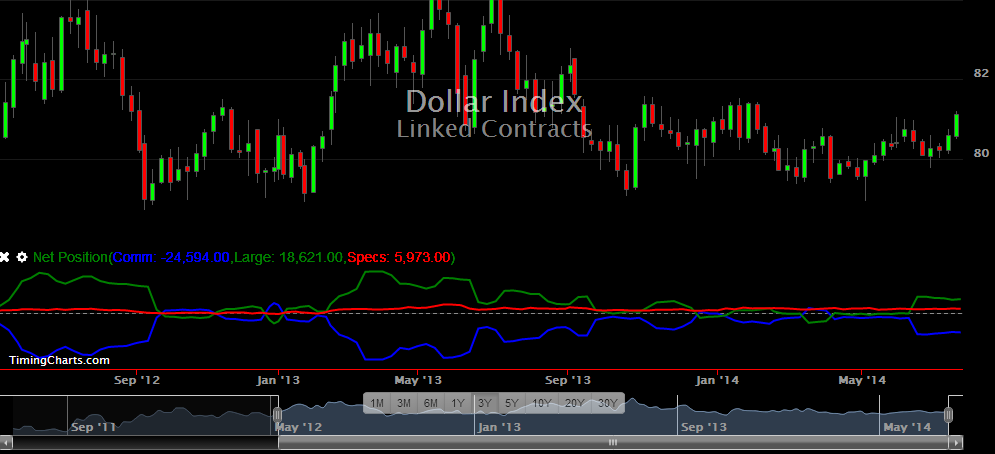
and there has been an increase in longs & shorts this week, so a general increase in interest in the DXY. That's like saying that the current trend on the DXY has received fuel this week to continue.
So now we can go and find out what might be behind the move. I've already touched on the sources I use for my research methods, and I've frequently touted the orderflowtrading.com newsfeed but if you don't want to go there, you don't have to!
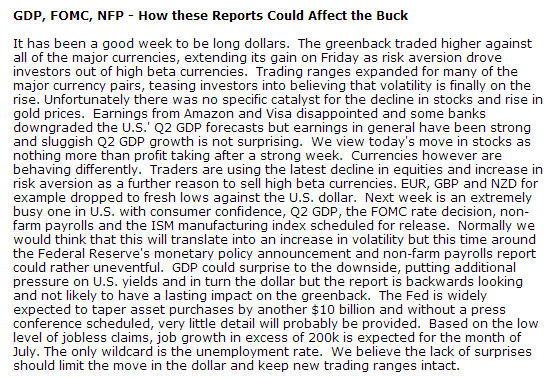
Kathy Lien does a good wrap up of the main events:
and ScotiaBank also gives out it's free research:
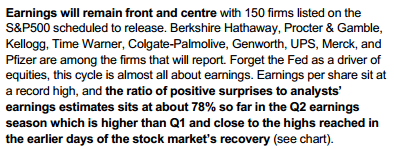
So basically even if last week we've had mixed headline data for the US, earnings & geopolitical unrest have had their say. Don't forget that the USD gets bid up in times of difficulty. US treasuries are still the "bunker" that money flows into when things get bad. It's not dire out there, don't get me wrong. Just that last week's events and the other facors drove up the greenback.
It's all a matter of filtering information. Find a few sources you like, scan them on a regular basis with some sort of method and that way you will derive your understanding of the current market sentiment playing out.

That is fine of you are trading one pair. If you trade a basket then you have to take into consideration correlation, diversification, portfolio heat etc....
Hey JC,
i don't have an answer to the question "which zones will hold"...because in trading we're dealing with odds (like in poker) and not certainties. So there will always be exceptions to any partcular rule you might attempt to create. So you don't need to "decide" anything before hand! Just let the market react and tell you where the higher odds are.
The way I work around this is twofold:
1. I try to make sure I'm looking to enter in line with the dominant flows (evidenced via higher highs/higher lows or lower highs/lower lows on my primary chart reference, which is usually the 4H chart.
2. I use the price action areas that are formed in line with the dominant trend to compound the position; i use price action areas formed against the dominant trend to manage the position (take some off the table, close everything, watch & wait, etc.).
3. Day-to-day I use headline news + chatter doing the rounds in the twitterverse (which has become a good substitute imo to some of the more professional news services if you know who to follow) to get a feel for what's doing the rounds. I'll also use the orderflow information (bids/offers/stops) as you've seen in the past posts, to help me.
Here's an example: my primary template on Crude, showing how las week we broke the lower high/lower low cycle on renewed Russian/Ukraine tensions (bad for Crude) and this week looking for pullback longs still makes sense as long as there are no new negative developments on the horizon.
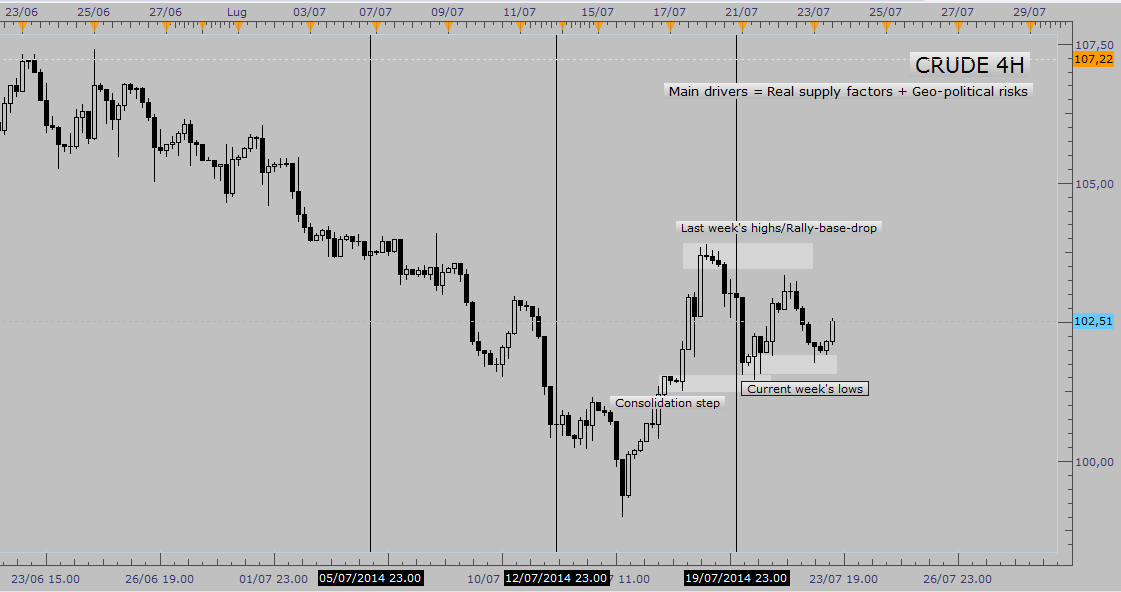
So a good place to look was the consolidation step from last week, which "should" be stronger than the conolidation step on the way down from friday (in yellow). And the consolidation area on the way up this week (yellow) held a little even though price had reached last week's rally-base-drop formation (which comes from a higher time frame and hence carries more weight).
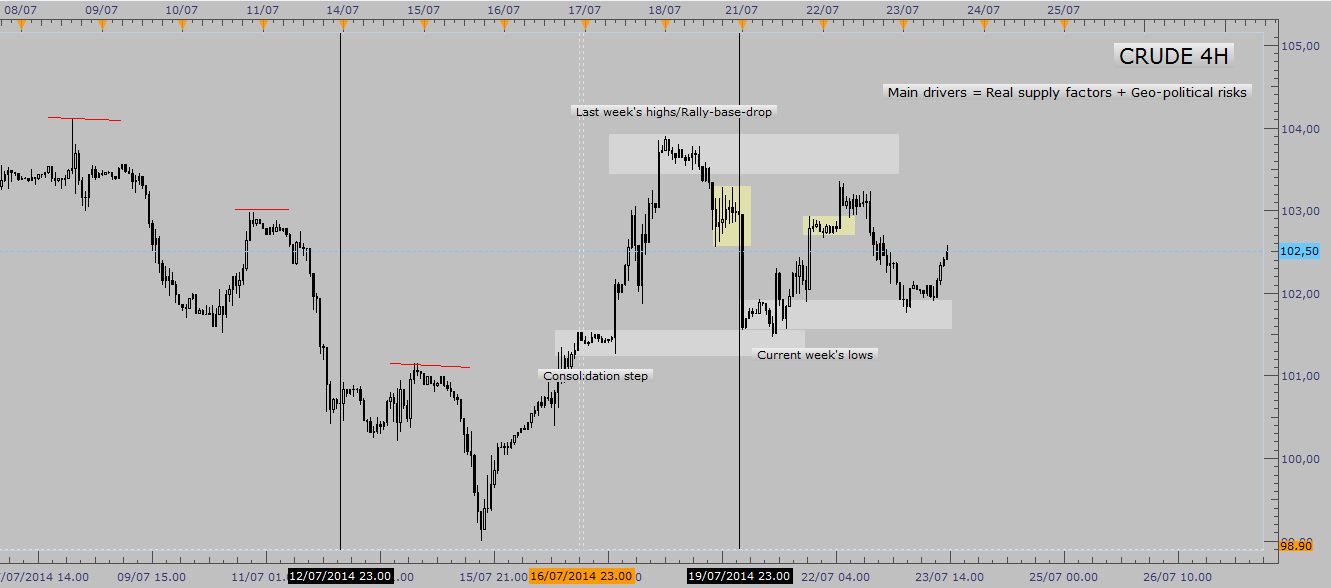
Price has reacted today off the current week's lows as expected...but it's becomming a little boring now...so more range-bound than trendy...and I like my odds more when there's a clear trending move.
Regarding confidence: you need to specialize. The most successful traders I've met are the ones that have developed a tight set of rules with which to engage the market. They know their angle, their edge. They know if they'll have a trade or if they won't. They are extremely disciplined and keep their stuff simple. The process goes more or less like this:
1. Rules for bias identification
2. Rules for sentiment identification
3. Rules for reactive level/zone identification
4. Rules for timing
5. Rules for trade management
And yes...even the best laid out plans fail...sometimes more than others. But as long as you are following a structure time & time again, you'll develop an expertise that noone can take away from you. At least, that's my experience!
That is fine of you are trading one pair. If you trade a basket then you have to take into consideration correlation, diversification, portfolio heat etc....
Well, one size doesn't fit all, when it comes to Trading...or finding your soul-mate!
The way I've learned to operate is to narrow down to 1-3 the pairs I'm trading during a single week. I try to stack the odds in my favour by searching for value wherever it may lie.
For example, the Euro is weak at the moment. But before taking a position, I want to establish whether the Euro is the flavor of the day/week or if something else is stealing the spotlight of late. What's the USD doing? How much weight does the Aussie or Jap have to throw around today? And what about the economic data and chatter on the wires ? Is it continuing to confirm one pairs dominance?
By running the ruler across the Gbp, the Euro, the Yen, the USD against their main trading partners, I can quickly determine if any particular currency is dominant or passive across the board or displaying a pattern of unique behavior. What we're trying to do is make sure that the weakness (for example) of the Euro is not an exception limited to EurUsd. Before selling the Euro, I'd prefer to see it weak across the board. Itâs then a case of matching the strongest vs. weakest to see if an opportunity exists.
So I usually start with the DXY: the dollar index will offer a snapshot of dollar strength vs. weakness. For example, if the USD is strong vs. the basket, we can then shift our focus to the currency which is displaying the weakest behavior patterns. If, as has recently happened, the Euro is the weakest looking pair vs. the dollar, then I'll go and see the Euro crosses to verify whether it's a widespread story of Euro weakness or just an exception vs. USD.
I'm are always hunting for value vs. risk. If the DXY is choppy or in a range, then it might be better to look outside the greenback for some action. We're basically looking regularly for trending candidates, without excluding anything.
By performing this exercize, it's tough to be trading multiple currencies at one time. Usually there are 1 to 3 candidates that emerge each week...sometimes there are none. So I really don't have to worry about diversification or portfolio heat. I spend my time finding the most evident/strongest trend to get into, and try to milk it until it turns. In this way, my risk might seem concentrated, but by filtering the candidates in a systematic way each time, and by using consistent entry tactics, I haven't run into too many obstacles.
Unless some major macro event is underway ( like Gulf war) CL trades within a tight range. Whether one looks at yearly, monthly,weekly or daily range.
CL tendency to be range bound provides some nice set ups for reversion to the mean type of traders. Seems like most of the years on this chart yearly range is $20 and some years $30.
Then there are 2007 and 2008 Gulf war years. Anyone who tried to short CL without understanding Gulf war effect on price of CL got taken out.
When war premium came out after CL hit high of $145 there was no looking back till all the buyers disappered who tried to catch a falling knife.
CL tendency to be range bound provides some nice set ups for reversion to the mean type of traders. Seems like most of the years on this chart yearly range is $20 and some years $30.
Then there are 2007 and 2008 Gulf war years. Anyone who tried to short CL without understanding Gulf war effect on price of CL got taken out.
When war premium came out after CL hit high of $145 there was no looking back till all the buyers disappered who tried to catch a falling knife.
Unless some major macro event is underway ( like Gulf war) CL trades within a tight range. Whether one looks at yearly, monthly,weekly or daily range.
I think that trend/range depends on the time frame you're looking at. I also believe in trading trends more than fading extremes. When a fade is no longer a real "fade" but a value ticket, there must be some really strong/evident level to play off of and I always think there's some confirmation necessary.
Regarding the trend/range debate on Crude, I just think that one man's range is another man's trend, depending on the primary time frame of choice. For example, on my primary template, you can see a move upwards, then some consolidation, then a clear downtrend... but these short term trends might not even show up on your radar!
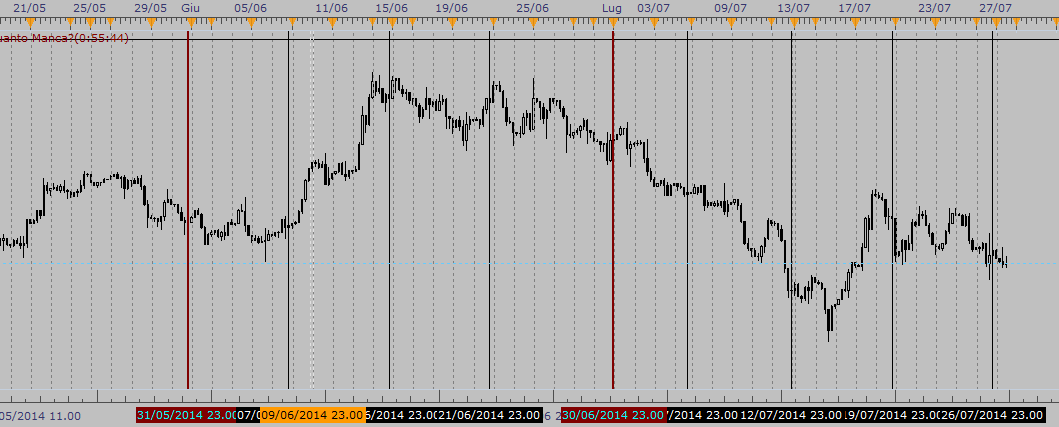
It depends on your objectives ;-)