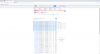
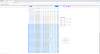
And: in this example just 1 option was used. In practice one can trade them only in lotsizes of 100 (= 1 contract). so one simply can multiply to the desired # of contracts, each contract consisting of 100 options...
This is... a confusing hash of words that can't even be fixed; it just needs to be thrown away. A standard options contract covers 100 shares of the underlying, so "a single option" implies control of 100 shares. Period.
The strategy you're proposing is synthetically equivalent to a 2-lot 15/185 strangle, and consists of 4 legs - i.e., 4 options. The prices on this graph are off by some random amount since we're outside RTH, but it shows the risk graph correctly.
As can be seen from the PL chart, the credit one earns is $30.49 per single option, ie. $3049 per contract, if things work out as expected in this strategy.
A loss happens only if the underlying stock rises more than about 245% to above spot $200 or so from current $57.85.
Doing a bit of actual trading, or at least reviewing what's happened to other highly-volatile stocks in real life, would probably be helpful to you. For example, when GME and AMC spiked a while ago, most brokers BPR on those trades went from ~20% of notional to 100% - and there were LOTS of margin calls as a result. So, no: that's not the only way that a loss can happen on this trade.
If the price
did spike by $200 tomorrow, your P&L would be at least $30k in the red, per lot. I say "at least" because this presumes an unchanged IV... a vain hope for that kind of volatility, so it's likely to be quite a bit higher. I assume you realize that max loss on this trade is
unlimited, right?
Beware: the "Implied Volatility" (IV) is available (or gets updated) only intraday; it updates only after the first x trades of the day, x >= 3 I guess. Initially it starts with 0. From my observation generally after the first regular market hour all IV's should be available...
Even if this was an actual concern, at 8k daily options trading volume in CRTX - low, but likely to be much higher given the current buzz about it - that would only take a few seconds, so there's nothing to "beware" of. Besides, there will be plenty of bids and offers stacked up even before the market opens.
I understand that all these things can look like problems when your only exposure to options is academic with no experience at all, but in practice, it all works quite smoothly. The folks at the exchanges have a little experience doing this; e.g., CBOE alone handles about 9.6 million trades per day.
(And to answer your initial question - at least the implied one - this trade does not look like a good idea at all.)