Options Arbitrage

Today I was thinking, If I bought a delta 1.0 Call, sold an OTM call.(bull debit vertical) At at the same buy a 1.0 delta Put, sold an OTM put, (put debit vertical), I end up with a risk free trade and collect the premium for both short contracts... I did the risk analysis in TOS and I'm seeing a horizontal line above zero, with a profit of 4.29.... or 10% in 10 days with this particular spread, "risk free"....

After doing some digging, I learned this is called a box spread. I also saw some info on reversals. Can any knowledgable traders share their insight with these strategies, and maybe what I am missing? This obviously sounds too good to be true. Really appreciate the responses.
 
Last edited:
Today I was thinking, If I bought a delta 1.0 Call, sold an OTM call.(bull debit vertical) At at the same buy a 1.0 delta Put, sold an OTM put, (put debit vertical), I end up with a risk free trade and collect the premium for both short contracts... I did the risk analysis in TOS and I'm seeing a horizontal line above zero, with a profit of 4.29.... or 10% in 10 days with this particular spread, "risk free"....

After doing some digging, I learned this is called a box spread. I also saw some info on reversals. Can any knowledgable traders share their insight with these strategies, and maybe what I am missing? This obviously sounds too good to be true. Really appreciate the responses.

Why do the lower strikes have to be the same? For instance, if stock XYZ is trading at 100, why can't I buy the 80 call, and sell the 105 call. Buy the 120 Put, and sell the 95 put? Im still showing a zero risk trade for some reason, but I would assume that if the stock blows past the short put for example, I would stop making money on the put, but keep losing money on the call until it was worthless. So in that sense it would not be risk free? Thanks!
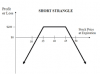
Assuming that long call & long put cancel each other out, you seem to be ending up with a short strangle.
 
Assuming that long call & long put cancel each other out, you seem to be ending up with a short strangle.
But a short strangle has unlimited loss potential if the stock moves past one of the short strikes, where as the box spread has no risk and the cost of the box just has to be less than the expiration value of the box.
 
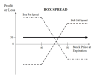
The short strangle has a risk graph with unlimited loss potential past each short strike, where as the box spread is a complete horizontal line above zero (if cost of box is less than expiration value of box)... Very intriguing. Does anyone know if theres any scanners that scan for arbitrage ?
 

Attachments

  • Unknown.png
    Unknown.png
    4.1 KB · Views: 20
  • long-box-options-strategy-chart.png
    long-box-options-strategy-chart.png
    9.2 KB · Views: 35
The short strangle has a risk graph with unlimited loss potential past each short strike, where as the box spread is a complete horizontal line above zero (if cost of box is less than expiration value of box)... Very intriguing. Does anyone know if theres any scanners that scan for arbitrage ?
I see no reason why it should not have the same risk profile as a short strangle.
 
I see no reason why it should not have the same risk profile as a short strangle.

Because, as the stock price moves past your short put strike, your making money on the long call and vise versa. Its a different risk profile.
 
Box spread means buying a bull call spread and equivalent bear put spread (or vice-versa), or doing synthetic short while at the same time going synthetic long. Therefore by default box spreads are 2 spreads that offset each other and cannot lose money and are locking the value they hold. With some exceptions.
I occasionally used box spreads strategy and currently hold a few of them only to earn basic interest at ~2%/year. I also lost a few $thousand on them while experimenting in the past.
Arbitrage opportunities are extremely rare and box spread would be too easy to just lay in the open. Currently box spread profit or loss occurs naturally only due to dividends and/or risk free rate (similar to fed interest rate) and/or short borrow/lending rates. Any profit beyond that is illusory and occurs due to bid/ask spreads, meaning that you won’t be able to buy or short the box at the price you may think you can.
In terms of dividends, you’ll lose money by calculating a profit on a box but your shares will be called away the day before dividend ex date (meaning you’ll end up with short shares on which you’ll owe dividends), or you should excercise them to not lose the dividend, as long as there is an intrinsic value in ITM part of your box.
On stocks that don’t have dividends, you can only earn risk free rate. Finally, on hard to borrow stocks, you’ll lose money in multiple ways, through assignment, through large bid/ask spreads, and through box value decreasing when the stock becomes harder to borrow. I’ll leave more details to practitioners who like to play with fire :)
 
Last edited:
Just to clarify, even when a stock pays dividends, max you can earn on a box is risk free rate of around 2%/year. The remaining profit will be lost due to the dividend, while you can lose more due to bid/ask spreads and overpaying for the box, as well as miscalculating box value.
 
Box spread means buying a call spread while selling equivalent put spread (or vice-versa), or doing synthetic short while at the same time going synthetic long. Therefore by default box spreads cannot lose money and are locking the value they hold. With some exceptions.
I occasionally used box spreads strategy and currently hold a few of them only to earn basic interest at ~2%/year. I also lost a few $thousand on them while experimenting in the past.
Arbitrage opportunities are extremely rare and box spread would be too easy to just lay in the open. Currently box spread profit or loss occurs naturally only due to dividends and/or risk free rate (similar to fed interest rate) and/or short borrow/lending rates. Any profit beyond that is illusory and occurs due to bid/ask spreads, meaning that you won’t be able to buy or short the box at the price you may think you can.
In terms of dividends, you’ll lose money by calculating a profit on a box but your shares will be called away the day before dividend ex date (meaning you’ll end up with short shares on which you’ll owe dividends), or you should excercise them to not lose the dividend, as long as there is an intrinsic value in ITM part of your box.
On stocks that don’t have dividends, you can only earn risk free rate. Finally, on hard to borrow stocks, you’ll lose money in multiple ways, through assignment, through large bid/ask spreads, and through box value decreasing when the stock becomes harder to borrow. I’ll leave more details to practitioners who like to play with fire :)
Thanks for the insight! I did do a little more digging on ET and realized people saying these arb opportunities are extremely rare and generally not realistic for retail traders, as they come and go very quickly, but the concept of is just so cool. So much good information on this forum!
 
Just to clarify, even when a stock pays dividends, max you can earn on a box is risk free rate of around 2%/year. The remaining profit will be lost due to the dividend, while you can lose more due to bid/ask spreads and overpaying for the box, as well as miscalculating box value.
So my initial thought process when I thought of the trade, without knowing what a box spread even was, was that I would be able to buy a put spread and call spread with the long positions deep ITM so there was little time value to lose, then have the short put and short call expire worthless and collect the premium for both, with no risk due to the delta neutral long call and put, but clearly it does not work like that. Also, my strikes were not the same, so although the risk profile looked horizontal, it must have not been perfectly horizontal. None the less, really cool stuff. If only there was something I could do with this new found knowledge XD
 
Back
Top