What is the calculation for the optimal % of account to risk on each position. I know everyone says stuff like the standard 1% ect. However, there must be a calculation based on your expectancy that gives you the optimal percentage. If you were right on 60% of you entries what would be the optimal % of the account to risk in order to avoid risk of ruin yet still generate the most amount of profit for the account.

You are using an out of date browser. It may not display this or other websites correctly.
You should upgrade or use an alternative browser.
You should upgrade or use an alternative browser.
Optimal Risk
- Thread starter tr222
- Start date


Optimal Risk would be the amount of $ or % that is worry free.

Could optimal account risks depend on what kind of returns the future will bring according to your trade plan?
Simple theoretical logic:
If the future provides great profit opportunities with 100% certainty, the most proftable bet is to not use stop loss at all, so as to not lose any of the profitable positions underway.
If the future provides bleak profit opportunities with 100% certainty, the most profitable bet is to abstain, or at least switch trade plan entirely.
Everything in between should be dictated by personal preference for risk, market opinion, trade plan and realistic execution.
What is optimal depends on your criterions for optimization and what the future will bring, eg. your perspective on the overall trend. IOW, your personal preference for overall risk vs reward and opinion on the market beyond what can be known in advance.
You mention expectancy, but this is only the historical returns, and future results are prone to change, especially if you start changing trading parameters. Optimize too aggressively based on historical returns at your financial peril, right up to the climax!
Kelly Criterion is based on the same, or on assumptions about expectancy, so same goes for that. Additionally Kelly Criterion seems to be about overall diversification in the portfolio allocation rather than individual position risk to account. I doubt many people really need that kind of real-time portfolio optimization for their retail trading. Number of positions in portfolio would then depend more on how many can you handle effectively.
CAPM and Efficient Frontier is predicting, and not really about position risk to account either.
In practice, risking 1-3% of account per instrument is comfortable trading. Beyond that, and you really ought to know what you're doing. There may be people using advanced formulas to find optimized position risk to account sizes, but wether they're really winning or losing might then also be more a product of luck and timing with large account risks. Then they'll never know until it's too late and meet their own personal Black Swan. Some advanced traders even go quite below 1% account risk, allowing for larger positions with the same account risk.
This is all a bit too theoretical.
Practically, you would want to simplify, and build from something working, rather than complicating and risking too much, which can be phsycologically and financially devastating.
So I'd conclude with what has been said many times before, this depends more on your personal preferences for risk and opinions about the market. Since the future is unknown, the real optimal settings are unknown until after the profit opportunities, and threats(!), have passed. In all the optimizing activity based on externals, don't forget yourself and your personal situation in the equation!
Rather than depending too much on unknowns and changing important trade parameters in real-time, many losses are due to simple trading mistakes. That's a kind of risk to really focus on. You'll have concrete facts available each and every time it happens. It'll be much more concrete and practical work. A little here and a little there do add up over time. Just mentioning this for those types who like complicated formulas and theoretical gains more than doing the practical necessary grunt-work.
Simple theoretical logic:
If the future provides great profit opportunities with 100% certainty, the most proftable bet is to not use stop loss at all, so as to not lose any of the profitable positions underway.
If the future provides bleak profit opportunities with 100% certainty, the most profitable bet is to abstain, or at least switch trade plan entirely.
Everything in between should be dictated by personal preference for risk, market opinion, trade plan and realistic execution.
What is optimal depends on your criterions for optimization and what the future will bring, eg. your perspective on the overall trend. IOW, your personal preference for overall risk vs reward and opinion on the market beyond what can be known in advance.
You mention expectancy, but this is only the historical returns, and future results are prone to change, especially if you start changing trading parameters. Optimize too aggressively based on historical returns at your financial peril, right up to the climax!
Kelly Criterion is based on the same, or on assumptions about expectancy, so same goes for that. Additionally Kelly Criterion seems to be about overall diversification in the portfolio allocation rather than individual position risk to account. I doubt many people really need that kind of real-time portfolio optimization for their retail trading. Number of positions in portfolio would then depend more on how many can you handle effectively.
CAPM and Efficient Frontier is predicting, and not really about position risk to account either.
In practice, risking 1-3% of account per instrument is comfortable trading. Beyond that, and you really ought to know what you're doing. There may be people using advanced formulas to find optimized position risk to account sizes, but wether they're really winning or losing might then also be more a product of luck and timing with large account risks. Then they'll never know until it's too late and meet their own personal Black Swan. Some advanced traders even go quite below 1% account risk, allowing for larger positions with the same account risk.
This is all a bit too theoretical.
Practically, you would want to simplify, and build from something working, rather than complicating and risking too much, which can be phsycologically and financially devastating.
So I'd conclude with what has been said many times before, this depends more on your personal preferences for risk and opinions about the market. Since the future is unknown, the real optimal settings are unknown until after the profit opportunities, and threats(!), have passed. In all the optimizing activity based on externals, don't forget yourself and your personal situation in the equation!
Rather than depending too much on unknowns and changing important trade parameters in real-time, many losses are due to simple trading mistakes. That's a kind of risk to really focus on. You'll have concrete facts available each and every time it happens. It'll be much more concrete and practical work. A little here and a little there do add up over time. Just mentioning this for those types who like complicated formulas and theoretical gains more than doing the practical necessary grunt-work.
Last edited:
For your p=60% the optimal bet fraction would be 20% of the acct value:What is the calculation for the optimal % of account to risk on each position. I know everyone says stuff like the standard 1% ect. However, there must be a calculation based on your expectancy that gives you the optimal percentage. If you were right on 60% of you entries what would be the optimal % of the account to risk in order to avoid risk of ruin yet still generate the most amount of profit for the account.
Code:
p should be 0.5 to 1 (ie. 50% to 100%), then:
  q = 1.0 - p;
  Optimal_f = 2.0 * p - 1.0;
  GrowthRate_for_f = log(1.0 + Optimal_f) * p + log(1.0 - Optimal_f) * q;
log() here means the natural logarithm function "ln".
[I think this is the so called "Fractional Kelly" formula]

For p = 50.00% the optimal bet fraction f = 0.00% of acct --> Acct GrowthRate r = 0.0000%
For p = 55.00% the optimal bet fraction f = 10.00% of acct --> Acct GrowthRate r = 0.5008%
For p = 60.00% the optimal bet fraction f = 20.00% of acct --> Acct GrowthRate r = 2.0136%
For p = 65.00% the optimal bet fraction f = 30.00% of acct --> Acct GrowthRate r = 4.5701%
For p = 70.00% the optimal bet fraction f = 40.00% of acct --> Acct GrowthRate r = 8.2283%
For p = 75.00% the optimal bet fraction f = 50.00% of acct --> Acct GrowthRate r = 13.0812%
For p = 80.00% the optimal bet fraction f = 60.00% of acct --> Acct GrowthRate r = 19.2745%
For p = 85.00% the optimal bet fraction f = 70.00% of acct --> Acct GrowthRate r = 27.0438%
For p = 90.00% the optimal bet fraction f = 80.00% of acct --> Acct GrowthRate r = 36.8064%
For p = 95.00% the optimal bet fraction f = 90.00% of acct --> Acct GrowthRate r = 49.4632%
Ie. do not put at risk more than 20% of your acct.
And: other formula and methods might suggest something different.
Last edited:

What is the calculation for the optimal % of account to risk on each position. I know everyone says stuff like the standard 1% ect. However, there must be a calculation based on your expectancy that gives you the optimal percentage.
Here is my current recommendation for a real-world trading fraction:
min[ 0.9/max[ .0001 , 2*max[ -Ri ]_i=1toN ] , ½*( new_Kelly_formula ) ]
new_Kelly_formula = max[ 0, s1 ]*( s2*s2 - s1*s3 )/(s2*s2*s2 + s1*s1*s4 - 2*s1*s2*s3) ,
where
S1 = sum[ Ri ]_i=1oN ,
S2 = sum[ Ri*Ri ]_i=1toN ,
S3 = sum[ Ri*Ri*Ri ]_i=1toN ,
S4 = sum[ Ri*Ri*Ri*Ri ]_i=1toN.
Last edited:

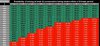
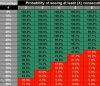
Risk per trade is dependent on a couple factors , trade success rate and R/R , the lower the trade success rate the higher the run of consecutive losses can be , to mitigate Drawdown on low success rate smaller trades as a % of account size are required ..
Ive actually decided to not contribute to ET in any meaningful way , this whole concept of a trollfest has put me right of this place TBH , deleted the following posts , leave the table as some might find it useful .... good luck to all , I got nothing to prove and refuse to jump through hoops of agitators
Ive actually decided to not contribute to ET in any meaningful way , this whole concept of a trollfest has put me right of this place TBH , deleted the following posts , leave the table as some might find it useful .... good luck to all , I got nothing to prove and refuse to jump through hoops of agitators
Attachments
Last edited: