
You are using an out of date browser. It may not display this or other websites correctly.
You should upgrade or use an alternative browser.
You should upgrade or use an alternative browser.
optimal point for profit taking
- Thread starter Baozi
- Start date

%%Stan Weinstein's 4 stages is good guide.
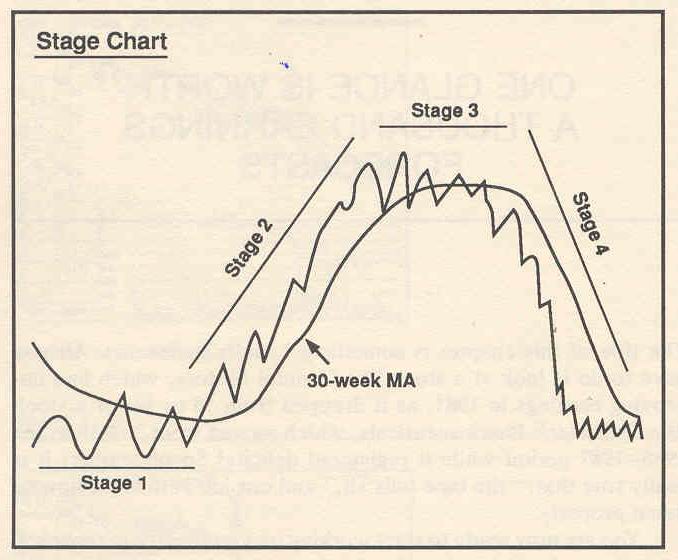
Brief description of each stage.
https://www.investopedia.com/articles/investing/070715/trading-stage-analysis.asp
In the real world, it's not so straight forward. There are frequent false moves.
Here is an example. This is Hong Kong stock.
View attachment 298208
In order to avoid these kind of traps, let it form a longer base.
1]Good book + good chart;
except/ 11 weeks up in a bear rally/ sure possible??Its possible. LOL
2]Unless you have some real oil drilling options, like Mr Hunt[oil + silver ];[ 3rd friday stuff has another strike against you so to speak.
3]Strike 3 is no dividends, but thats a minor point, unlike my first 2 major points.
Stage 2 + 3 on that chart can easy go up more\ so a chart is not a prediction
Great question,and I wrestle with the same issue all the time..
I used to look at Delta/Theta,while also valuing the fly structure on my chosen flat vol to see if I had "edge"..
Nowadays,I look at Orats D%,common sense and gut feel...
Like you,I look at max gain vs max risk.
On short dated flys,I typically start scaling out at 25% of max gain,and rarely have much left at 50 percent..
As you may guess,I don't pay much for these structures,and on split strike flys I am quick to buy the imbedded short verticals..
Fwiw,I'm sure Des can offers some valuable insight..
I used to look at Delta/Theta,while also valuing the fly structure on my chosen flat vol to see if I had "edge"..
Nowadays,I look at Orats D%,common sense and gut feel...
Like you,I look at max gain vs max risk.
On short dated flys,I typically start scaling out at 25% of max gain,and rarely have much left at 50 percent..
As you may guess,I don't pay much for these structures,and on split strike flys I am quick to buy the imbedded short verticals..
Fwiw,I'm sure Des can offers some valuable insight..
hello all,
So.. I am often playing with pseudo-fly structures which have the maximum payoff at a certain strike and lose at the wings. I usually have a defined profit target at 25% of the maximum payoff, which seems a reasonable rule of thumb.
It happened however many times that the structure immediately gained 15%~20%, then went back almost to zero, then after one month finally reached the target. Clearly, in hindsight, had I taken immediately 15% that would have been a much better allocation of my capital.
So at this point I'm wondering: anyone here came up with some useful heuristic that links elapsed time and profit target? Care to share?
hello all,
So.. I am often playing with pseudo-fly structures which have the maximum payoff at a certain strike and lose at the wings. I usually have a defined profit target at 25% of the maximum payoff, which seems a reasonable rule of thumb.
It happened however many times that the structure immediately gained 15%~20%, then went back almost to zero, then after one month finally reached the target. Clearly, in hindsight, had I taken immediately 15% that would have been a much better allocation of my capital.
So at this point I'm wondering: anyone here came up with some useful heuristic that links elapsed time and profit target? Care to share?
Last edited:

summing what your gamma/theta pnl should have been from inception to now. alternatively, how much of your pnl has come from vega/delta. If most of your pnl is vega/delta then you might want to cut. if it's inline with the gamma/theta then your thesis might still be intact.
makes sense and sounds simple in theory, but I fear that the actual calculation is going to be a pain

Great question,and I wrestle with the same issue all the time..
I used to look at Delta/Theta,while also valuing the fly structure on my chosen flat vol to see if I had "edge"..
Nowadays,I look at Orats D%,common sense and gut feel...
Like you,I look at max gain vs max risk.
On short dated flys,I typically start scaling out at 25% of max gain,and rarely have much left at 50 percent..
As you may guess,I don't pay much for these structures,and on split strike flys I am quick to buy the imbedded short verticals..
Fwiw,I'm sure Des can offers some valuable insight..
Oh I see.. thanks a lot for all the insight. When you say "split strike" you mean "skip strike"?
yes,skip a strike,and if I am feeling feisty and directional,I will buy the wing closer to the short strike as opposed to further away
Oh I see.. thanks a lot for all the insight. When you say "split strike" you mean "skip strike"?

hello all,
So.. I am often playing with pseudo-fly structures which have the maximum payoff at a certain strike and lose at the wings. I usually have a defined profit target at 25% of the maximum payoff, which seems a reasonable rule of thumb.
It happened however many times that the structure immediately gained 15%~20%, then went back almost to zero, then after one month finally reached the target. Clearly, in hindsight, had I taken immediately 15% that would have been a much better allocation of my capital.
So at this point I'm wondering: anyone here came up with some useful heuristic that links elapsed time and profit target? Care to share?
Cover at Soy's max pain. Ofc you'll have to befriend the dude/bot.
I don't trade a lot of classic flies now, but say you're long upside flies (long delta).
Vol-corr: Are you marking down vol at neutrality (Sticky S)?
In index you have to account for sticky D, but skews are essentially locally-flat so not an issue.
It may be an idea to reduce the position a bit if you're up 2X theta (less delta gains).
Vol-corr: Are you marking down vol at neutrality (Sticky S)?
In index you have to account for sticky D, but skews are essentially locally-flat so not an issue.
It may be an idea to reduce the position a bit if you're up 2X theta (less delta gains).
hello all,
So.. I am often playing with pseudo-fly structures which have the maximum payoff at a certain strike and lose at the wings. I usually have a defined profit target at 25% of the maximum payoff, which seems a reasonable rule of thumb.
Why 25%?
Why not more or less than 25%?
Is your expected profit 25% every time you open a trade?
Why 25%?
Why not more or less than 25%?
Is your expected profit 25% every time you open a trade?
haha well there is no profound reason.. I remember reading one of destriero's journals and he was aiming more or less for that level, so I just copied it. Intuitively, on a fly makes sense because getting to full payoff is possible only in theory..