Hello to all, i am new here and this is my first post. I am learning to do auto trading and have some active automatic strategies that i write. I don't use ready-made things, bot or similar.
So, like title, I'm curious to read your opinions about my simple volatility compression filter indicator. He's nothing special or complicated, but work good.
The Masters of trading teach that to identify a fairly important volatility compression we can take any volatility indicator, and calculate it on 2 values : one in a fast period and one in a slow period. When the value of the fast period reaches 50% of the slow period, yes, we have a very strong volatility compression. I have no doubt about it. This work very good.
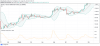
Since I'm curious, I asked myself if there wasn't a more "logical or simple" way to filter the volatility. Not that the comparison between an short and long value was not logical, but I asked myself: "it would not be much simpler and more logical to compare an volatility indicator, calculated on X bars, with its same average? " if I do it and divide the value of indicator by its average I get an oscillator whose values move above and below the value 1 :
When the oscillator is below the value 1 it simply means that the volatility is below its average, so we have volatility compression.
When the oscillator is above the value 1 it simply means that the volatility is above its average, so we have volatility expansion.
I test it on some (brekout) strategies, with various indicators but always i have got the best results with BBW. I calculate the BBW on 20 bars and compare it with its average, always at 20 bars. I enter at breakout of a major price level only if my oscillator value is below 1 or 0.9 or 0.8 ....
I am using it on live strategy and it work good.
I am sorry for my not perfect English, i hope you understand me, i also added a photo to show what I'm talking about.
So, like title, I'm curious to read your opinions about my simple volatility compression filter indicator. He's nothing special or complicated, but work good.
The Masters of trading teach that to identify a fairly important volatility compression we can take any volatility indicator, and calculate it on 2 values : one in a fast period and one in a slow period. When the value of the fast period reaches 50% of the slow period, yes, we have a very strong volatility compression. I have no doubt about it. This work very good.
Since I'm curious, I asked myself if there wasn't a more "logical or simple" way to filter the volatility. Not that the comparison between an short and long value was not logical, but I asked myself: "it would not be much simpler and more logical to compare an volatility indicator, calculated on X bars, with its same average? " if I do it and divide the value of indicator by its average I get an oscillator whose values move above and below the value 1 :
When the oscillator is below the value 1 it simply means that the volatility is below its average, so we have volatility compression.
When the oscillator is above the value 1 it simply means that the volatility is above its average, so we have volatility expansion.
I test it on some (brekout) strategies, with various indicators but always i have got the best results with BBW. I calculate the BBW on 20 bars and compare it with its average, always at 20 bars. I enter at breakout of a major price level only if my oscillator value is below 1 or 0.9 or 0.8 ....
I am using it on live strategy and it work good.
I am sorry for my not perfect English, i hope you understand me, i also added a photo to show what I'm talking about.
And You, what do you think about it ?
Nice trading to all.