On the Fed's ability to control unemployment, and other silly Ricter thoughts...

Quote from Tsing Tao:

I have a presentation to give in 6 min, but I will gladly come back and answer this with general commentary afterwards. Too many specifics are needed in order to answer it at the 5 foot level, but would love to chat with you on it. Be back in 30 or so.

Deal, I gotta run, so I will be looking for the commentary, I think you have something to offer on the macro side that might help all of us. I know very little about econ theory in detail.

So spell out how we could have avoided this reset. Who knows, this could be your "Book of Eli" moment. And, no, I am not joking.
 
Quote from RCG Trader:

Fair enuf, Tsing, fair enuf.

All jokes aside tho. If you got hired to save the world, what would you do?

Legit question. After the meltdown, if we survive it, someone after us will need to know. Because we will do this again as long as humans cannot recognize their common humanity.

So, how would you have fixed our system BEFORE it became terminal?

Ok, back. So as I mentioned, "how would you save the world" is a bit too general to answer in something so short as a forum post. But the first thing (which won't surprise you) that I would do is get rid of the Fed.

It's harmful. Interest rates can be set by a computer. We don't need a super bank who's interest is merely to prop up zombie and criminal institutions who are speculating in markets at the expense of the public.

Which brings me to point #2, bring back Glass-Stegall. Make it illegal for banks to be anything other than banks. Get them out of the business of trading.

Then, prosecute and put people in jail, throw away the key of executives who knowingly engage in fraudulent activity. CEOs and company execs who cause catastrophic losses to their company through negligence need to have bonuses clawed back, and never work in their industries again. No federal bailouts moving losses to the taxpayer side of the equation, ever. A company goes bad, it gets to go through the bankruptcy proceedings set to handle companies going bad. No more picking and choosing who wins and who loses. The company that wins is the company that runs itself profitably within the scope of the law.

Refine regulatory oversight. It's worthless, and in many cases complicit in illegal/immoral activities. Get rid of the nest of vipers completely. Replace it with IRS type personalities - lower paid individuals that have no ties to government and politics. Make executives on Wall Street fear when they come to audit.

Get rid of lobbying and any interference whatsoever from the private sector and washington. A politician who takes a donation or a payment from any corporation goes to jail. The company that makes the payment gets fined outrageously.

Politicians are arrested for insider trading. Politicians are forced to have term limits, and get paid almost nothing, have all their expenses paid for them (housing, medical, etc) and their family, but once done with their term return to the private sector world without life pensions. If you want to keep medical benefits, i'm ok with that. But make it like Jury Duty or being called up by the National Guard. If you get called to political service, you go serve and your job is kept for you wherever you work so you can return when done.

This is just to start.

 
Quote from Tsing Tao:

Funny that this article came out today after I launched my latest salvo of (unanswered) questions to Ricter in his Protecting the rentier class thread. That thread is a fun read, but don't expect much two way conversation there.

Again, I challenge Ricter, or any other Keynesian acolyte (follower of Krugman) who believes that the Fed can can control unemployment, to prove how this is possible. I offer and open debate, fair and free (mostly) of insults :) All you have to do is show up and agree to answer questions as well as pose them in return. But if you're going to hide and dodge, don't bother wasting my time.
http://www.oftwominds.com/blogjuly12/Fed-tools7-12.html
Charles Hugh Smith (Of Two Minds)

Fed Has No Hammer, Uses Handsaw and Chisel to Pound Nails
(July 12, 2012)


The next time the Fed unleashes quantitative easing, maybe we'll finally wake up to the fact the Fed is not just powerless, it is actively destructive.

The Fed is promising once again to pound nails with the only tools in its toolbox, a saw and a chisel. The "nails" the Fed is trying to pound down are unemployment and deflation. Needless to say, whacking these big nails with a handsaw and a chisel is completely useless: they can't get the job done.

The Fed claims all sorts of supernatural powers to sink nails at will--"unconventional monetary policy," quantitative easing, money dropped from helicopters and so on. But all it really has are two tools which have no positive effect on unemployment or the real economy.

1. The Fed can manipulate interest rates to near-zero

2. The Fed can shove "free money" to the banks

That's it. That's all the tools the Fed has in its toolbox. Let's consider what these tools accomplish in the real world.

Zero interest rates do not cause potential employers to hire unemployed people. Zero interest rates incentivize financial speculation (yield-chasing via trading risk assets) and malinvestment in projects that would be marginal if rates were normalized.

If capital cost 10% to borrow, only high-quality, low-risk ventures would attract funding or qualify for a loan. At 1% interest, the borrowing costs are so low that all sorts of high-risk, marginal schemes can afford to float loans.

Low interest rates also lead to money flowing to marginal borrowers. If rates were 10%, only those with good credit, credible income streams and collateral qualify for loans. At 1%, marginal borrowers (the kind who are most likely to default) qualify for loans.

All the Fed accomplishes with zero-interest rates is to build up a new wave of borrowers who will default. The Fed's policy simply adds to the mountain of impaired debt that is crushing the global economy.

The Fed's zero-interest rate policy (ZIRP) has impoverished savers and pension funds and provided disincentives to capital formation. In its anxious rush to lower the cost of borrowing, the Fed has stripped hundreds of billions of dollars of interest income out of the economy, and punished those who accumulate capital (cash savings) that is the bedrock of capitalism (a meaningless myth now that the Fed and Federal government are central-managing the economy).

Talk about unintended consequences. The Fed's ZIRP punishes the prudent and rewards financier gamblers and encourages marginal borrowers who are tomorrow's defaulters.

Pushing "free money" to the banks was supposed to do three things: It was supposed to enable the banks to lend lots of money at a premium and skim enormous profits that could be used to rebuild their ravaged balance sheets.

It was also supposed to spur consumption and investment, because money was so "cheap" how could you refuse to borrow more?

Lastly, it was supposed to enable homeowners to refinance their underwater mortgages at lower rates, creating disposable income that the homeowners would then spend on Chinese-made TVs, clothing, etc., creating "growth."

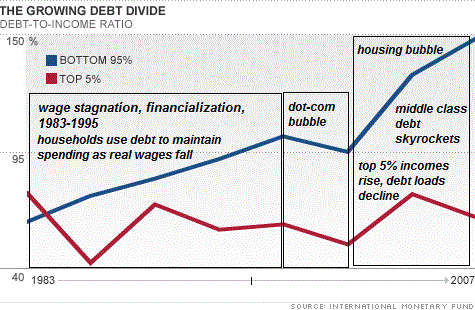
As Mish Shedlock often points out, you can't force people to borrow money, and offering marginal borrowers more debt does not make them magically creditworthy. The truth is that 95% of American households have taken on ever-rising debt loads while their adjusted incomes have been flatlined for decades.

debt-divide2.gif


The Fed's "solution" to over-indebtedness and excessive leverage is more debt and more leverage. Financial media lackeys and assorted analyst-toadies keep proclaiming that "households have deleveraged" and are now ready, willing and able to take on a couple trillion dollars more of debt to buy stuff, but this is the usual propaganda of cherry-picking data to fit the happy story being "sold."

The top 5% have improved their debt-income ratios, but the lower 95% don't qualify for new loans or refinancing. Now that the banks are weighed down with bad debt and writedowns, they are wary of loaning more to marginal borrowers.

So the Fed's "free money" that it shoved to the banks sits in reserves. It's dead money. It isn't funding wonderful new enterprises that are hiring millions of unemployed workers, it's sitting as reserves, bolstering balance sheets, or it's funding trading-desk speculations in the foreign exchange, stock and bond markets.

Maybe trading desks added a few traders to play with the Fed's "free money," but that's like hitting the unemployment nail with a handsaw blade: it doesn't do anything in the real economy or the labor market.

Fed Chairman Ben Bernanke's famous "helicopter" from which he drops money into the economy is a misnomer. He can't drop money into the real economy; all he can do is drop it into the banks, where it languishes as reserves or is used to fuel speculative bets in global markets.

The Fed is powerless, as its tools have no effect in the real world. It can fuel "risk on" market rallies with its trillions in "free money," but it can't lower unemployment or accomplish anything in the real economy except rob savers and pension funds of hundreds of billions of dollars each and every year.

It's actually, pathetic, isn't it? Ben and the rest of the impotent board are uselessly banging away at nails with their handsaws and chisels, while claiming to be financial wizards with unlimited powers. The next time the Fed unleashes quantitative easing, maybe the citizenry will wake up to the fact the Fed's only power--to steal from savers in order to benefit insolvent parasitic banks--is actively destructive.

I'd be happy if they decided I was a bank , but I guess that game is only for political crony's.
 
Quote from Tsing Tao:

...pointing out the Keynesian flaw is great fun to me because it's so hilariously simple. Hell, even my admin is outside sometimes going "what are you laughing at?"...
Before you can properly laugh at something, you first need to understand it. Good luck with that.
 
Quote from Brass:

Before you can properly laugh at something, you first need to understand it. Good luck with that.

Be careful he'll copy and paste an article showing he understands.
 
Quote from bigarrow:

Be careful he'll copy and paste an article showing he understands.

Neither of you two imbeciles has even addressed ONE point in the entire article. Per usual, just a bunch of ankle biting...
 
Quote from denner:

Neither of you two imbeciles has even addressed ONE point in the entire article. Per usual, just a bunch of ankle biting...

It's a poorly written article. Have twinkle Tao copy and paste a better written article that expresses his thoughts.
 
Quote from bigarrow:

It's a poorly written article. Have twinkle Tao copy and paste a better written article that expresses his thoughts.

Why dont you regale us all with your thoughts on how the economy works?
 
Quote from denner:

Neither of you two imbeciles has even addressed ONE point in the entire article. Per usual, just a bunch of ankle biting...


+1

Its funny cause both of them simply say everyone else is an idiot, yet neither one will ever engage in any kind of debate on economics.... Tsing Tao and many others have posted our views, yet their only response is "you dont know what your talking about."

I think that both Brass and Bigarrow realize they are in over their heads.....
 
Quote from denner:

Neither of you two imbeciles has even addressed ONE point in the entire article. Per usual, just a bunch of ankle biting...

Would the proper way to address twilight Tao views as expressed in the article be to copy and paste another article?
 
Back
Top