ObamaCare Comes Up 24 Million Enrollees Short

Goalposts Moved Again, As ObamaCare Comes Up 24 Million Enrollees Short
Obamacare-signup-Getty-640x480.jpg


by John Hayward29 Mar 201655

After surveying the latest Congressional Budget Office numbers, Jeffrey Anderson of the Weekly Standard restates what should be obvious to everyone by now: “ObamaCare is basically an expensive Medicaid expansion coupled with 2,400 pages of liberty-sapping mandates.”
So great is the failure of this insanely expensive, Constitution-shredding boondoggle that ObamaCare’s dwindling band of defenders has to cook the books with flamethrowers to conceal how badly it flopped:

Three years ago, on the eve of Obamacare’s implementation, the Congressional Budget Office (CBO) projected that President Obama’s centerpiece legislation would result in an average of 201 million people having private health insurance in any given month of 2016. Now that 2016 is here, the CBO says that just 177 million people, on average, will have private health insurance in any given month of this year—a shortfall of 24 million people.

Indeed, based on the CBO’s own numbers, it seems possible that Obamacare has actually reduced the number of people with private health insurance. In 2013, the CBO projected that, without Obamacare, 186 million people would be covered by private health insurance in 2016—160 million on employer-based plans, 26 million on individually purchased plans. The CBO now says that, with Obamacare, 177 million people will be covered by private health insurance in 2016—155 million on employer-based plans, 12 million on plans bought through Obamacare’s government-run exchanges, and 9 million on other individually purchased plans (plus a rounding error of 1 million).

In other words, it would appear that a net 9 million people have lost their private health plans, thanks to Obamacare—with a net 5 million people having lost employer-based plans and a net 4 million people having lost individually purchased plans.

None of this is to say that fewer people have “coverage” under Obamacare—it’s just not private coverage. In 2013, the CBO projected that 34 million people would be on Medicaid or CHIP (the Children’s Health Insurance Program) in 2016. The CBO now says that 68 million people will be on Medicaid or CHIP in 2016—double its earlier estimate. It turns out that Obamacare is pretty much a giant Medicaid expansion.

How can anyone paper over a disaster of this magnitude? Easy – just magically rewrite the projections for the imaginary world in which ObamaCare didn’t pass, then claim – without any substantiation whatsoever – that the number of people in that ObamaCare-free Earth-2 who have private insurance would be 20 million less than CBO projected in 2013, and they’d all be on Medicaid instead.

When the projections that were used to sell a massive government program are retroactively revised to make it look better, We the People can rest assured we are being ripped off. That’s doubly true when the end result of the process is something America would have rebelled against, before they were “socially engineered” at their own expense.

American taxpayers were charged a staggering amount of money – and have lost countless man-hours grappling with ObamaCare’s crashtastic website and gruesome bureaucracy – to get a stealth Medicaid expansion they never would have agreed to, if it had been presented to them honestly, beginning with the 2008 presidential election. A lot of people lost insurance plans they love, for no better reason than Democrats’ lust for power, and their institutional refusal to be honest about their socialist plans.

Of course, the same media that peddled Obama’s phony statistics, phony doctors, and false promises to create the illusion of devastating health care crisis has absolutely zero interest in turning the spotlight on ObamaCare’s many, many victims.

Socialism cannot muster even the faintest pretense of compassion for its victims. Those who have been hosed by the “Affordable” Care Act are non-persons, expected to suffer in silence, their complaints as invalid and immoral as a billionaire who objects to a tax increase. Their complaints don’t even matter when it’s obvious they were made to suffer for no good reason at all.

The people who inflicted ObamaCare on America don’t consider a hideously overpriced stealth Medicaid exemption to be “failure.” Single-payer health care has been their not-so-secret agenda all along.

Pushing a huge number of Americans out of private insurance, and into Medicaid, is a major step toward that goal. (As Anderson points out, the nature of ObamaCare’s subsidies, which are paid directly to insurers, also drags the American public closer to a “single-payer” mindset.)

Doctor’s offices grow ever more distant from the free market. In a few more years, when people have started to forget the high quality and lower prices of insurance before ObamaCare came along, it will be time to take the next step. Resistance will be far more difficult when a growing percentage of the populace already thinks of health care as a “free” benefit provided by their benevolent rulers.
 
thanks for the article. I fear it's going to be swept under the rug and will exist forever as another failed government policy we can't do anything about.
 
Where are the Republicans on this?

Why are the democrats and liberals not pushing for single payer to replace this crap?
 
Where are the Republicans on this?

Why are the democrats and liberals not pushing for single payer to replace this crap?
like the lady said, we don't need another contentious debate.
That's why I fear it will just be swept under the rug and forgotten like so many other well meaning regulations we are all still paying for.
 
Obama and Justice Roberts shall go down as bigger losers than the tax payers if this thing does not get dismantled.
 
6 Years After Obamacare’s Passage, Haters Refuse to Accept Reality
By Jonathan Chait
March 29, 2016 7:00 a.m.

"During the Obama era, the keenest minds in the conservative movement have had to develop policy responses to the administration’s agenda. But those policies had to be crafted within bounds established by Republican politics — conservative ideas were useful only insofar as conservative politicians could plausibly advocate them. Republican politicians, in turn, had to operate within the bounds of what their voters considered acceptable. And Republican voters, as the 2016 election cycle has made abundantly clear to even those long committed to denying it, are bat-shit crazy.

"That frothing quality burst forth in its fullest form during the debate over health-care reform, in the summer of 2009. Angry Republicans flooded town hall meetings to denounce a law that they saw as redistributing resources from people like themselves to people who were not, identifying sources of grievance both real (cuts to Medicare) and imagined (death panels). The Republican Party’s stance on health-care reform took shape during those days of rage, and even six years after the law’s passage, its position on Obamacare has remained unaltered. The law is a failure and must be repealed, and no evidence can convince conservatives otherwise. A half-dozen years after its passage, none have dared revise that stance.

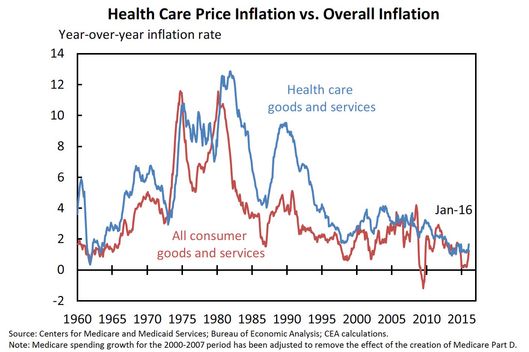
"One of Obamacare’s goals, beyond expanding access to health insurance and paying for its budgetary costs, was to “bend the curve” of health-care inflation, which has historically grown faster than the cost of other things. The law implemented a wide array of reforms designed to bring more cost-consciousness into the system. Indeed, health-care inflation has not only slowed, it has dropped to the lowest level since the government began measuring it:

28-obamacare-chart1.w529.h352.jpg


"Some aspects of the lower health-care-inflation rate can be clearly tied to Obamacare reforms. For instance, the old Medicare system gave hospitals little incentive to keep their patients healthy once admitted. Just the opposite: A patient who acquired an illness in the hospital, or had to be readmitted, would receive more treatment, making more money for the hospital. Obamacare changed its reimbursements to penalize hospitals with high readmission rates. And sure enough, medical errors in hospitals are down, as are patient readmission rates:

28-obamacare-chart3.w529.h352.jpg


"Other reforms have worked through the medical economy in ways that are harder to measure as precisely. It’s impossible to know just what proportion of credit the law deserves for the lower inflation rate, some of which might have occurred anyway. (Or it might not — it can’t be proven.)

"Among conservatives, though, it remains an unchallengeable certainty that Obamacare has failed. What about the historically low medical inflation? Ramesh Ponnuru, a leading conservative intellectual, expresses his certainty that the entire trend would have happened without any of the law’s cost reforms. According to Ponnuru, health-care inflation was already falling before Obamacare’s enactment:

"The administration argues that the law has contributed to a slowdown in the growth of health spending. But that slowdown started in 2002. Obamacare can’t be the cause. The best that can be said about the law's effect on health spending is that its early years haven't interrupted that slowdown.

"This data point is the state of the art in gainsaying Obamacare’s success. Here is what Ponnuru is referring to. During the middle of the last decade, health-care inflation had a mini-spike, which had already begun to recede by the time Obamacare was signed into law. But this doesn’t mean that health-care inflation was on an inexorably falling trajectory. It simply means that the unusually elevated levels of health-care inflation that took place during the Bush administration’s second term had given way to historically normal health-care inflation rates that were still unsustainably high. What has occurred since 2010 is not more of the same. It is a rate of health-care inflation far lower:

28-obamacare-chart2.w529.h352.jpg


"I followed the health-care debate extremely closely. In 2010, I was not aware of any influential analysts who predicted that health-care inflation was poised to drop to historically low rates on its own. Not only was that view unheard-of at the time, there was a deep skepticism that Obamacare could do much if anything to ameliorate it. Indeed, conservatives were unanimous in their belief that Obamacare would not only fail to bring down health-care inflation, it would cause health-care inflation to skyrocket. Ponnuru predicted that Obamacare would “exacerbate” health-care inflation:

"The trouble is that the cost explosion is in the first place largely a function of the way the government has used its power as a provider and regulator of health insurance. The open-ended structure of Medicare and of the employer-based-insurance tax exclusion, together with the way Medicaid costs are shared by states and the federal government, have created huge incentives to spend more on health care, and therefore pushed costs upward. Obamacare would double down on an approach to limiting Medicare costs that has failed for decades, would massively expand Medicaid without reforming it, and would largely keep in place the tax exclusion while adding a new entitlement on top of it. It would exacerbate the causes of the cost problem while moving us further away from a real market in health insurance.

"This was a testable hypothesis. If health-care costs rose at a higher rate than they had before 2010, conservative critics of the law would have reason to claim vindication. Indeed, they seized on every preliminary scrap of data that seemed to indicate higher health-care costs. National Review (where Ponnuru works as a senior editor) editorialized, beginning in 2010, that Obamacare was already causing health-care inflation to rise:

"Health-insurance rates already are rising even more quickly than they had been in the past because of concern about the costs that will be imposed by Obamacare … These consequences were unintended, but they were not unpredictable: They were, in fact, predicted by a very large number of critics, not least those writing for National Review.

"Conservatives have gone from absolute ideological certainty that health-care inflation would rise in the wake of Obamacare to absolute ideological certainty that the drop in health-care inflation has nothing at all to do with Obamacare. It’s obvious that no conceivable data can falsify conservative opposition to Obamacare. The premise that Obamacare has failed is a matter of doctrinal writ, as holy as the sanctity of the great Ronald Reagan. To abandon this position is to abandon conservatism itself. Conservatives can try to redirect their base’s rage toward the construction of an alternative plan to replace Obamacare, but they cannot concede that the law has actually succeeded in advancing its stated goals. Republicans hate Obamacare not for its concrete outcomes but for what it represents to them. If Trump’s campaign has demonstrated anything, it is the hopelessness of crafting technocratic justifications for the pulsating right-wing Id."

More >>
 

Ah, the game of picking your own statistics. Spending by payer not inclusive of deductible...as even the NYT will tell you...Of course it looks better if you remove that!

Many Say High Deductibles Make Their Health Law Insurance All but Useless
By ROBERT PEARNOV. 14, 2015


WASHINGTON — Obama administration officials, urging people to sign up for health insurance under the Affordable Care Act, have trumpeted the low premiums available on the law’s new marketplaces.

But for many consumers, the sticker shock is coming not on the front end, when they purchase the plans, but on the back end when they get sick: sky-high deductibles that are leaving some newly insured feeling nearly as vulnerable as they were before they had coverage.

“The deductible, $3,000 a year, makes it impossible to actually go to the doctor,” said David R. Reines, 60, of Jefferson Township, N.J., a former hardware salesman with chronic knee pain. “We have insurance, but can’t afford to use it.”

In many states, more than half the plans offered for sale through HealthCare.gov, the federal online marketplace, have a deductible of $3,000 or more, a New York Times review has found. Those deductibles are causing concern among Democrats — and some Republican detractors of the health law, who once pushed high-deductible health plans in the belief that consumers would be more cost-conscious if they had more of a financial stake or skin in the game.

“We could not afford the deductible,” said Kevin Fanning, 59, who lives in North Texas, near Wichita Falls. “Basically I was paying for insurance I could not afford to use.”

He dropped his policy.

As the health care law enters its third annual open enrollment period, premiums and subsidies have been one of the administration’s main selling points.

“Most Americans will find an option that costs less than $75 a month,” President Obama said.

Sylvia Mathews Burwell, the secretary of health and human services, issued a report analyzing premiums in the 38 states that use HealthCare.gov. “Eight out of 10 returning consumers will be able to buy a plan with premiums less than $100 a month after tax credits,” she said.

But in interviews, a number of consumers made it clear that premiums were only one side of the affordability equation.

“Our deductible is so high, we practically pay for all of our medical expenses out of pocket,” said Wendy Kaplan, 50, of Evanston, Ill. “So our policy is really there for emergencies only, and basic wellness appointments.”

Her family of four pays premiums of $1,200 a month for coverage with an annual deductible of $12,700.

In Miami, the median deductible, according to HealthCare.gov, is $5,000. (Half of the plans are above the median, and half below it.) In Jackson, Miss., the comparable figure is $5,500. In Chicago, the median deductible is $3,400. In Phoenix, it is $4,000; in Houston and Des Moines, $3,000.

Ms. Burwell said the administration had “seen high levels of satisfaction with the marketplace.”

And the marketplaces do vary. In Newark, some plans have no deductible, although the median deductible is $2,000, according to HealthCare.gov.

Health officials and insurance counselors cite several mitigating factors. All plans must cover preventive services like mammograms and colonoscopies without a deductible or co-payment. Some plans may help pay for some items, like generic drugs or visits to a primary care doctor, before patients have met the deductible. Under the Affordable Care Act, health plans must have an overall limit on out-of-pocket costs, to protect people with serious illness against financial ruin.

In addition, people with particularly low incomes can obtain discounts known as cost-sharing reductions, which lower their deductibles and other out-of-pocket costs if they choose midlevel silver plans. Consumer advocates say this assistance makes insurance a good bargain for people with annual incomes from 100 percent to 250 percent of the poverty level ($11,770 to $29,425 for an individual).

To those worried about high out-of-pocket costs, Dave Chandra, a policy analyst at the liberal-leaning Center on Budget and Policy Priorities, has some advice: “Everyone should come back to the marketplace and shop. You may get a better deal.”

But for many consumers, the frustration is real, as is the financial strain. In employer-sponsored health plans, deductibles have also been rising as companies shift costs to workers. Still, the average annual deductible in employer plans, $1,320 for individual coverage according to the Kaiser Family Foundation, is considerably less than the deductibles in many marketplace plans.

The Internal Revenue Service defines a high-deductible health plan as one with an annual deductible of at least $1,300 for individual coverage or $2,600 for family coverage.

Sara Rosenbaum, a professor of health law and policy at George Washington University who supports the health law, said the rising deductibles were part of a trend that she described as the “degradation of health insurance.”

Insurers, she said, “designed plans with a hefty use of deductibles and cost-sharing in order to hold down premiums” for low- and moderate-income consumers shopping in the public marketplaces.

But the deductibles are so high they may be scaring away some consumers.

Alexis C. Phillips, 29, of Houston, is the kind of consumer federal officials would like to enroll this fall. But after reviewing the available plans, she said, she concluded: “The deductibles are ridiculously high. I will never be able to go over the deductible unless something catastrophic happened to me. I’m better off not purchasing that insurance and saving the money in case something bad happens.”

People who go without insurance next year may be subject to a penalty of $695 or about 2.5 percent of their household income, whichever is greater.

Karin Rosner, a 45-year-old commercial freelance writer who lives in the Bronx, pays about $300 a month, after a subsidy, for a silver insurance plan with a $1,750 deductible and a limit of $4,000 a year on out-of-pocket expenses.

She is extremely nearsighted and has an eye condition that puts her at risk for a detached retina, but has put off visits to a retina specialist because, she said, she would have to pay the entire cost out of pocket.

“While my premiums are affordable, the out-of-pocket expenses required to meet the deductible are not,” said Ms. Rosner, who makes about $30,000 a year.

Mr. Fanning, the North Texan, said he and his wife had a policy with a monthly premium of about $500 and an annual deductible of about $10,000 after taking account of financial assistance. Their income is about $32,000 a year.

The Fannings dropped the policy in July after he had a one-night hospital stay and she had tests for kidney problems, and the bills started to roll in.

Josie Gibb of Albuquerque pays about $400 a month in premiums, after subsidies, for a silver-level insurance plan with a deductible of $6,000. “The deductible,” she said, “is so high that I have to pay for everything all year — visits with a gynecologist, a dermatologist, all blood work, all tests. It’s really just a catastrophic policy.”

Another consumer, Anne Cornwell of Chattanooga, Tenn., said she was excited when Congress passed the Affordable Care Act because she had been uninsured for several years. She is glad that she and her husband now have insurance, because he has had tonsil cancer, heart problems and kidney stones this year.

But with a $10,000 deductible, it has still not been easy.

“When they said affordable, I thought they really meant affordable,” she said.
 
Last edited:
The way I view deductibles is: save money to pay for it. That is the responsible, conservative thing to do. Besides, back when these folks had no insurance they needed to... wait for it... save money for their healthcare or go without.
 
Back
Top