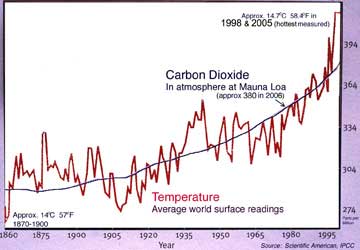
Even your blog post corroborates the data. The poster just wants to call it an anomaly when, indeed, the warming spike could be the anomaly. Obviously, the stable period has gone on longer than the model allowed for which invalidates the warming model. Again, investigate before you post.Quote from exGOPer:
DailyMail, CNSNews ..you don't get facts in the way of a good circlejerk!
"Firstly, the Met Office has not issued a report on this issue. We can only assume the article is referring to the completion of work to update the HadCRUT4 global temperature dataset compiled by ourselves and the University of East Anglia's Climate Research Unit.
We announced that this work was going on in March and it was finished this week. You can see the HadCRUT4 website here."
http://metofficenews.wordpress.com/2012/10/14/met-office-in-the-media-14-october-2012/
...tell me what this says about the models used by the IPCC and others which have predicted a rise of 0.2 degrees celsius per decade for the 21st century. I accept that there will always be periods when a rising gradient may be interrupted. But this flat period has now gone on for about the same time as the 1980 â 1996 warming.â
The models exhibit large variations in the rate of warming from year to year and over a decade, owing to climate variations such as ENSO, the Atlantic Multi-Decadal Oscillation and Pacific Decadal Oscillation. So in that sense, such a period is not unexpected. It is not uncommon in the simulations for these periods to last up to 15 years, but longer periods are unlikely.