more CO2 and Zero warming - statistically speaking - means your models failed.
the IPCC vice chair said so.
agw nutter scientists hans van storch admitted only 2 percent of his runs came out with no warming... which means in the world of modeling the models failed.
from the respected MIT professor...
http://www.drroyspencer.com/2014/02/95-of-climate-models-agree-the-observations-must-be-wrong/
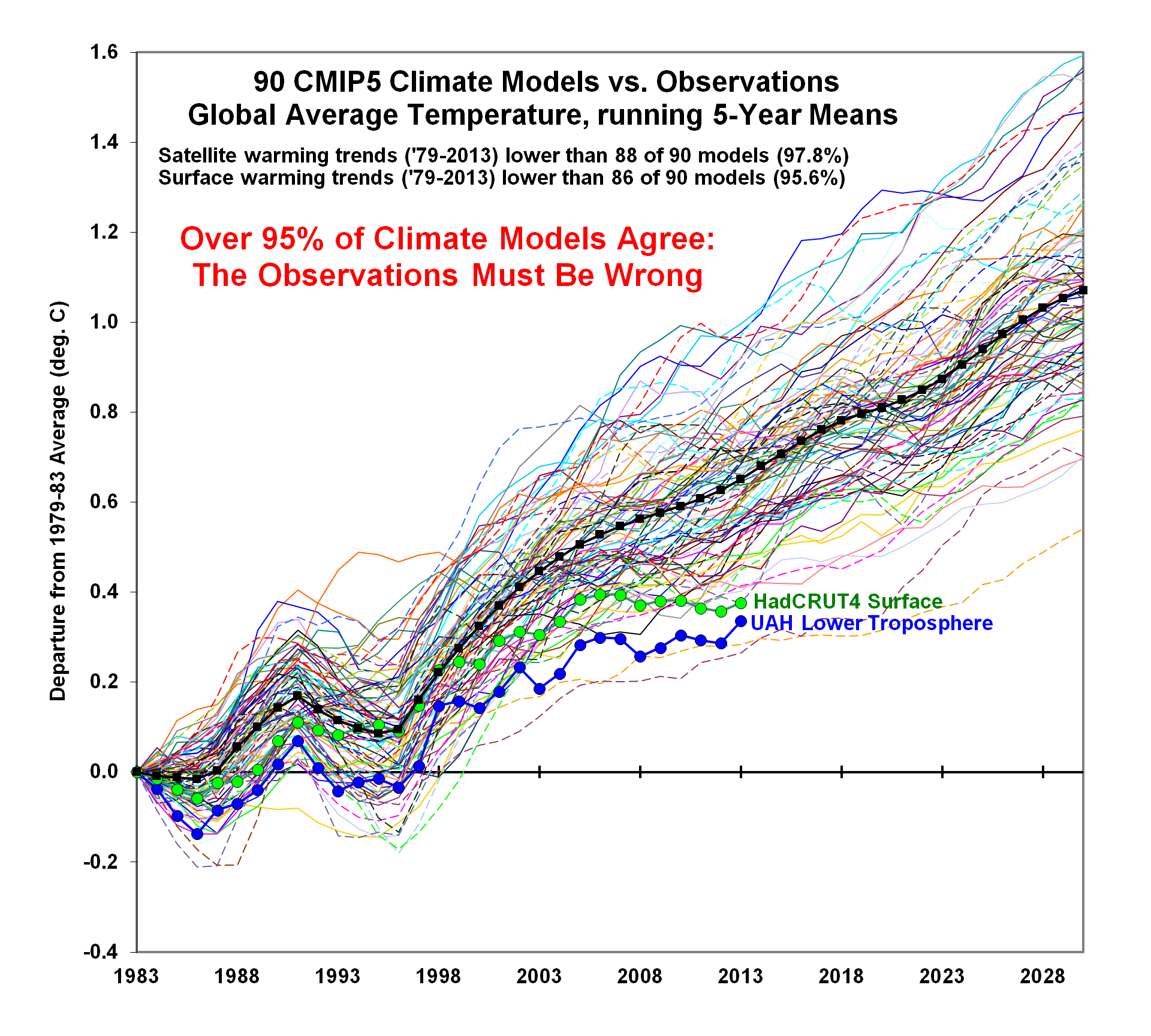
95% of Climate Models Agree: The Observations Must be Wrong
February 7th, 2014 by Roy W. Spencer, Ph. D.
Iâm seeing a lot of wrangling over the recent (15+ year) pause in global average warmingâ¦when did it start, is it a full pause, shouldnât we be taking the longer view, etc.
These are all interesting exercises, but they miss the most important point: the climate models that governments base policy decisions on have failed miserably.
Iâve updated our comparison of 90 climate models versus observations for global average surface temperatures through 2013, and we still see that >95% of the models have over-forecast the warming trend since 1979, whether we use their own surface temperature dataset (HadCRUT4), or our satellite dataset of lower tropospheric temperatures (UAH):
CMIP5-90-models-global-Tsfc-vs-obs-thru-2013
Whether humans are the cause of 100% of the observed warming or not, the conclusion is that global warming isnât as bad as was predicted. That should have major policy implicationsâ¦assuming policy is still informed by facts more than emotions and political aspirations.
And if humans are the cause of only, say, 50% of the warming (e.g. our published paper), then there is even less reason to force expensive and prosperity-destroying energy policies down our throats.
I am growing weary of the variety of emotional, misleading, and policy-useless statements like âmost warming since the 1950s is human causedâ or â97% of climate scientists agree humans are contributing to warmingâ, neither of which leads to the conclusion we need to substantially increase energy prices and freeze and starve more poor people to death for the greater good.
Yet, that is the direction we are heading.
And even if the extra energy is being stored in the deep ocean (if you have faith in long-term measured warming trends of thousandths or hundredths of a degree), I say âgreat!â. Because that extra heat is in the form of a tiny temperature change spread throughout an unimaginably large heat sink, which can never have an appreciable effect on future surface climate.
If the deep ocean ends up averaging 4.1 deg. C, rather than 4.0 deg. C, it wonât really matter.
here is what I said.... i removed the surrounding words so you could understand.
From your chart makers vice chair.
http://articles.latimes.com/2013/sep/22/science/la-sci-climate-change-uncertainty-20130923
"The models had predicted that the average global surface temperature would increase by 0.21 of a degree Celsius over this period, but they turned out to be off by a factor of four, Zwiers and his colleagues wrote. In reality, the average temperature has edged up only 0.05 of a degree Celsius over that time â which in a statistical sense is not significantly different from zero. ..."
[/QUOTE]