
$NFLX will end the day red, sorry bulls

You are using an out of date browser. It may not display this or other websites correctly.
You should upgrade or use an alternative browser.
You should upgrade or use an alternative browser.
NFLX
- Thread starter Phill Twist
- Start date
Crystal balls are notoriously hazy, but expanding original content is a fairly obvious trend. Before it starts getting into theme parks, however, the real opportunity for Netflix as it completes its global build out is providing transnational and cross-cultural programming.
There is a world of local and national programming around the world that would find a ready audience outside their home countries. To date finding and distributing such content has been a slow and painful affair, and one that's ripe for disruption. All that's really needed is a concerted focus on subtitling and there's no reason why most content could not be distributed globally.
Combine this with continued improvements in the recommendation engines--adding curated services, for example, would enable easy discovery of and access to the "best of Netflix" from around the world. This will also go hand-in-hand with the ongoing trend of moving away from anachronistic territorial licensing models, by allowing various international tiers to be introduced that would enable access to various national programming internationally.
Here's my analysis: It's priced to achieve one of the most, if not the best, growth paths of any company in history. A global monopoly position for the next 15 years might allow for that growth. So what is their competitive advantage that is not only insurmountable now, but far into the future? I use Amazon, Hulu, Walmart, Apple, cable and Netflix already. And can't anyone see that the full fracturing of the bundle cable model will only create more competition (e.g. HBO, direct sports delivery from the leagues)? Go ahead and create scenarios all you want to justify the crazy price it has now...but believing it will go up just as dramatically as it has to date is more than wishful thinking...
There is a world of local and national programming around the world that would find a ready audience outside their home countries. To date finding and distributing such content has been a slow and painful affair, and one that's ripe for disruption. All that's really needed is a concerted focus on subtitling and there's no reason why most content could not be distributed globally.
Combine this with continued improvements in the recommendation engines--adding curated services, for example, would enable easy discovery of and access to the "best of Netflix" from around the world. This will also go hand-in-hand with the ongoing trend of moving away from anachronistic territorial licensing models, by allowing various international tiers to be introduced that would enable access to various national programming internationally.
Here's my analysis: It's priced to achieve one of the most, if not the best, growth paths of any company in history. A global monopoly position for the next 15 years might allow for that growth. So what is their competitive advantage that is not only insurmountable now, but far into the future? I use Amazon, Hulu, Walmart, Apple, cable and Netflix already. And can't anyone see that the full fracturing of the bundle cable model will only create more competition (e.g. HBO, direct sports delivery from the leagues)? Go ahead and create scenarios all you want to justify the crazy price it has now...but believing it will go up just as dramatically as it has to date is more than wishful thinking...
$NFLX closed down 3.89 percent on Tuesday, September 8, 2015, on 2.01 times normal volume.


i could do so but i prefer giving reference
$NFLX I'm doing a back ratio in Oct. Buy 1 Put at $80, and finance it with Selling 2 Puts at $70. Make money on both sides = bull? or bear?
$NFLX closed up 4.45 percent on Wednesday, September 9, 2015, on 1.62 times normal volume.

Phill,
NFLX not looking too bad here at support (99 area), and good long trade quality, it's on my radar.
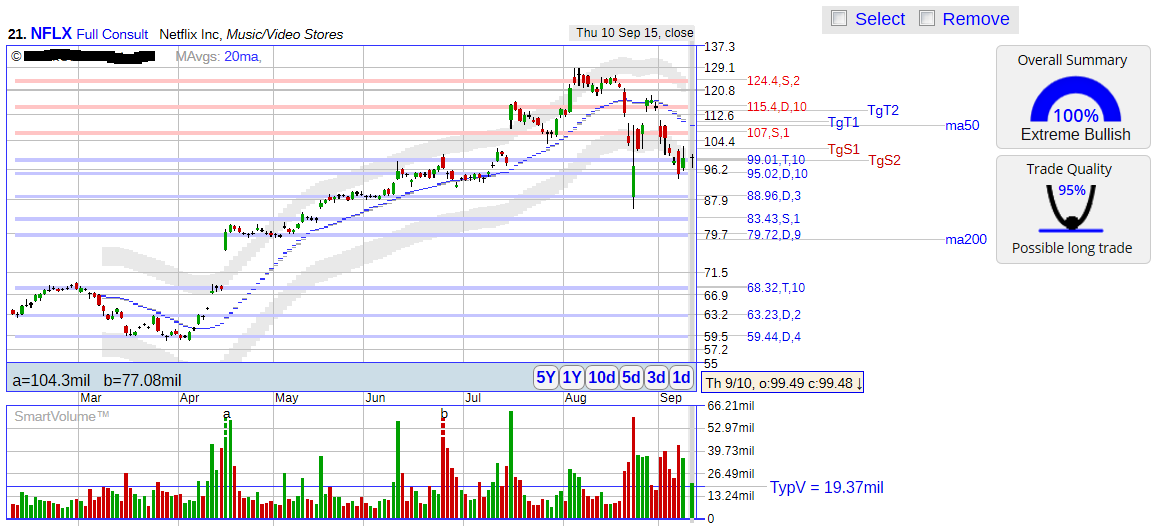
NFLX not looking too bad here at support (99 area), and good long trade quality, it's on my radar.
For people who have invested in them, what it is that gives you reason to believe they can grow at a sufficient rate to justify their current (grossly exaggerated IMO) valuation?
I understand that they got in there first with online streaming and saw off the old brick-and-mortar rental stores in the process but I'm not sure why one would assume they will continue to grow at a strong rate from here onwards. What is it about them that gives people confidence that they can see off strong competition from the likes of Amazon, Apple, etc, in this space?
I understand that they got in there first with online streaming and saw off the old brick-and-mortar rental stores in the process but I'm not sure why one would assume they will continue to grow at a strong rate from here onwards. What is it about them that gives people confidence that they can see off strong competition from the likes of Amazon, Apple, etc, in this space?
$NFLX stock closed the last trading session -1.98% lower even as the S&P 500 gained by 0.45%
