

Baron
ET Founder
The days of using the Body Mass Index (BMI) for estimating body fat seems to be coming to an end. Researchers at the Cedars-Sinai Medical Center in Los Angeles published a better method to determine how fat you are, and it's called the RFM. Using this new method you only need to know your body height and be able to measure the circumference of your waist. That's it.
BMI
Scientists, physicians and sometimes also trainers still use the BMI to determine if someone is too fat. In general, this method works, but in many instances, it simply does not.
A better way to determine how much body fat someone has is to make DEXA scans. Measuring skin folds with clippers is a good second. But in practice, there is a need for an easier and faster way.
The researchers wanted to find a simple formula that assesses the fat percentage, without having to do all sorts of difficult measurements and calculations. They used data from 12,581 Americans collected in the National Health and Nutrition Examination Survey [NHANES] to generate 365 formulas that could estimate how much fat someone has by using variables such as body weight, height, and waist circumference.
The researchers then released the formulas on a database of 3,456 Americans and checked which formula gave the most accurate estimate.
And the winner is...
Below you see the most accurate formula: the RFM, which stands for relative fat mass. The result gives an estimate of the fat percentage. Height & waist circumference are expressed in meters, by the way.

The figures below show that the RFM gives a more precise estimate of body fat percentage than the BMI does.
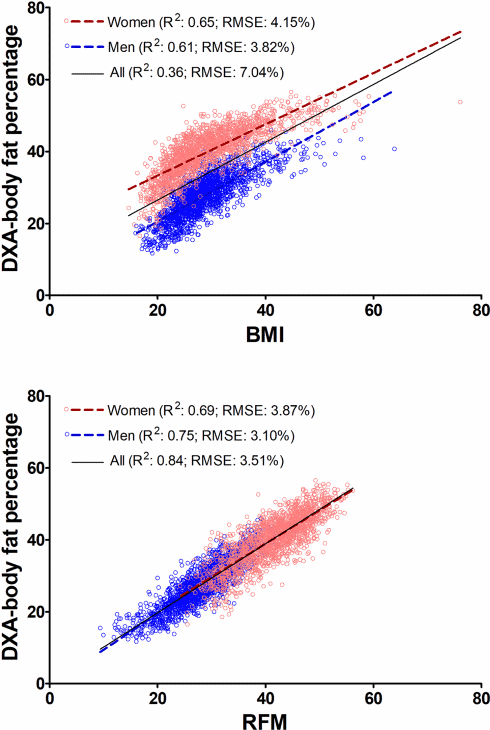
The researchers looked at men and women, and at people from European, African and Latin American ethnicity. The RFM formula estimated the fat mass equally accurately for all groups.
Conclusion
"We wanted to identify a more reliable, simple and inexpensive method to assess body fat percentage without using sophisticated equipment", says lead author Orison Woolcott in a press release. [sciencedaily.com August 27, 2018] "Our results confirmed the value of our new formula in a large number of subjects: relative fat mass [RFM] is a better measure of body fatness than many indices currently used in medicine and science, including the BMI."
"The relative fat mass formula has now been validated in a large database", adds research leader Richard Bergman. "It is a new index for measuring body fatness that can be easily accessible to health practitioners trying to treat overweight patients who often face serious health consequences like diabetes, high blood pressure, and heart disease."
Source:
Sci Rep. 2018 Jul 20;8(1):10980.
BMI
Scientists, physicians and sometimes also trainers still use the BMI to determine if someone is too fat. In general, this method works, but in many instances, it simply does not.
A better way to determine how much body fat someone has is to make DEXA scans. Measuring skin folds with clippers is a good second. But in practice, there is a need for an easier and faster way.
The researchers wanted to find a simple formula that assesses the fat percentage, without having to do all sorts of difficult measurements and calculations. They used data from 12,581 Americans collected in the National Health and Nutrition Examination Survey [NHANES] to generate 365 formulas that could estimate how much fat someone has by using variables such as body weight, height, and waist circumference.
The researchers then released the formulas on a database of 3,456 Americans and checked which formula gave the most accurate estimate.
And the winner is...
Below you see the most accurate formula: the RFM, which stands for relative fat mass. The result gives an estimate of the fat percentage. Height & waist circumference are expressed in meters, by the way.
The figures below show that the RFM gives a more precise estimate of body fat percentage than the BMI does.
The researchers looked at men and women, and at people from European, African and Latin American ethnicity. The RFM formula estimated the fat mass equally accurately for all groups.
Conclusion
"We wanted to identify a more reliable, simple and inexpensive method to assess body fat percentage without using sophisticated equipment", says lead author Orison Woolcott in a press release. [sciencedaily.com August 27, 2018] "Our results confirmed the value of our new formula in a large number of subjects: relative fat mass [RFM] is a better measure of body fatness than many indices currently used in medicine and science, including the BMI."
"The relative fat mass formula has now been validated in a large database", adds research leader Richard Bergman. "It is a new index for measuring body fatness that can be easily accessible to health practitioners trying to treat overweight patients who often face serious health consequences like diabetes, high blood pressure, and heart disease."
Source:
Sci Rep. 2018 Jul 20;8(1):10980.


 , so I'm sure that putting in a RFM² variable might prove statistically *significant*, but not *practically* helpful.

