
You are using an out of date browser. It may not display this or other websites correctly.
You should upgrade or use an alternative browser.
You should upgrade or use an alternative browser.
New Study Confirms That Carbs Make You Fat
- Thread starter Baron
- Start date


You know, if I only look at his mouth, he seems to be saying the opposite --
"I'm not big-boned -- I'm fat."
One thing and one thing only makes you fat and that is too many calories. I've been nearly 300 pounds (I'm 5'7) and got my weight down to 140 lbs. This was 10 years ago. During this time, I've done the low carb dieting (paleo and keto) and I've eaten whatever I wanted (plenty of junk food was included) as long as my calories were the right number. Doing low carb and eating whatever I wanted at the same caloric intake the results, in terms of weight maintenance, were the exact same.
If you eat 1500 calories a day of carbs or 1500 calories a day of fat and protein I think after a period of time you will see a significant difference in your body composition and weight loss/maintenance over time. While quantity of calories can be more significant when coming down from 300 pounds (i.e. a deficit will cause weight loss no matter what you are eating), what type of weight loss you seek, overall health and long term maintenance are all based on QUALITY of calories.
To say one thing and only one thing makes you fat is too many calories is an oversimplified view of a subject science and research has already proven otherwise. For example, go eat 3500 calories of mostly carb laden food da in and day out or try and eat 3500 calories of fat/protein based foods. The former is what most American diets consist of and an easy target to hit with junk foods, desserts and processed foods. The latter is impossible to keep up as the satiety and fullness will stop you from hitting that target on a regular basis.
Eating calorie restricted diet of Paleo/Keto changes your metabolic systems. Eating calorie restricted of junk food will still cause issues with insulin/blood sugars and also cause your body to break down muscle at a higher rate.
It is way too easy to say "exact same" until you do the research.
The goal is never to simply reduce the number on the scale, we do that daily with a good dump. You need to bring down the fat mass, improve blood sugar, reduce cholesterols/tris etc..
To say one thing and only one thing makes you fat is too many calories is an oversimplified view of a subject science and research has already proven otherwise. For example, go eat 3500 calories of mostly carb laden food da in and day out or try and eat 3500 calories of fat/protein based foods. The former is what most American diets consist of and an easy target to hit with junk foods, desserts and processed foods. The latter is impossible to keep up as the satiety and fullness will stop you from hitting that target on a regular basis.
Eating calorie restricted diet of Paleo/Keto changes your metabolic systems. Eating calorie restricted of junk food will still cause issues with insulin/blood sugars and also cause your body to break down muscle at a higher rate.
It is way too easy to say "exact same" until you do the research.
The goal is never to simply reduce the number on the scale, we do that daily with a good dump. You need to bring down the fat mass, improve blood sugar, reduce cholesterols/tris etc..

I understand for those who are morbidly obese (rough words but sadly true) they have to cut down weight fast and it is all about calorie restriction but quality of calories will be more telling of success and reversing some metabolic syndrome issues.
Strict calorie quantity will get you down but strict calorie quality will get you healthy, keep you down, and make the road easier to maintain as oppsoed to quick unrealistic diets.
If you weigh 300 lbs. plus and you are forced to do 1200 calories a day, it would be foolish to think you get the same results whether you did Keto/Paleo or 1200 calories of any junk food combinations. First it is impossible to stick to 1200 calories eating empty crap. Second, you will lose weight due to caloric restriction but you will not be getting healthier on the way down or changing the bad habits that got you up.
It is not surprising that even patients who undergo bariatric surgeries who are morbidly obese are put in a ketogenic type diet since they are forced to eat in smaller quantities and need to maximize calories.
I think most people do not realize that the USDA has been behind the food pyramid for many decades which first started the movement of limiting all fats (i.e. no distinction between healthy or unhealthy) and having larger portions of grains (i.e. USDA clients). Sugar lobbies were also called out for stopping any message putting down high sugars as cause of many diet issues and obesity. Then fat free craz took over in the '90s.
My point in all of this is that caloric intake is clearly no longer the hard and fast rule in weight loss. Obviously caloric restriction will lead to weight loss on the scale but we have discussed that the scale number alone is meaningless. If you are losing water, lean body mass and fat then that is not good for the long run.
The one exception I understand is morbidly obese where the only concern is get the total mass/number down. Always easy to build back up when someone can get from 350 to 200 lbs.
Strict calorie quantity will get you down but strict calorie quality will get you healthy, keep you down, and make the road easier to maintain as oppsoed to quick unrealistic diets.
If you weigh 300 lbs. plus and you are forced to do 1200 calories a day, it would be foolish to think you get the same results whether you did Keto/Paleo or 1200 calories of any junk food combinations. First it is impossible to stick to 1200 calories eating empty crap. Second, you will lose weight due to caloric restriction but you will not be getting healthier on the way down or changing the bad habits that got you up.
It is not surprising that even patients who undergo bariatric surgeries who are morbidly obese are put in a ketogenic type diet since they are forced to eat in smaller quantities and need to maximize calories.
I think most people do not realize that the USDA has been behind the food pyramid for many decades which first started the movement of limiting all fats (i.e. no distinction between healthy or unhealthy) and having larger portions of grains (i.e. USDA clients). Sugar lobbies were also called out for stopping any message putting down high sugars as cause of many diet issues and obesity. Then fat free craz took over in the '90s.
My point in all of this is that caloric intake is clearly no longer the hard and fast rule in weight loss. Obviously caloric restriction will lead to weight loss on the scale but we have discussed that the scale number alone is meaningless. If you are losing water, lean body mass and fat then that is not good for the long run.
The one exception I understand is morbidly obese where the only concern is get the total mass/number down. Always easy to build back up when someone can get from 350 to 200 lbs.

It doesn’t have to be either/or. You can use both. I recently started including chia seeds in my daily milkshakes, and I really like the thickness and texture they add to the drink. They don’t have a discernible taste of their own as flax seeds do, but they are a worthy addition for both the nutritional value and the added texture.Chias are quite nutritionally dense with omega 3 fatty acids, protein and fiber. They plump in liquids making a nice fiberous paste in the stomach which leads to slow digestion and fullness. They are made up of a lot of fiber and have calcium and iron. Pretty healthy as an additive to shakes. Lot of bang for the small buck.
Chias and grains are not the same thing.
Flaxseeds have the same nutritional profile but chia seeds have more per tbsp so I go with Chia. Plus chia makes shakes thicker when you let it sit in the fridge for a bit.
Here is a good comparison of the two:
https://www.theglobeandmail.com/lif...d-or-chia-seeds-better-for-me/article4371817/
I give Chia the edge for me for the reasons above.
I like Almond milk as I am not trying to add too many sugars and vamilla unsweetened just acts as a base. 2 cups is 60 calories, 2 grams of fiber, 5g of fat and 2 grams of protein, 0 sugars.
But as w wrote earlier, flax seeds have lignans, which chia seeds do not. Lignans, as I understand it, have protective properties worth considering.

The theory that a diet with many carbohydrates - and especially a diet with a lot of quickly absorbable carbohydrates - leads to overweight and obesity, is not new. A high carb diet allows fat cells to grow, but ensures that the rest of the body gets less energy. Says that theory. Nutritional scientists from the University of Harvard published a trial in BMJ that suggests that this theory is correct.
Carbs, insulin and body fat
The researchers wanted to test the 'carbohydrate-insulin model', which describes how a diet with a lot of carbohydrates makes humans fat.
"According to this model, the processed carbohydrates that have flooded our lives during the low-fat era have raised insulin levels, driving fat cells to store excessive calories, with fewer calories, hunger increases and metabolism slows - a recipe for weight gain", says research leader Dadid Ludwig in a press release. [sciencedaily.com November 14, 2018]
Study
The researchers experimented with a group of 120 healthy subjects aged 18-65 years. The subjects had a BMI of 25 or higher. Before the real experiment started, the subjects had lost 12 percent of their body weight by a slimming diet. In the 12 weeks that the study lasted, the subjects were given a diet that provided exactly enough kilocalories to maintain their new weight.
The researchers divided the subjects into 3 groups. They gave one group a high carb diet; 60 percent of which consisted of carbohydrates. A second group received a moderate carb diet, with 40 percent of the energy coming from carbohydrates. Finally, a third group received a low carb diet, which consisted of only 20 energy percent of carbohydrates.
In a laboratory, the researchers determined the energy consumption of the test subjects before, during and after the 12 weeks.
Results
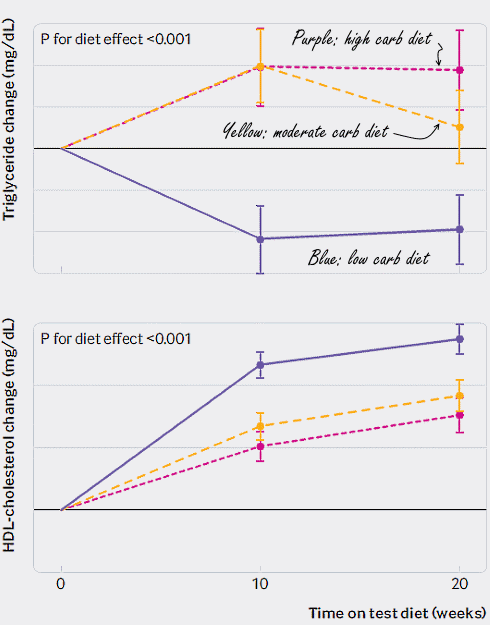
A low carbohydrate diet reduced the concentration of triglycerides in the blood. That is about the same as the concentration of VLDL, the 'worst worst cholesterol'. At the same time, a low-carbohydrate diet increased the 'good cholesterol' HDL.
In the low-carb group, calorie consumption increased by 200 kilocalories. In the high-carb group, calorie consumption decreased.
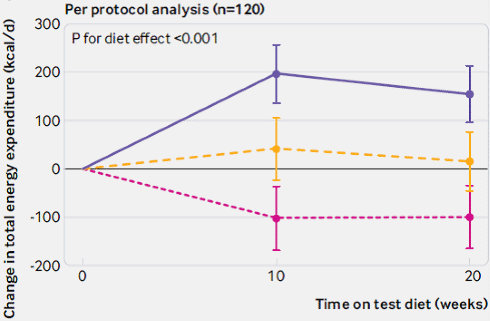
"If this difference persists - and we saw no drop-off during [...] our study - the effect would translate into about a 20-pound [9.1 kilo] weight loss after three years, with no change in calorie intake", says first author Cara Ebbeling. "Our observations challenge the belief that all calories are the same to the body. Our study did not measure hunger and satiety, but other studies suggest that low-carb diets also decrease hunger, which could help with weight loss in the long term."
Insulin
Before the researchers divided the subjects into 3 diet groups, they measured the effect of a portion of glucose on their insulin levels. On the basis of this, they divided the subjects into 3 other groups: a group in which the insulin level hardly reacted to glucose, a group with a moderate response, and a group in which the insulin level rose sharply.
The stronger the insulin level responded, the stronger was the effect of a low-carbohydrate diet on calorie consumption. Click on the figure below for a larger version.
Conclusion
"Dietary composition seems to affect energy expenditure independently of body weight", the researchers write. "A low glycemic load, high fat diet might facilitate weight loss maintenance beyond the conventional focus on restricting energy intake and encouraging physical activity."
"Additional research is warranted to examine the effects of glycemic load on body weight, with control of energy intake. If metabolic benefits of reduced glycemic load diets are confirmed, development of appropriate behavioral and environmental interventions would be necessary for optimal translation to public health."
Source:
BMJ 2018;363:k4583.

Interesting. This is exactly what I was discussing with Fred in another thread. This is what Gary Taubes talks about in "Why We Get Fat". But apparently there are bad reviews about it so it can't be true!
I understand for those who are morbidly obese (rough words but sadly true) they have to cut down weight fast and it is all about calorie restriction but quality of calories will be more telling of success and reversing some metabolic syndrome issues.
Strict calorie quantity will get you down but strict calorie quality will get you healthy, keep you down, and make the road easier to maintain as oppsoed to quick unrealistic diets.
If you weigh 300 lbs. plus and you are forced to do 1200 calories a day, it would be foolish to think you get the same results whether you did Keto/Paleo or 1200 calories of any junk food combinations. First it is impossible to stick to 1200 calories eating empty crap. Second, you will lose weight due to caloric restriction but you will not be getting healthier on the way down or changing the bad habits that got you up.
It is not surprising that even patients who undergo bariatric surgeries who are morbidly obese are put in a ketogenic type diet since they are forced to eat in smaller quantities and need to maximize calories.
I think most people do not realize that the USDA has been behind the food pyramid for many decades which first started the movement of limiting all fats (i.e. no distinction between healthy or unhealthy) and having larger portions of grains (i.e. USDA clients). Sugar lobbies were also called out for stopping any message putting down high sugars as cause of many diet issues and obesity. Then fat free craz took over in the '90s.
My point in all of this is that caloric intake is clearly no longer the hard and fast rule in weight loss. Obviously caloric restriction will lead to weight loss on the scale but we have discussed that the scale number alone is meaningless. If you are losing water, lean body mass and fat then that is not good for the long run.
The one exception I understand is morbidly obese where the only concern is get the total mass/number down. Always easy to build back up when someone can get from 350 to 200 lbs.
Caloric restriction doesn't work for several reasons.
First, it isn't sustainable. The individual is essentially starving themselves and the constant hunger, constant restriction of calories is only a temporary fix. the individual will return to this as soon as the diet is over.
Second, restricting calories without changing the composition of these calories will actually serve to leave the individual with less energy without as much weight loss. Allow me to explain.
If insulin is spiked because of the types of calories consumed, then insulin is determining where those sugars and fatty acids are going. There is a marker called LPL (Lipoprotein Lipase) that is attached to fat cells or muscle cells and it is this marker that determines where fatty acids and sugars (in the form of glycerol) go once they are in the bloodstream.
Think of this gauge as a metric for judging insulin levels. I just picked a random image.
When insulin levels are high, fat and sugars are diverted to the fat cells for storage. Once inside, the fat cells use two fat molecules and one glycerin to create a Triglyceride. These are stored and cannot be removed from the fat cells without first being broken down.
When insulin levels are low, these fats and sugars go to muscle cells (via the LPL marker) for energy. You burn them.
If someone simply cuts calories but keeps the same amount of carbs and sugars, all that means is the muscle cells are getting less energy from the already small partition of fats and sugars they got before. The patient gets more sedentary. Weight loss is extremely challenging.
Instead, understand how to keep the insulin level low by changing the calories you put in your body and then the fats and (hopefully minimal) sugars are used for energy in muscle cells. Remove sugars and refined flours and bad carbs from the diet completely and for long enough and the body has to tap into fat cells and break down triglycerides for use. This makes the individual leaner, lowers triglycerides and is overly beneficial to the patient.
I've skipped a lot of the technical stuff to try to keep it simple.
No, we were not discussing that. We were discussing Taubes's misrepresentative zealotry. Just because simple carbs are unhealthy does not mean that complex carbs, with fiber, are not. Simple carbs spike insulin levels, which in turn encourage calories to be stored as fat. Complex carbs (i.e., with fiber) in moderation don't cause that kind of deleterious spike. Taubes is throwing out the baby with the bath water. And he thinks you should bathe in saturated fat.Interesting. This is exactly what I was discussing with Fred in another thread. This is what Gary Taubes talks about in "Why We Get Fat". But apparently there are bad reviews about it so it can't be true!
Did you watch the 2 Dean Ornish videos I posted in the other thread? I'm guessing you didn't.