New Study Confirms That Carbs Make You Fat

From the figures i gave, only 6 pounds of lean mass gained in 2 years! WTF. Having said that, I probably lost a couple of pounds of lean in the last 3 months whilst on my cut which i suspect i'll put back on pdq.
I'm no way near my genetic upper limit potential for lean mass. As mentioned in another thread, I have low free testosterone (caused by v high levels of SHBG) which is hindering my ability to build muscle.

Went to an endo today, he has ordered more tests.
I hope it goes well with your endocrinologist.

Remember that initial gains come the quickest. It gets harder and slower as you progress. You may wish to consider taking a flyer and giving lower volume, lower frequency, higher intensity a try. Just saying. If, after a few months, you're worse off, then you can take comfort knowing that your way is better, and you can get back to it, having definitively proven it to yourself. But if your results are just as good, then you'll be able to choose which approach appeals more to you. And what if the alternative actually gives you a better outcome?
 
Sams Club now has 24 size packs of cage free hormone free eggs. I’ve also been using the house brand Pesto as a universal condiment - it’s delicious on everything from eggs to meat and has only 4 grams of Carb in a quarter cup.

I also get the fresh baby French green beans, broccoli florets and the Spring greens mix out of the produce cooler.
 
I hope it goes well with your endocrinologist.
Thanks, but I have a feeling this guy is gonna be a waste of time.
Remember that initial gains come the quickest. It gets harder and slower as you progress. You may wish to consider taking a flyer and giving lower volume, lower frequency, higher intensity a try. Just saying. If, after a few months, you're worse off, then you can take comfort knowing that your way is better, and you can get back to it, having definitively proven it to yourself. But if your results are just as good, then you'll be able to choose which approach appeals more to you. And what if the alternative actually gives you a better outcome?

The training is not the problem, the hormonal imbalance is. Try building muscle with free T at the bottom of the range.
 
The training is not the problem, the hormonal imbalance is. Try building muscle with free T at the bottom of the range.
Apart from your individual biology, as I understand it, overtraining can reduce testosterone levels. So there is a window, where some exercise boosts it, but beyond which it causes it to diminish. You may wish to look into the possibility that you're overdoing it. I'm not saying you are, but it's worth some consideration. The thing about ~high volume training but not to failure, is that you're depleting your recovery resources without necessarily activating your higher order type IIb muscle fibers. So, theoretically, you get all of the cost (and then some) but not all of the benefit for your effort.

If you get to a point where you're not pleased with your progress, you may wish to consider scaling back on some of the volume and frequency while dialing up the effort to concentric failure (while focusing on deliberate rep cadence to minimize momentum on both the concentric and eccentric side of each rep). You won't lose anything trying it for a couple of months, and you just might be pleasantly surprised.

Whatever you choose to do, I hope your issue resolves. Good luck.
 
Apart from your individual biology, as I understand it, overtraining can reduce testosterone levels. So there is a window, where some exercise boosts it, but beyond which it causes it to diminish. You may wish to look into the possibility that you're overdoing it. I'm not saying you are, but it's worth some consideration. The thing about ~high volume training but not to failure, is that you're depleting your recovery resources without necessarily activating your higher order type IIb muscle fibers. So, theoretically, you get all of the cost (and then some) but not all of the benefit for your effort.

Thanks for your concerns.

The possibility of overtraining definitely exists. Overtraining what though? If u do 100 sets on your chest but only 3 sets on your legs, well u might be overdoing it on the chest but definitely not on the legs. You see my point, overtraining relates to specific muscle groups.

I keep logs of every workout i do. Evidence of overtraining might be if i was losing strength in a a particular area. My data show that my reps and weight have been consistently increasing in all exercises. No evidence whatsoever of any overtraining.

With regard to training to failure, I go one rep to failure. Going all the way to failure is not worth doing. The cost of the exponentially increased levels of ammonia in the brain and other side effects are not worth a relatively small amount more muscle activation. I'm sure we have discussed this before.
 
Thanks for your concerns.

The possibility of overtraining definitely exists. Overtraining what though? If u do 100 sets on your chest but only 3 sets on your legs, well u might be overdoing it on the chest but definitely not on the legs. You see my point, overtraining relates to specific muscle groups.

I keep logs of every workout i do. Evidence of overtraining might be if i was losing strength in a a particular area. My data show that my reps and weight have been consistently increasing in all exercises. No evidence whatsoever of any overtraining.

With regard to training to failure, I go one rep to failure. Going all the way to failure is not worth doing. The cost of the exponentially increased levels of ammonia in the brain and other side effects are not worth a relatively small amount more muscle activation. I'm sure we have discussed this before.
Your example is rather extreme but, as I understand it, overtraining can also be systemic. I don't think it needs to be limited to a single muscle group.

I've never heard about this brain ammonia thing from training to failure, or come across it in any of the literature I've read. What I did come across is that training to failure has been found to be the most efficient way to stimulate all of the muscle fibers without having to deplete the body's energy reserves too much (with unnecessary volume) to compromise full recovery between workouts.

In any event, I think we've reached an impasse. I think we're each set on our chosen path. A key difference between you and me, however, is that I tried both. :)
 
Last edited:
The people that worry the most about overtraining are the ones that don't train hard enough and aren't strong enough to need to worry about it - Ben Bruno

The mind always fails first not the body. The secret is to make your mind work for you, not against you. - Arnold Schwarzenegger
 
The people that worry the most about overtraining are the ones that don't train hard enough and aren't strong enough to need to worry about it - Ben Bruno

The mind always fails first not the body. The secret is to make your mind work for you, not against you. - Arnold Schwarzenegger
^^Please stop with all the science. You're liable to get ammonia on the brain...
 
The theory that a diet with many carbohydrates - and especially a diet with a lot of quickly absorbable carbohydrates - leads to overweight and obesity, is not new. A high carb diet allows fat cells to grow, but ensures that the rest of the body gets less energy. Says that theory. Nutritional scientists from the University of Harvard published a trial in BMJ that suggests that this theory is correct.

Carbs, insulin and body fat
The researchers wanted to test the 'carbohydrate-insulin model', which describes how a diet with a lot of carbohydrates makes humans fat.

"According to this model, the processed carbohydrates that have flooded our lives during the low-fat era have raised insulin levels, driving fat cells to store excessive calories, with fewer calories, hunger increases and metabolism slows - a recipe for weight gain", says research leader Dadid Ludwig in a press release. [sciencedaily.com November 14, 2018]

Study
The researchers experimented with a group of 120 healthy subjects aged 18-65 years. The subjects had a BMI of 25 or higher. Before the real experiment started, the subjects had lost 12 percent of their body weight by a slimming diet. In the 12 weeks that the study lasted, the subjects were given a diet that provided exactly enough kilocalories to maintain their new weight.

The researchers divided the subjects into 3 groups. They gave one group a high carb diet; 60 percent of which consisted of carbohydrates. A second group received a moderate carb diet, with 40 percent of the energy coming from carbohydrates. Finally, a third group received a low carb diet, which consisted of only 20 energy percent of carbohydrates.

In a laboratory, the researchers determined the energy consumption of the test subjects before, during and after the 12 weeks.

Results
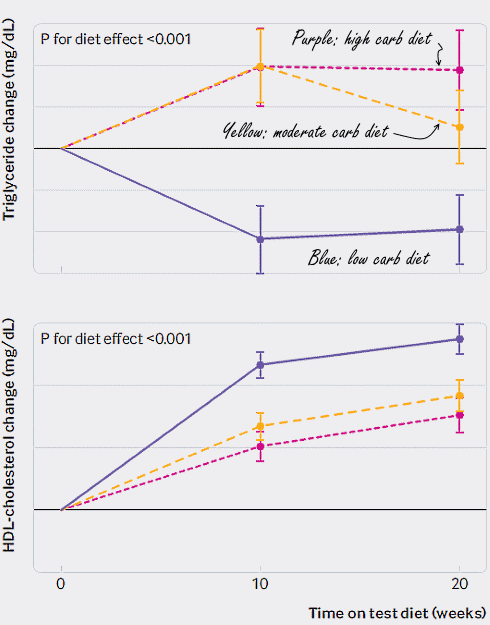
A low carbohydrate diet reduced the concentration of triglycerides in the blood. That is about the same as the concentration of VLDL, the 'worst worst cholesterol'. At the same time, a low-carbohydrate diet increased the 'good cholesterol' HDL.


carbsafterweightlossdiet3.gif


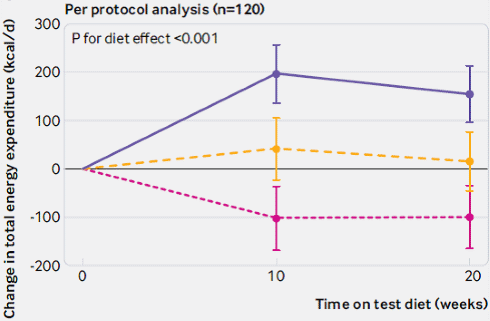
In the low-carb group, calorie consumption increased by 200 kilocalories. In the high-carb group, calorie consumption decreased.


carbsafterweightlossdiet.gif


"If this difference persists - and we saw no drop-off during [...] our study - the effect would translate into about a 20-pound [9.1 kilo] weight loss after three years, with no change in calorie intake", says first author Cara Ebbeling. "Our observations challenge the belief that all calories are the same to the body. Our study did not measure hunger and satiety, but other studies suggest that low-carb diets also decrease hunger, which could help with weight loss in the long term."

Insulin
Before the researchers divided the subjects into 3 diet groups, they measured the effect of a portion of glucose on their insulin levels. On the basis of this, they divided the subjects into 3 other groups: a group in which the insulin level hardly reacted to glucose, a group with a moderate response, and a group in which the insulin level rose sharply.

The stronger the insulin level responded, the stronger was the effect of a low-carbohydrate diet on calorie consumption. Click on the figure below for a larger version.


Conclusion
"Dietary composition seems to affect energy expenditure independently of body weight", the researchers write. "A low glycemic load, high fat diet might facilitate weight loss maintenance beyond the conventional focus on restricting energy intake and encouraging physical activity."

"Additional research is warranted to examine the effects of glycemic load on body weight, with control of energy intake. If metabolic benefits of reduced glycemic load diets are confirmed, development of appropriate behavioral and environmental interventions would be necessary for optimal translation to public health."

Source:
BMJ 2018;363:k4583.



It has been rightly said that "carb" is the new "fat". The past few decades have seen vapid demonization of fats which is actually an essential nutrient that regulates a number of metabolic functions. The problem is people think that if they eat fats, they will get fat - and this fallacy has led many crash dieters to plunge into unhealthy fad diets.

Most fad diets advocate one thing - remove fats.

However, recent studies have revealed that it is not the fat that makes you fat it is the carbs. Glucose or sugar present in starchy foods such as refined sugar or potatoes cause blood sugar spikes, disturb the insulin production, and cause weight gain (along with other chronic illnesses such as diabetes).

Gradually reducing carbs and compensating it with increased fat and protein intake is that mantra to healthy and sustained weight loss.

Ask any keto diet follower and he/she will agree.

No wonder, low-carb diets such as Keto and Atkins have become trending diet patterns that actually help people lose weight in a healthy manner.
 
Most fad diets advocate one thing - remove fats.

I think this approach peaked in the 1990's with the Snackwell generation and hs been correct in the 2000s. the problem is, the diet industry simply cares about making money not keeping people healthy so they jumped on the gluten-free, paleo/keto focus and turned it into a fad and people are eating just as bad as they were wolfing down Snackwells with gluten free pastas and cookies or loading up on unlimited bacon and eggs.

The Diet/Nutrition section of the bookstore is the best measure of how much misinformation and hype is out there haha.
 
Back
Top