
You are using an out of date browser. It may not display this or other websites correctly.
You should upgrade or use an alternative browser.
You should upgrade or use an alternative browser.
Negative Interest Rates Implications - deflationary and inflationary
- Thread starter TraderD
- Start date
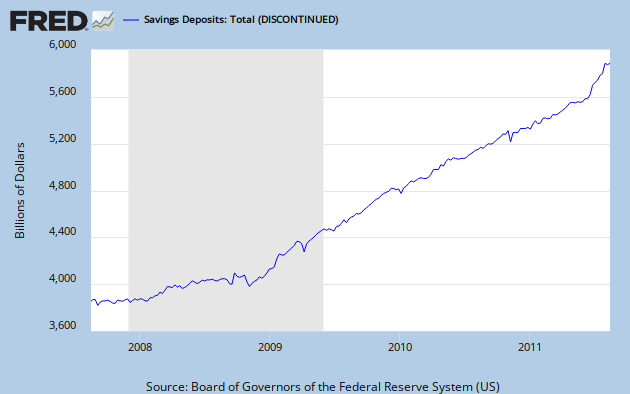
Interest rate changes work differently: the fed stands to lend money at the Fed Funds Rate. Borrowing from the Fed is not the same as borrowing from any other bank: the Fed's balancesheet is magical. As a central bank, it can grow both its asset and liability side (hence, expanding the money supply).
Quote from TraderD:
Thanks, good points. But then if this does not change money supply net net in one country, what an ingenious way to charge interest for NOT giving you money.
DontMissTheBus, what is your macro view for the next couple years?
M
morganist
Quote from DontMissTheBus:
I'll go with no - because financial transactions are book entry changes: when you withdraw $1k to buy stocks, you are transferring that deposit from your savings bank to your brokerage account, who then deposits it in the custody account. When your buy trade settles, that $1k is then transferred to the custody account of the seller and sits as a deposit there; So net net, there's no change in the net money supply.
Buying foreign stocks is different of course, but that's the same as any other net foreign transaction flow.
As usual you are looking at it from a macro view rather than the individual bank. The national level may be net by the investment in stocks. But the individual bank may have a run due to people taking money out of their account to invest in something else. If enough people do that quickly enough it could cause a bank run in that bank. Also you assume that the money is kept in the country. That interest rate fall may in itself create a flow to international alternatives.
This guy introduces a good argument on that topic.
Tell me what you think?
http://ineteconomics.org/video/30-ways-be-economist/david-weinstein-when-banks-fail-case-japan
Tell me what you think?
http://ineteconomics.org/video/30-ways-be-economist/david-weinstein-when-banks-fail-case-japan
First, you said "If there is less incentive to lend then could it cause a bank run?" But let's ignore that the fact that you weren't talking the deposit side for a second get to the meat of your argument here.
No. If you are talking about individual bank runs, then you are positing the scenario that some bank gets so hard by withdraws that it greats its own run. This is idiotic for two reasons. First: the shift in savings vs custodial deposits is likely to be reasonably well distributed across all the banks in the economy. Second, the whole point of the FDIC system is to prevent this from happening: in addition to reserve requirements, the FDIC alleviates the fear of bank runs in any individual bank because it stands by to guarantee the deposits. Since there's no systematic withdraw of capital, it cannot become a systemic problem to endanger the whole FDIC system.
Finally, your point about international outflows is legitimate - except a free floating exchange rate regime balances it out by making it more expensive to move assets out. Obviously, there are vast complications. But is it really worth talking about a scenario that requires movements of capitals so large as a (%) of the target investment? Far more things will complicate that kind of movements than what we are talking about here.
No. If you are talking about individual bank runs, then you are positing the scenario that some bank gets so hard by withdraws that it greats its own run. This is idiotic for two reasons. First: the shift in savings vs custodial deposits is likely to be reasonably well distributed across all the banks in the economy. Second, the whole point of the FDIC system is to prevent this from happening: in addition to reserve requirements, the FDIC alleviates the fear of bank runs in any individual bank because it stands by to guarantee the deposits. Since there's no systematic withdraw of capital, it cannot become a systemic problem to endanger the whole FDIC system.
Finally, your point about international outflows is legitimate - except a free floating exchange rate regime balances it out by making it more expensive to move assets out. Obviously, there are vast complications. But is it really worth talking about a scenario that requires movements of capitals so large as a (%) of the target investment? Far more things will complicate that kind of movements than what we are talking about here.
Quote from morganist:
As usual you are looking at it from a macro view rather than the individual bank. The national level may be net by the investment in stocks. But the individual bank may have a run due to people taking money out of their account to invest in something else. If enough people do that quickly enough it could cause a bank run in that bank. Also you assume that the money is kept in the country. That interest rate fall may in itself create a flow to international alternatives.
M
morganist
Quote from DontMissTheBus:
First, you said "If there is less incentive to lend then could it cause a bank run?" But let's ignore that the fact that you weren't talking the deposit side for a second get to the meat of your argument here.
No. If you are talking about individual bank runs, then you are positing the scenario that some bank gets so hard by withdraws that it greats its own run. This is idiotic for two reasons. First: the shift in savings vs custodial deposits is likely to be reasonably well distributed across all the banks in the economy. Second, the whole point of the FDIC system is to prevent this from happening: in addition to reserve requirements, the FDIC alleviates the fear of bank runs in any individual bank because it stands by to guarantee the deposits. Since there's no systematic withdraw of capital, it cannot become a systemic problem to endanger the whole FDIC system.
Finally, your point about international outflows is legitimate - except a free floating exchange rate regime balances it out by making it more expensive to move assets out. Obviously, there are vast complications. But is it really worth talking about a scenario that requires movements of capitals so large as a (%) of the target investment? Far more things will complicate that kind of movements than what we are talking about here.
There is less of an incentive to lend, which will have an impact on bank runs too. Remember if less people put money into the bank, with the intention of keeping it there, the funds available to those who do not want to stay with the bank are less for them to withdraw. Think individual bank inputs and outputs. If they do not balance it could cause a bank run.
In relation to the bank run scenario. This is what happened in Northen Rock. British banks are different. You are discussing a completely different country.
I think you are an Austrian. Correct?
You have a supply side concept of money supply, which is better than the demand side. Oddly Monetarists have a more demand based understanding of money supply. That is why I assume you are an Austrian.
Money is a proxy for energy.
Until we find a replacement for cheap oil, the global economy will remain deflationary, despite the rising price of essentials.
Until we find a replacement for cheap oil, the global economy will remain deflationary, despite the rising price of essentials.