That is the reason I wouldn't live there. Beautiful state, bad politicos.
Used to be CO politics were OK. Then the Dems revved up their cheat machine to turn us red. We're now "California's Mini-Me", so of course our politics are bad.


That is the reason I wouldn't live there. Beautiful state, bad politicos.
I'm old enough to remember when scientists kept warning us about the inevitable coming of an impending ice age...
View attachment 264658
It never happened! Experts also warned us about how almost the entire world population would be starving to death by the year 2000...
View attachment 264656
That didn't happen either...
speaking for the Cali bill, it's doubtful as there's no provision for custom built hardware which is what most PC based miners are. It also does not bar ASIC or crypto specific miners which make the bulk of the hash rate.I feel like this is mainly targeting crypto miners rather than targeting the traders because trading software and platforms are not demanding at all. Any modest laptop should be able to handle most (if not all) broker platform. It's why I built a computer with no graphic card. I still spent a lot of CPU, RAM, and SSDs... I skimmed on graphic card cause I don't need it unless I play game with heavy spec or a lot of video/photo editing.
Then the Dems revved up their cheat machine to turn us red.

Dell won't ship energy-hungry PCs to California and five other US states due to power regulations
Dell is no longer shipping energy-hungry gaming PCs to certain states in America because they demand more energy than local standards allow.
Customers seeking to purchase, for example, an Alienware Aurora Ryzen Edition R10 Gaming Desktop from Dell's website and have it shipped to California are now presented with a message that tells buyers they're out of luck.
"This product cannot be shipped to the states of California, Colorado, Hawaii, Oregon, Vermont or Washington due to power consumption regulations adopted by those states," the website says. "Any orders placed that are bound for those states will be canceled."
Dell confirmed to The Register that the California ban was down to power consumption regulations, saying:
Yes, this was driven by the California Energy Commission (CEC) Tier 2 implementation that defined a mandatory energy efficiency standard for PCs – including desktops, AIOs and mobile gaming systems. This was put into effect on July 1, 2021. Select configurations of the Alienware Aurora R10 and R12 were the only impacted systems across Dell and Alienware.
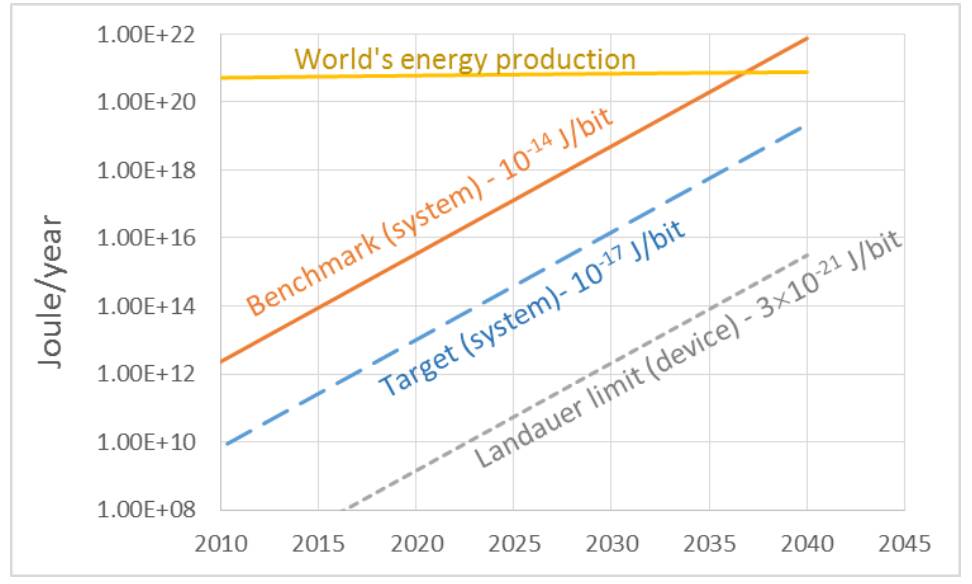
Such concern about energy efficiency appears to be appropriate given the findings of a 2015 Semiconductor Industry Association report [PDF] that, given a benchmark system of 10-14 Joules/per bit transition, "computing will not be sustainable by 2040, when the energy required for computing will exceed the estimated world’s energy production."
Graph from SIA report on the IT revolution ... Click to enlarge
Current processors operate at about 10-17 J/bit, which the SIA considers to be a workable target for more efficient computing, though the group said in a more recent report, "Revolutionary changes to computing will be required soon."
That report describes the growing energy usage of computing in less dire terms – as a limit to future computational capacity rather than a trend destined to devour all available energy. It notes that "the total energy consumption by general-purpose computing continues to grow exponentially and is doubling approximately every three years, while the world’s energy production is growing only linearly, by approximately 2 per cent a year."
At the end of 2016, California became the first state to approve energy efficiency limits for computers. At the time, the California Energy Commission (CEC) voted unanimously to adopt tighter appliance energy standards in an effort to meet climate policy goals. According to the 2016 CEC Staff Report, computers and monitors account for about 3 per cent of residential and 7 per cent of commercial energy use in the state.
Since then, other states have adopted similar energy standards for computers.
The Natural Resources Defense Council (NRDC) at the time projected that the California standards will "save more than 2.3 billion kilowatt-hours of electricity a year – equivalent to annual electricity use by all the homes in San Francisco – and avoid 730,000 tons a year of climate-disrupting carbon pollution from fossil fuel-fired power plants."
Tier I requirements took effect on January 1, 2019. As of July 1, 2021, Tier II requirements affecting desktop computers, thin clients and mobile gaming systems took effect.
And come December 9, 2021, "computers with high-speed networking capability, multi-screen notebooks, notebooks with cyclical behavior, and monitors with high refresh rates" will be covered by the rules.
A CEC spokesperson told The Register that staff was unaware of vendors not shipping to California as a result of the Tier II requirements taking effect.
- Boffins improve on tech that extracts DC power from ambient Wi-Fi
- Boffins say they've improved on algorithm for dynamic load balancing of server workloads
- Tomorrow's wireless world will be fatter, faster, and creepier
- Intel sponsors report on tech's role in decarbonisation and the irony isn't lost on us
The standards [PDF] specify energy consumption targets that cover four non-active usage modes – short-idle, long-idle, sleep and off-modes – tied to the device's "expandability score" (ES), based on the number and types of interfaces, and on additional power requirements arising from add-on capabilities (graphics cards, high-bandwidth system memory, etc.).
The requirements thus vary depending in the device's characteristics, but as a baseline, desktop computers, mobile gaming systems, and thin clients manufactured between January 1, 2019 and July 1, 2021 can consume no more than 50/80/100 kWh per year for ES scores of less than 250, 251-425, and 426-690 respectively.
For such devices manufactured after July 1, 2021, the kWh per year limit becomes 50, 60, and 75. The Alienware Aurora Ryzen Edition model cited above lists [PDF] a short-idle energy consumption of 66.29 watts and 563.01 watts when stressed.
A spokesperson for Acer, asked whether the rules affect any of its products, responded by saying the company is looking into the matter. HP did not respond to a request for comment. ®
Dell is no longer shipping energy-hungry gaming PCs to certain states in America because they demand more energy than local standards allow.