
The matter is closed.You may have settled it in your mind, and that’s ok, but as a nation it is not. I’m of the mind that the DOJ memorandum is sound. All I’m saying is it isn’t irrefutable because it hasn’t been tried in a court.

You are using an out of date browser. It may not display this or other websites correctly.
You should upgrade or use an alternative browser.
You should upgrade or use an alternative browser.
Mueller
- Thread starter Buy1Sell2
- Start date

meant to say "he might switch." wow, that must have gotten you excited when you read that. I could feel the love coming my way from you already. Sorry. I am not going to switch. As Bette Midler says: "I have standards. They are very, very low but I do have them." Also I am a registered independent so there is no "switching" involved with either party.
Although, every man knows that the lib women are easy, so it does have its advantages.
I see. It would be more likely Jones switch to republican or independent than Moore switch from Republican to anything else.
The current state of the Republican Party is due to Reince Priebus’ genius idea to have an “SEC Primary”. The south has risen again and a carpetbagger is leading them. Roy Moore fits in very well in the current Republican Party. He’s real comfortable.
Correct, so there would never be a need for a Special Counsel if the FBI could just investigate on their own. The reason we have one though is not to investigate anything they come across that leads to something else entirely like Ken Starr did. It is to investigate one specific crime and that crime only, not to go on fishing expeditions. Rod Rosenstein granted way too much power here as did previous orders before. ----By the way, the whole Special Counsel idea this time is unconstitutional anyway because there was no evidence of a crime which is prerequisite for appointing Special Counsel. ---Iny any event I'm still happy they are doing it to get this ridiculousness over with.---Mueller and cronies need to go though and scope needs to be limited.This is something you guys - especially Froggy - don’t understand, a special counsel doesn’t have any more power than a regular fbi Investigation.
As to your assertion that law enforcement should not be able to “get someone on anything” there are prisons full of people that agree with you but the law has a very long arm.
It is better to have Moore elected and then if removed he would be replaced with another Republican. It's the seat that we support, not Roy Moore.I see. It would be more likely Jones switch to republican or independent than Moore switch from Republican to anything else.
The current state of the Republican Party is due to Reince Priebus’ genius idea to have an “SEC Primary”. The south has risen again and a carpetbagger is leading them. Roy Moore fits in very well in the current Republican Party. He’s real comfortable.
Roy Moore fits in very well in the current Republican Party. He’s real comfortable.
Sure, he will be real comfortable in the Senate too.
Al Franken.......errrr.....not so sure yet.
Also unclear about Menendez. Don't forget that although he got hung jury that he may be tried again but either way....the FBI continues to stand by the assertion that they have evidence of his being with child prostitutes in Haiti or the domincan republic or some shithole country. That's another ticking timebomb as to when the senate has to deal with that.
Sure, he will be real comfortable in the Senate too.
Al Franken.......errrr.....not so sure yet.
Also unclear about Menendez. Don't forget that although he got hung jury that he may be tried again but either way....the FBI continues to stand by the assertion that they have evidence of his being with child prostitutes in Haiti or the domincan republic or some shithole country. That's another ticking timebomb as to when the senate has to deal with that.
I didn’t say Moore wouldn’t be persona non grata in the Senate. That man is going to need a good dog. But among the rising southern strain of the party, he’s a rock star. And that is the strain running the party right now. Bannon is more influential than Trump
Franken should be gone tomorrow and Menendez I don’t know. He has some issues at home but he’s a feisty one. He may survive.
Franken should be gone tomorrow and Menendez I don’t know. He has some issues at home but he’s a feisty one. He may survive.
Menendez makes the point that I keep banging on which is that the FBI gets to swing the big dicks and land on someone gangbusters with all guns blasting in court. But after they have had their little drama, they eventually find that the defendant actually gets to put on defense and some of them can afford quite a bit of defense and slam-dunk starts looking like a long hard slog where you might lose and get a hung jury if you are the prosecutor. Yet another case where the justice department threw everything it had at a big fish and lost. They are better at squeezing the little guys and getting pleas on perjury charges. Some of the big fish don't scare that easily.
As an aside, although Menendez is probably guilty and is a lefty scumbag, I am opposed to the government trying him again even though they have the right to do that. It gets to be harassment at a certain point as a substitute for just putting on a better case.
That time is coming at some point for Mueller.

Here's a great read on Andrew Weissmann.Now that it's been shown to be irrefutable that a president cannot be indicted, let's move on to why Mr. Mueller needs to be removed as Special Impeachment Counsel (SIC). Reason 1 --He hired Andrew Weissmann as investigator knowing full well his anti-Trump/pro-Hillary stance and also his failings and nefarious tactics in other cases, such as Enron. Weissman, as well as Mueller, should be removed from the witch hunt poste haste.
Please feel free to post your reasons here as well. --Izzy
https://www.washingtontimes.com/news/2017/oct/22/christopher-wray-robert-muellers-top-prosecutor-kn/
Mueller’s top gun in Russia probe known for hardball tactics, overturned rulings
Has history of intimidating low-level Mafiosos and corporate figures to force them to snitch
FBI Director Christopher A. Wray was an assistant attorney general in 2004 when he heaped praise on an ambitious Mafia-tested prosecutor while promoting him to the top of the Justice Department’s high-profile Enron task force.
Mr. Wray specifically lauded Andrew Weissmann for obtaining convictions against two Enron clients: accounting giant Arthur Andersen and executives at banking dynamo Merrill Lynch.
Andersen was finished as a company; four Merrill executives went to prison.
Today, Mr. Weissmann stands as special counsel Robert Mueller’s top gun in a squadron of nearly 20 prosecutors and scores of FBI agents delving into Trump-Russia. Mr. Weissmann is leading the probe into the biggest target to date, Paul Manafort, President Trump’s onetime campaign manager.
How Mr. Weissmann operated over a decade ago offers possible glimpses at how he carries out orders today from his longtime mentor, Mr. Mueller.
By the time he left in 2005, he had rung up some impressive numbers, such as 22 guilty pleas and millions of dollars in restitution. But he also suffered historic courtroom losses. And how he won and how he lost is still the subject of bitter comments from his adversaries in Houston.
“Do not misunderstand my disdain for him with ineffectiveness or something not to be concerned with,” said Dan Cogdell, who represented three Enron defendants. “He’s a formable prosecutor. If I’m Donald Trump and I know the backstory of Andrew Weissmann, it’s going to concern me. There is no question about it.”
The backstory: Defense attorneys say Mr. Weissmann bent or broke the rules. As proof, they point to appeals court decisions, exhibits and witness statements.
They say he intimidated witnesses by threatening indictments, created crimes that did not exist and, in one case, withheld evidence that could have aided the accused. At one hearing, an incredulous district court judge looked down at an Enron defendant and told him he was pleading guilty to a wire fraud crime that did not exist.
“Weissmann seemed more interested in obtaining convictions than in promoting justice,” said Tom Kirkendall, a Houston lawyer who represented an Enron executive.
Said Mr. Cogdell, a colorful courtroom performer dubbed a “gunslinger” by the local press, “He’s the most aggressive prosecutor I’ve ever been up against. He is, if not win at all cost, he’s win at almost any cost.”
Those convictions for which Mr. Wray offered praise in 2004?
Mr. Weissmann’s cases against Andersen and Merrill Lynch lay in shambles just a few years later.
The Supreme Court, in a 9-0 vote in 2005, overturned the Andersen conviction. A year later, the 5th U.S. Circuit Court of Appeals erased all the fraud convictions against four Merrill Lynch managers. The jury had acquitted another defendant.
“People went off to prison for a completely phantom of a case,” said Mr. Kirkendall.
Mr. Kirkendall became sort of an unofficial Enron historian. He observed goings-on at the Houston federal courthouse and blogged about what he considered a systematic miscarriage of justice.
The task force, which ultimately would catapult prosecutors to lucrative careers, wanted to win as many convictions as possible. They were prosecuting players in one of the nation’s biggest corporate scandals. Enron bosses falsified balance sheets, inflated earnings and traded stocks with insider knowledge. By 2001, the behemoth went bankrupt. Its stock was worthless.
The Justice Department task force mobilized in 2002 and quickly won convictions. But there were dark sides.
That’s where Sidney Powell enters the picture. The Dallas lawyer took the appeal of a Merrill Lynch figure. She obtained from Justice a batch of task force documents in 2010 that should have been disclosed to trial attorneys years earlier.
The documents began to flow in the aftermath of the Sen. Ted Stevens debacle. Justice prosecutors not connected to the Enron task force deliberately withheld evidence favorable to Stevens. A judge threw out his conviction.
Ms. Powell wrote a 2014 book about the scandals, “Licensed to Lie: Exposing Corruption in the Department of Justice.”
“All of the cases Weissmann pushed to trial were reversed in whole or in part due to some form of his overreaching and abuses,” Ms. Powell told The Washington Times. “The most polite thing the Houston bar said about Weissmann was that he was a madman.”
The special counsel’s office declined to comment to The Times about Mr. Weissmann’s track record.
However, the Justice Department in 2012 and 2013 defended him against ethics complaints and concluded he did not violate the rules.
Given Mr. Weissmann’s long association with Mr. Mueller, who has given him a prominent management role in one of the most important investigations in U.S. history, The Times took a look back at Mr. Weissmann‘s’ 2002-05 Enron task force tenure.
His hardball tactics seem intact today. Within weeks of his arrival in June, the FBI executed a no-knock, predawn raid on Mr. Manafort’s condo. Agents stayed for hours after waking up the target and his wife.
Then a leak appeared in The New York Times. Mr. Mueller had informed Mr. Manafort that he would be indicted. It’s an old Enron tactic: Scare people into talking.
Arthur Anderson
With over 20,000 employees, Andersen stood as one of the country’s most prominent corporate auditors. The Securities and Exchange Commission began investigating Enron, an Andersen client. Auditors started destroying documents.
Mr. Weissmann took the lead in prosecuting Andersen for obstruction of justice in 2002. Andersen’s defense: It followed company policy on when to destroy confidential material.
Convicted at trial, a fatally damaged Andersen appealed. The Supreme Court eventually took the case.
In 2005, the nation's highest court overturned the conviction in a 9-0 opinion, a devastating judgment that shattered Mr. Weissmann’s showcase.
Chief Justice William H. Rehnquist wrote the opinion, solo — a message of how seriously the high court took the breach.
In essence, Rehnquist said the prosecutor sold the presiding judge on jury instructions that assured conviction.
“Indeed, it is striking how little culpability the instructions required,” Mr. Rehnquist wrote. “For example, the jury was told that, even if [Andersen] honestly and sincerely believed that its conduct was lawful, you may find [Andersen] guilty. The instructions also diluted the meaning of ‘corruptly’ so that it covered innocent conduct.”
Mr. Rehnquist wrote that the government (Mr. Weissmann) insisted, over defense objections, that the word “dishonestly” be excluded from the instructions and that the word “impede” be added.
The chief justice went to the dictionary, read the meaning of “impede” and concluded it was “such innocent conduct” for someone to “impede” the government.
Said Ms. Powell, “Weissmann indicted them for conduct that was not criminal, and he took criminal intent out of the jury instructions that he then persuaded the judge to give.”
With a lack of sustaining clients, a mortally wounded Andersen put out a statement.
“We are very pleased with the Supreme Court’s decision, which acknowledges the fundamental injustice that has been done to Arthur Andersen and its former personnel and retirees,” it said.
In the end, the George W. Bush Justice Department put out of business a thriving accounting firm whose actions could have been handled in other ways short of felony charges.
Merrill Lynch
It became known as the Nigerian barge case. Mr. Weissmann induced indictments in 2003 against four Merrill Lynch executives, an Enron vice president and an Enron accountant. He contended that Merrill and Enron entered into a sham transaction in 1999. The banker would buy three Enron barge-mounted power generators for $7 million purely to boost the Houston company’s balance sheet — and then Enron would buy them back at a profit.
They were charged under a federal statute that normally requires proof that someone paid a bribe or received kickbacks that sullied the business practices of “honest services.” There were no bribes or kickbacks.
Five were convicted. The accountant — represented by Mr. Cogdell — heard the jury say, “Not guilty.”
Four of them appealed while serving time in prison. In 2006, the 5th Circuit reversed all the fraud charges, leaving just a perjury conviction against one executive, whom Ms. Powell came to represent on appeal.
Again, the problem for Mr. Weissmann was his definition of a crime that greatly relaxed the standard for convictions.
“We reverse the conspiracy and wire-fraud convictions of each of the defendants on the legal ground that the government’s [Weissmann task force] theory of fraud relating to the deprivation of honest services is flawed,” the appeals court said.
The opinion said the scheme may have been unethical but did not violate federal fraud laws. The court said that not all corporate fiduciary lapses are tantamount to crimes.
Attorney Kirkendall said the Enron trials in Houston were held “in a highly inflamed environment.”
“The task force took advantage of that and convicted these men,” he said. “What it caused them and their families, you can just imagine.”
The government did not retry the five on fraud charges.
Concealed evidence
What the Merrill defense attorneys did not know during trial was this: There were favorable witness statements that the prosecution withheld.
In 2010, Justice began releasing confidential Enron task force documents. They showed that Mr. Weissmann’s team provided misleading summaries at trial of raw witness statements to the FBI and to the grand jury.
The disconnect became an issue in the appeal of Ms. Powell’s client, Merrill executive James A. Brown, in the Nigerian barge case. Although his fraud conviction went away, his perjury guilt stuck.
Ms. Powell was particularly struck by this: The government’s summary said a witness, Enron’s Jeffrey McMahon, “does not recall” a barge buyback agreement. In in his actual interview, he said there was no deal. The prosecution badly distorted what he had said, depriving trial attorneys of information that could persuade a jury to acquit. Mr. McMahon was under threat of indictment and did not testify.
The 5th Circuit agreed — to a point.
“Favorable information was plainly suppressed from McMahon’s notes,” the court wrote.
“The McMahon notes contain numerous passages that unequivocally state that it was McMahon’s understanding that there was only a ‘best efforts’ agreement and no ‘promise,’ whereas the government’s disclosure letter says only that McMahon ‘does not recall’ a guaranteed buyback.”
Even worse, Ms. Powell said, the documents showed that Weissmann’s team yellow-highlighted favorable information that it deliberately withheld from its proffered summaries.
Yet, to Ms. Powell’s great disappointment, the appeals court did not throw out the perjury conviction. It said the prosecution “flaw” was not material.
William Hodes, an analyst on legal ethics who assisted in the appeal, found the ruling “crazy.” The judges acknowledged that the prosecutors misled the defense, yet they somehow could predict it would have made no difference at trial.
“The summaries were false,” Mr. Hodes told The Times. “They said things that the witnesses did not say. They themselves yellow-highlighted what they left out of the summaries. It’s astonishing. We should have gotten a new trial.”
Chilling witnesses
When the task force brought indictments in July 2004 against the big cheese in the Enron saga — Kenneth L. Lay, Jeffrey Skilling and Richard Cause — defense attorneys ultimately learned that Mr. Weissmann had done something even more far-reaching. In a sealed court document, he named 114 unindicted co-conspirators, the Houston Chronicle reported.
Defense attorney Kirkendall did some research. He found that it was by far the largest number of such targeted people in the history of federally prosecuted white-collar crime.
The significants: Defendants at trial hoped that some Enron executives would testify on their behalf. But those hopes collapsed on the list of 114.
“Chilling effect, my ass,” said attorney Cogdell. “It was Ice Station Zebra. No one in their right mind would do anything that would upset the task force, specifically Weissmann.”
Mr. Kirkendall believes Mr. Weissmann made the list for that exact reason.
“It was common knowledge in the Houston community,” he told The Times. “If you had a client who was cooperating with defendants in an Enron criminal prosecution, you’d better be careful because they would become a target.”
Mr. Kirkendall knows firsthand. In civil matters, he represented Mr. McMahon, the follow-on chief financial officer at Enron who ended up as one of the 114.
The Merrill Lynch defendants wanted Mr. McMahon to testify. But he planned to take the Fifth Amendment if called because Mr. Weissmann had made it clear on three occasions that he could be indicted.
“We had him ready to post bail and go through the arraignment process because of pressure being applied by the government not to testify for any of the defendants,” he said.
Mr. McMahon never testified. He was never indicted.
The incredulous judge
As he was leaving the task force in July 2005 to accept his first of three stints as an aide to FBI Director Robert Mueller, Mr. Weissmann announced a new guilty plea.
Christopher Calger, then a 39-year-old former Enron vice president, pleaded guilty in a Houston courtroom to fraud. The FBI issued a national press release saying Mr. Calger admitted to making a deal with two businesses that inflated Enron’s earnings. Mr. Calger agreed to become a prosecution witness.
But the announcement did not tell the full story of the hearing that day.
District Court Judge Lynn N. Hughes read the evidence and expressed incredulity that Mr. Calger was pleading guilty.
According to a court transcript, Judge Hughes grilled Linda Lacewell, one of Mr. Weissmann’s prosecutors. He asked her repeatedly to explain what the actual crime was. He said Enron lost no money, there were no bribes and the basic mechanism for the sale of some electric turbines was legal.
Ms. Lacewell said Enron should never have put proceeds on its balance sheets, echoing the 2003 prosecution of Merrill Lynch people in the Nigerian barge transaction.
The judge: “You don’t know the difference between their capital and their current income transaction?”
And he said, “But we do know that this transaction could not have been a tax avoidance scheme, right?”
Ms. Lacewell: “That’s right.”
She then said the plea was to wire fraud, not taxes. To that, Judge Hughes said the task force was trying to criminalize a private transaction to which all parties agreed.
“So you want to convert every default by a corporate officer into a wire fraud case,” he said.
When she explained the deal, the judge replied bluntly, “That’s not wire fraud.”
When she asserted that it was, Judge Hughes lashed out at the task force.
“According to your employer, everything is wire fraud,” he said. “It’s a far cry from what the statute was intended to do when it was adopted.”
But Mr. Calger persisted. He wanted to plead guilty, to which the judge said, “There’s no factual basis for your plea.”
The judge did not know then, but his spot courtroom lecture proved prescient. A year later, the 5th U.S. Circuit Court of Appeals came to the same conclusion and ruled in the Merrill case that there was no wire fraud.
In 2007, a Houston judge erased Mr. Calger’s conviction. He never testified in an Enron trial.
Attorney Kirkendall said the financial strain of legal bills for years while fighting a powerful government task force played a role in Mr. Calger’s decision to plea.
“The Enron task force’s public relations campaign was far better than its actual prosecutions,” he said.
The task force rattled other potential defense witnesses. But at least one bucked the juggernaut and took the stand as a defense witness in the so-called Enron Broadband Services case.
Mr. Weissmann in 2003 brought charges against executives for ballyhooing the development of internet products to drive up the share price and make an insider stock killing.
At a 2005 trial, engineer Lawrence Ciscon took the stand for the defense. Mr. Ciscon, who had been vice president for software at EBS, said he met with the FBI two times. They never informed him that he was a target. Then he obtained an attorney. The next thing he knew, the task force had labeled him as an unindicted co-conspirator.
As the trial approached and he worked with the defense, prosecutors reminded his attorney of that status.
“They’ve called my lawyer to remind me,” he testified, according to a transcript reviewed by The Times.
He viewed the calls, he said, “as a threat that I could be prosecuted.”
The threats, he said, “made me hesitant” to appear in court. Asked by the defense why he decided to show up in court, he answered, “I have nothing to hide.”
“Regardless of the outcome of this trial, the Enron task force’s ugly tactic of effectively suppressing important testimony of witnesses favorable to Enron defendants has now been fully exposed,” Mr. Kirkendall blogged at the time.
The task force never charged Mr. Ciscon, who went on to a successful technology career.
Today
Justice Department press releases in the 2000s would tout the number 30 as in over 30 people charged in the Enron saga.
But final conviction count is short that number given that appeals courts eviscerated two major cases — Merrill Lynch and Arthur Andersen — while juries acquitted two people and partially acquitted others and two were allowed to withdraw guilty pleas.
In all, 22 pleaded guilty and four trial convictions stuck, according to a Houston Chronicle list.
Afterward, some task force prosecutors rose to significant government posts.
Mr. Weissmann joined Mr. Mueller at the FBI and then arrived at a powerhouse New York law firm as a white-collar-crime defense specialist. He returned to the FBI as Mr. Mueller’s general counsel and, later, was appointed by the Obama administration as chief of Justice’s fraud unit in Washington.
FBI Director Christopher Wray, the Justice Department assistant attorney general who named him task force chief a decade ago, is now supplying Mr. Weissmann with the FBI manpower he needs to pursue Trump-Russia.
Kathryn Ruemmler prosecuted both the Merrill defendants and Lay-Skilling. Years later, she emerged in the prestigious post of White House counsel to President Obama.
Lisa Monaco, another task force prosecutor, stayed at Justice, was Mr. Mueller’s chief of staff and then went to the Obama White House as the president’s top counterterrorism adviser. She joined CNN as an analyst this year.
Whether Mr. Weissmann’s brand — intimidating low-level Mafiosos and corporate figures to force them to snitch — will work in Washington against political operatives will be answered in the coming months.
Last edited:
and now Reason #2
--It would appear that Mr Mueller needs to follow Trent Franks lead--
https://www.washingtontimes.com/news/2017/aug/1/robert-mueller-must-resign-russia-probe-due-james-/
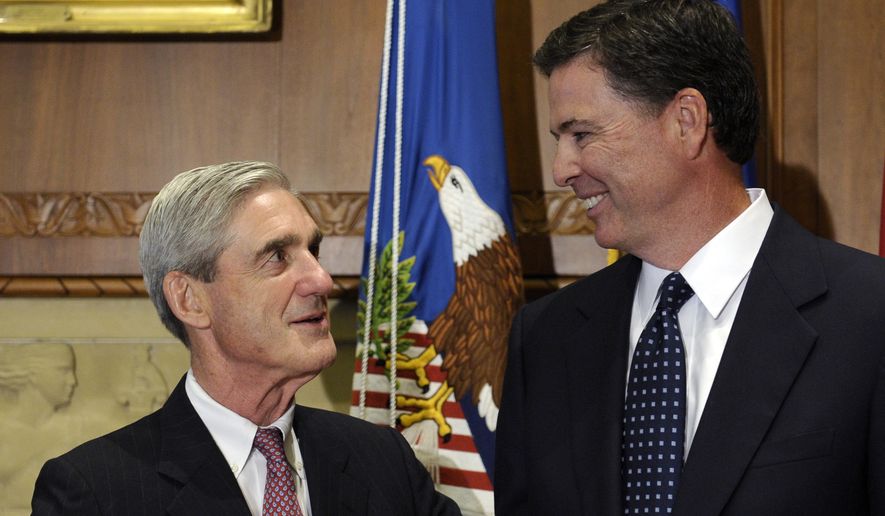
A Republican congressman is calling on Special Counsel Robert Mueller to resign from his role leading the Russia investigation, citing the investigator’s friendship with former FBI Director James B. Comey.
Rep. Trent Franks said Mr. Mueller’s relationship with Mr. Comey should make him ineligible to lead a probe of Russian interference in the presidential election and any possible coordination with the Trump campaign — the investigation includes whether the president fired the FBI director in an effort to undermine the investigation.
“Those who worked under them have attested he and Jim Comey possess a close friendship, and they have delivered on-the-record statements effusing praise of one another,” Mr. Franks, Arizona Republican, said in a statement issued Tuesday. “No one knows Mr. Mueller’s true intentions, but neither can anyone dispute that he now clearly appears to be a partisan arbiter of justice.”
Mr. Franks, a member of the House Judiciary Committee, cited federal law that prevents the special counsel from serving in the role if the person has a conflict of interest. In Mr. Mueller’s case, the lawmaker said that conflict is “a personal relationship with any person substantially involved in the conduct that is the subject of the investigation.”
Mr. Mueller was appointed to lead the FBI by President George W. Bush. He headed the bureau for 12 years before Mr. Comey was appointed in 2013, but the two men worked together for a time when Mr. Comey served as deputy attorney general.
The decision to appoint Mr. Mueller as special counsel fell to Deputy Attorney General Rod Rosenstein as Attorney General Jeff Sessions recused himself from all investigations related to the presidential campaign. The appointment was made a week after Mr. Trump fired Mr. Comey.
Mr. Franks’ call for Mr. Mueller’s resignation comes as other lawmakers have expressed concern that the president may be looking to fire his attorney general as a vehicle for removing the special counsel or curtailing his investigation.
Mr. Trump has expressed disappointment over the fact Mr. Sessions recused himself from the investigation, meanwhile members of his administration have been critical of some of the attorneys Mr. Mueller has selected for his special counsel team and the widening scope of the investigation.
Mr. Mueller is a registered Republican.
--It would appear that Mr Mueller needs to follow Trent Franks lead--
https://www.washingtontimes.com/news/2017/aug/1/robert-mueller-must-resign-russia-probe-due-james-/
A Republican congressman is calling on Special Counsel Robert Mueller to resign from his role leading the Russia investigation, citing the investigator’s friendship with former FBI Director James B. Comey.
Rep. Trent Franks said Mr. Mueller’s relationship with Mr. Comey should make him ineligible to lead a probe of Russian interference in the presidential election and any possible coordination with the Trump campaign — the investigation includes whether the president fired the FBI director in an effort to undermine the investigation.
“Those who worked under them have attested he and Jim Comey possess a close friendship, and they have delivered on-the-record statements effusing praise of one another,” Mr. Franks, Arizona Republican, said in a statement issued Tuesday. “No one knows Mr. Mueller’s true intentions, but neither can anyone dispute that he now clearly appears to be a partisan arbiter of justice.”
Mr. Franks, a member of the House Judiciary Committee, cited federal law that prevents the special counsel from serving in the role if the person has a conflict of interest. In Mr. Mueller’s case, the lawmaker said that conflict is “a personal relationship with any person substantially involved in the conduct that is the subject of the investigation.”
Mr. Mueller was appointed to lead the FBI by President George W. Bush. He headed the bureau for 12 years before Mr. Comey was appointed in 2013, but the two men worked together for a time when Mr. Comey served as deputy attorney general.
The decision to appoint Mr. Mueller as special counsel fell to Deputy Attorney General Rod Rosenstein as Attorney General Jeff Sessions recused himself from all investigations related to the presidential campaign. The appointment was made a week after Mr. Trump fired Mr. Comey.
Mr. Franks’ call for Mr. Mueller’s resignation comes as other lawmakers have expressed concern that the president may be looking to fire his attorney general as a vehicle for removing the special counsel or curtailing his investigation.
Mr. Trump has expressed disappointment over the fact Mr. Sessions recused himself from the investigation, meanwhile members of his administration have been critical of some of the attorneys Mr. Mueller has selected for his special counsel team and the widening scope of the investigation.
Mr. Mueller is a registered Republican.