
So the Democrats in year 2000 who drew the districts are Conservatives. Good to know.
Which page of the book you recommended says this?
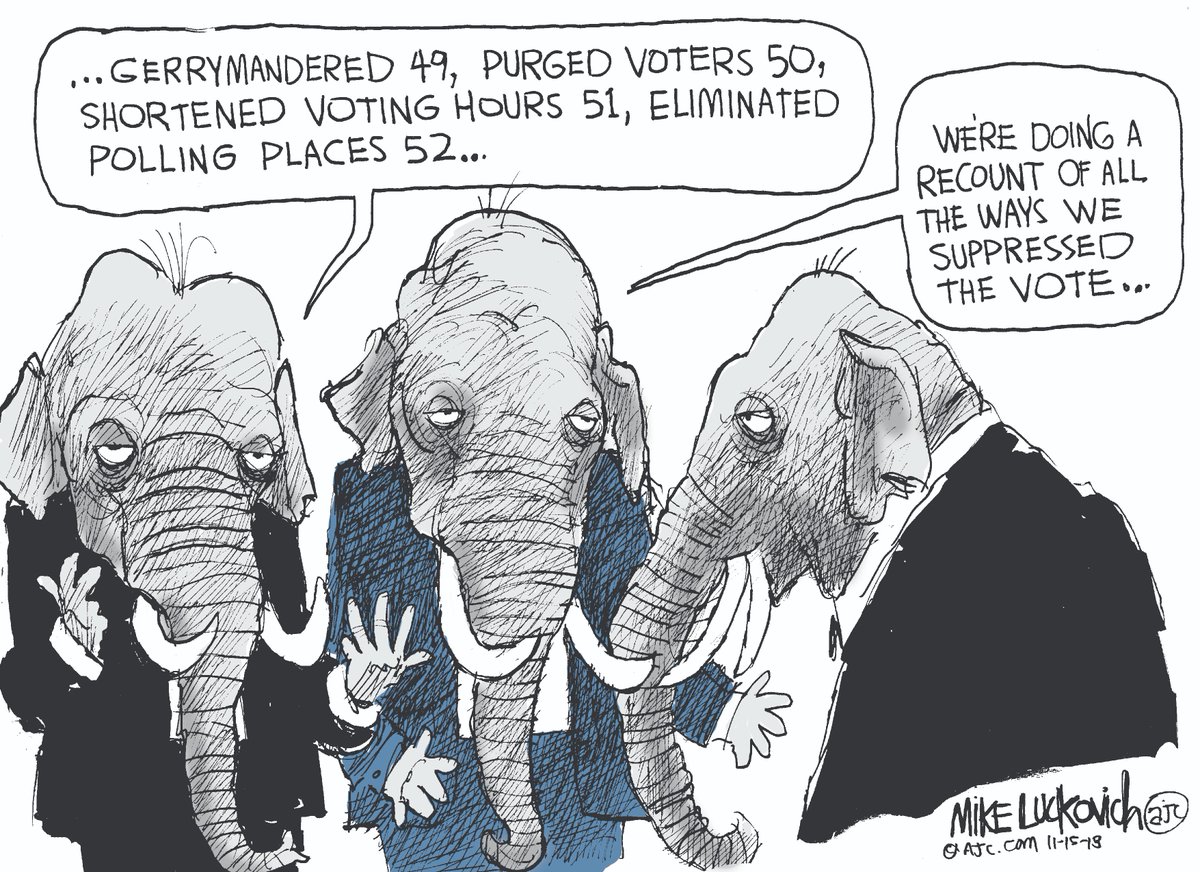

So the Democrats in year 2000 who drew the districts are Conservatives. Good to know.
Which page of the book you recommended says this?
And where do you have any evidence that Republicans in the North Carolina legislature purged voters, shortened voting hours, and eliminated voting places.
https://www.brennancenter.org/blog/florida-georgia-north-carolina-still-purging-voters-high-rates
https://www.theatlantic.com/politics/archive/2016/11/north-carolina-early-voting/506963/
https://www.newsweek.com/almost-half-north-carolina-counties-shut-down-polling-places-1136813
https://www.nbcnews.com/news/nbcblk/study-north-carolina-polling-site-changes-hurt-blacks-n468251
Got more questions? You know who to ask.
So your Newsweek articles outline how the North Carolina state legislature extended early voting hours and made them uniform as 7am to 7pm across the state.
"But local election officials from both parties regard the new measures as a burden that make it more difficult to vote, even if the altered practices mean that polls will be open for early voting almost 24,000 more hours."
How in your fantasy is this voter suppression?
"20 percent fewer early voting locations during the 2018 elections than it did in 2014"
Cutting locations in Dem areas while increasing areas everywhere else cuts down the Dem vote, that's how.
Actually you are not aware of the context of the reduction in polling places, nor did you read the articles in detail.
Traditionally North Carolina counties have used small private venues as polling places. The typical example being churches. Many older churches are small, have limited parking, and have issues with handicap accessibility.
The trend in North Carolina is to move polling to large venues which are public such as community centers, libraries and larger schools (High Schools) with sizable gyms that can be used for voting . These venues have more parking and have better accessibility.
The actual throughput of voters and the number of voters served is actually better in these larger venues. Also the selection of larger venues is normally done in a manner to provide better geographic diversification. Smaller venues tended to cluster (for example most small churches are all located in one area of many towns).
There is also the reality that many private venues no longer desire to host voting. The private venue still has the responsibility of opening up early, staffing for support of the building, closing up and cleaning up.
Keep in mind that it is the county election boards that make decisions on venues - not the state government. The trend has been in place for years towards using a smaller number of larger venues. The trend is driven by public accessibility & parking as well as the cost of manning all the locations.
