
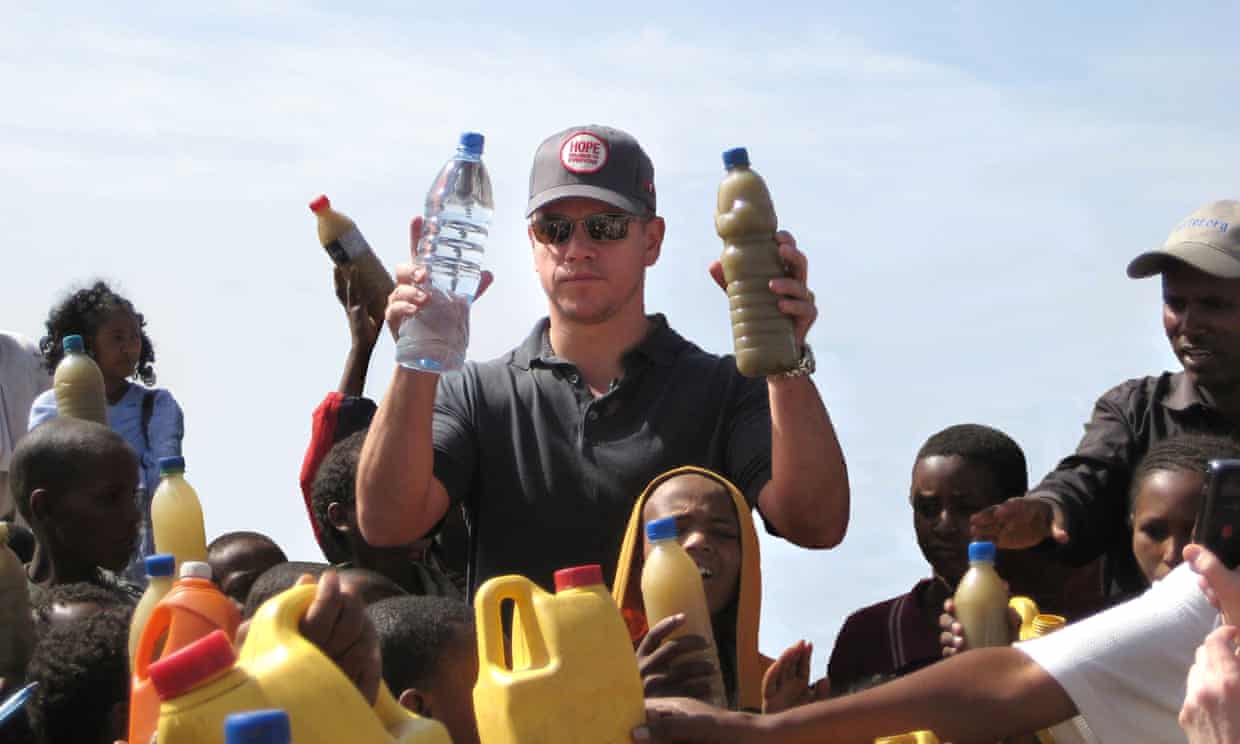
Matt Damon: ‘Children are drinking water so dirty it looks like chocolate milk’

Perhaps we do need to love God more, than any Science advancements which undoubtedly can make rich people richer, much much richer!

Even nuclear warfare!
3000.jpg
Matt Damon visits a well just outside Mekele, Ethiopia, in 2009. In his right hand he holds a bottle of regular water, in his left is a bottle of dirty water local children in Mekele drink every day.


Global development

Matt Damon: ‘Children are drinking water so dirty it looks like chocolate milk’

The Hollywood star reveals how a conversation with an ambitious 14-year-old in Zambia inspired a project to help people in dire need of clean water

David Smith in Washington

Tuesday 25 April 2017

https://www.theguardian.com/global-...g-water-so-dirty-it-looks-like-chocolate-milk

Damon explains: “The poorest of poor are actually already paying for water, and in a lot of cases paying more than the middle class. If you’re not connected to the infrastructure then you’re taking time away from a job to go to a common water source and spend hours waiting in line with your jerrycan to fill up and bring it home. It’s incredibly inefficient.”

These people are wasting time and money – for example on bottled water from vendors that can cost 10 or 15 times more than tap water – at an estimated worldwide cost of $300bn (£235bn) a year, White says. White’s big idea was to find a way to redirect that money to connecting homes and installing toilets. The “community buy-in” is seen as a better long-term bet than aid dropped from on high; Damon remembers seeing a state-of-the-art well system in India that had fallen into disrepair, forcing children to revert to a hand-dug well with water “so dirty it looked like chocolate milk”.
 
Last edited:
6b143bed530619ff03829e8af355688a.jpg
The real pieces of oceanic plastic garbage are typically smaller than your pinky fingernail.


The Largest Landfill On Earth: Plastic Garbage In The Oceans?

By Amy Gleich - Jul 15, 2014

http://oilprice.com/Energy/Energy-General/Plastic-Garbage-in-the-Oceans-Thats-Rubbish.html

Think about the last time you got takeout or ate at a fast food restaurant. Or the last time you bought a pre-packaged food item from a store, or drank a bottle of water or soda. Chances are, plastic was involved in all those items -- plastic that will still be around up to 1,000 years from now.

Americans throw away over 30 million tons of plastic every year, of which only about 25 percent is recycled. The rest goes to landfills. Unfortunately, the largest “landfill” on Earth is actually in the North Pacific Ocean.

The “Great Pacific Garbage Patch” is estimated to be anywhere from 3,100 square miles to twice the size of Texas.


AE3402.jpg
 
Last edited:

World Military Spending

by Anup ShahThis Page Last Updated Sunday, June 30, 2013
http://www.globalissues.org/article/75/world-military-spending

" Of all the enemies to public liberty war is, perhaps, the most to be dreaded because it comprises and develops the germ of every other. War is the parent of armies; from these proceed debts and taxes … known instruments for bringing the many under the domination of the few.… No nation could preserve its freedom in the midst of continual warfare. " - James Madison, Political Observations, 1795

world-spending-88-12.png


us-spending-2001-2014.png
 
Perhaps we do need to love God more, than any Science advancements which undoubtedly can make rich people richer, much much richer!

Even nuclear warfare!

3000.jpg
Matt Damon visits a well just outside Mekele, Ethiopia, in 2009. In his right hand he holds a bottle of regular water, in his left is a bottle of dirty water local children in Mekele drink every day.

Those kids really should buy a water filter. They can buy a brita water filter with 10 filters at costco for about $50. It should last about 2 years.
 
Another way for fire fighting:


A Water and Sanitation Needs Assessment for Mekelle City, Ethiopia ...

This needs assessment identifies the main water and sanitation challenges in Mekelle and the investment levels required to meet Target 10 of United Nations .

https://academiccommons.columbia.edu/catalog/ac:125887

This needs assessment identifies the main water and sanitation challenges in Mekelle and the investment levels required to meet Target 10 of United Nations Millenium Development Goals (MDG) 7. There is a need to improve water supply and sanitation, sewage treatment and hygiene education in Mekelle. The findings of this needs assessment indicate that in order to meet MDG targets related to water and sanitation, spending per capita needs to increase from about $10 in 2010 to $12 in 2015. MCI believes that this modest increase made over five years can dramatically improve Mekelle citizens’ access to safe water and sanitation as well as the public health citywide and is well worth the incremental additional investment.
 
Water is mentioned but water problem is not on this page, at all.

https://unlimitedjca.com/what/eit-m-ethiopian-institute-of-technology-in-mekelle/

The Ethiopian Institute of Technology in Mekelle is part of Mekelle University that has short but complex history. The city of Mekelle is situated in northwestern Tigray region, in the region rich in cultural and architectural heritage. The Institute offers various programmes – architecture and urban planning among them.


Improved water and land management in the Ethiopian ...

books.google.com.au
Awulachew, Seleshi Bekele, Erkossa, Teklu, Smakhtin, Vladimir - ‎2009 - 310 pages
The Effect of Integrated Soil and Water Conservation Measures On Soil Physical and Chemical Properties, A Case For Enebsie Sar Midir Wereda, Ethiopia. A Thesis Paper, Mekelle University, Mekelle. Landon, J.R., 1991. Booker Tropical Soil ...


Groundwater in Ethiopia: Features, Numbers and Opportunities

books.google.com.au
Seifu Kebede - ‎2012 - 283 pages - More editions
Groundwaters in the Mesozoic sediments of the south eastern Ethiopia are generally high in their HCO3, SO4 and Ca contents. ... Water Quality Risks In the Mekelle Outlier water quality is the principal challenge for groundwater resources
 
Back
Top