MAs.. usefulness comes and goes

I use a cyclical indicator "Whiter is Brighter". I have yet to find an MA I am happy (and profitable) with. For those who do offline analysis, I think the ultimate MA is an IIR in forward-backward mode, ala Gustafsson, a true zero group delay filter.

First Order Filter or Holt’s Two Parameter Linear Exponential Smoothing function?
 
First Order Filter or Holt’s Two Parameter Linear Exponential Smoothing function?
The same physics applies. The higher the frequency cutoff of the filter, the less group delay. The less group delay a filter has, the less attenuation ability.

A lot of people over the years have written about Kalman filters in finance. A Kalman filter is really an estimator rather than a traditional digital filter. However, no matter what flavor of Kalman filter you use, they don't really seem to perform any better than digital filters. That is because you need to understand the distribution of the statistics of the process you are dealing with. Financial time series have a much more complex underlying process than say a satellite orbiting the earth.
 
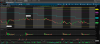
I trade on the 5 or 15 minute charts with the the daily moving averages displayed on it. Look at how Tesla tried to hold above its 200-Day @$217 until 10/25 @115pm when it finally collapsed. It couldn't do it. The RSI was indicating weakness.
 

Attachments

  • TSLA.PNG
    TSLA.PNG
    101.7 KB · Views: 34
Last edited:
.

Ahem... some individuals have found value in utilizing the slopes of medium term moving averages like EMAs and WMAs to try to trade with the trend :). My preference is to only accept long entry signals when the slope is up and opposite for shorts.

Combining them with a good momentum indicator can point out low points in price where one can look for long entries as well as peaks in price where one could look to place sell orders. Other factors should be taken into consideration too like candle structure, position of the close, risk:reward ratio, etc.

The chart below is the same one shown in post #1. It shows a 40 period EMA plus a momentum indicator called the Ehlers Stochastic, which is similar to the fast line of the regular Stochastic indicator but better because it can still point out extremes when prices are moving in a long linear trend. Conventional Stochastics and RSI and some other momentum indicators don't show extreme values very well in strong trends, though these extremes are often the preferred places to initiate buy and sell trades.


View attachment 326304

Ditto.

I illustrated the 50, 100, 200 MAs because those are the most commonly followed. However over any particular time, one can try different periods to see if one fits better than others.
 
I trade on the 5 or 15 minute charts with the the daily moving averages displayed on it. Look at how Tesla tried to hold above its 200-Day @$217 until 10/25 @115pm when it finally collapsed. It couldn't do it. The RSI was indicating weakness.
Check out ROC RateofChange as opposed to a MA especially one as long as 200 for intra day.
No averaging, although I plot an MA of the ROC, which is very secondary. Entry and exits are both earlier.

Also did you note where the 200 MA was from the 18th to 23rd? For 5 days it was MIA.

! TSLA ROC.png
 
Check out ROC RateofChange as opposed to a MA especially one as long as 200 for intra day.
No averaging, although I plot an MA of the ROC, which is very secondary. Entry and exits are both earlier. View attachment 326338
.

I have struggled to formulate good rules for using ROC indicators that would allow them to be incorporated into new or existing trading systems.

I believe the classical approach was to take buy signals when the ROC line is above its center line and take sell signals when it is below. However, prices often go down for a long time while it's above or go up for a long time while it is below...

What do you think is the best way to use this type of indicator?
 
Back
Top