Ok, I will for now let all this IBGS/Doji doubts aside for now. I'll give it a rest.
Of course, if anyone knowing and understanding what i'm doing, have the questions that I must ask myself to solve this out, feel free to interact.
I'll focus now on
9 : this one deals with the next and last one and they both are the biggest ones. The biggest not because they are the two biggest doubts I have, but because it’s what have most consequences on my understanding of the chart. I am uncapable of passing from a n+1 bar status to a n+2 bar status ALONG THE SAME BAR. But I am capable of passing from a n to a n+1 bar status along the same bar. And I am capable of passing from an n+2 to an n to an n+1 bar status along the same bar. In fact, the massive importance of the doubt I have here comes from this still unsolved question : after being sent to A by J/K during a bar, is there a possibility to see, later in the same bar, the bar bar have the status of a n+1 node. It makes the link with point 11.
I have hesitated a lot before continuing today. It's a hard day.. I’ve held on a bit more.
I think this deals with D node.
So in an attempt to solve point 9, I’ll use the work I’m gonna do on point 4 which was "the reference trough - D node.
The idea of going up in the list is because after prior post, I glanced at the Cycle 1 chart.
I feel that I need to begin with the very first node that bothers me in the OOE of the chart. Being as I’m ok now with C node thanks to my recent research and work on midday, I am ok with A, B and C nodes. Which is the next one ? D. And I’ve a problem with it. So….Let’s go with it.
D node study
Between MADA doc, 3x5 cards and sheets that’s what I have.
-FIND TROUGH @look back @ open.
-D is a point at the end of a bar. At the next bar (n+1) open, it is determined that bar n is a trough. PRV is used at 12sec into the bar.
- D Reference Look back NODE
Sit is Wait – Establish reference trough as bar n
OR BEFORE
Look for beginning of dominant move on n+1 open
ENTER on open
Merging and shaking it all, this is what results atm in my thinkin
- It’s a good idea to be back to that node. It seems that D node is a crucial node.
- I need to reread material from JH on ExSc about D node.
- The « OR BEFORE » makes a big difference.
- Reviewing sheet 3, I notice troughs are the explicit reference point for dominant moves.
- Many further doubts in the cylce 1 come from this misunderstanding of the D node
What makes all this hard is that to unlock it, one must ignore/go against prior DDs that were true at a given moment, and that are in the end, so at the moment of truth, false.
That’s the biggest difficulty.
Thus why, apparently paradoxally but, in reality, complementaritely, all this stuff (like any other in fact, when approached in the radical methodology) deals with both PATTERNS AND DE-PATTERNING.
Let’s go.
From what I read about D node, it’s the one that allows one to establish a reference. We always need a reference in volume coupled with a reference for price, for a given trend in question. If I talk about this in the most granular so smaller POV, it’s a tick POV.
I know a trend always follow the same OOE. This OOE is a combination of volume/price points and moves.
It’s always better to analyse a trend by showing its birth point inside a former trend failing to pursue its completion, AND by showing the former trend within which it was born. But in any case, any trend, at the highest level of awareness, is either a C or a D set of trend, RDBMSly speaking.
The point in volume beginnng a container is a peak. To be more precise, this peak in volume is the end of a Dom leg of a slower container containing it at a higher level of fractal. When this given Dom leg ends, a new leg begins. In the current higher=slower level of fractal, this new leg is at first, non-Dom by nature. It’s either the 4th, 6th, 8th etc. leg of the current slower container, depending on its level of completeness into completeness (C or D set).
We’ll use a short trend that was a C set, just formed. And we say that the 3rd leg failed to reach LTL, and begins to go back to the RTL. At the MADA oriented POV, we already know from volume that this fourth leg beginning won’t be a retrace, but it’ll be a reversal, therefore a new trend of the same level of fractal as prior one (the slower encapsulating the 3 legs) has just begun.
So, let’s illustrate each step we do.
As in any C set of trend, at the highest level of awareness, being as a reversal has just begun, we know pt2 of the new trend will cross prior established RTL.
For that, we know volume must increase. Being as at beginning of any reversal (it would be the same for any retrace) volume decreases, if we want to see it increase when crossing RTL, this obligates to have a trough on the volume sequence. This is the B2B in our example. The first B is for the part of the forming long leg from ftt/pt1 to rtl, 2 is for the momentum when price crosses rtl and second B is for the part of the forming long leg between crossed RTL and pt2 that will surge.
After that, pt2 of the new container appears. This is necessarily on a peak of volume. After pt2 creates, the long leg which is the first leg of the new long container, fails to continue. Dominance ends, and as a result, volume begins to decline. Price does so, and goes short. At last, volume stops decreasing, and begins to be back on an increasing move. This move ends leg 2, and volume creates a trough. That’s the second trough of the currently-forming long container. After increasing for the second time, volume stops. It makes a peak, and the 3 leg has just ended. We end this point 3 at a volume peak.
Let’s say this 3rd leg failed to reach LTL. And let’s say we know this point 3 is the beginning of a reversal.
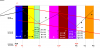
Visually, this is where we are.
Now, let’s establish horizontally, the references for points in price and in volume. This will be a glance to BMs for price, and to P1/T1/P2/T2P/P3P for volume.
As we can see, while there’re clear distinctions as for price points’ reference lines, there’s a total and complete confusion for the reference lines that concern volume. This is where I begin to make the bridge with D and S node.
Let’s focus on D node.
D node is, manifestly, according to the litterature provided at the beginning of this post, here to establish a reference.
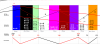
Looking at the last chart of this post, which is, basically and logicaly, the reference trough for the long container ? By definition, the reference is what we refer to at a n moment. Then, a reference is before the moment we look at it. Throwing away time of the analyze, we’d say the space of the reference is on the left of the space into which we look for it (for an occidental POV).
This explains simply, why D node action is to look back. Its nature is to, by a look back, search for a reference point.
By nature, a reference is a primordial thing, so it’s both what comes first AND what is the most primordial. Primordius.
Therefore, which is the first trough of the just-created long container ? In RDBMS terms, it’s the BO,T1, in SCT terms it’s the 2 of its B2B. It’s the black star on the chart.
I DD this is the reference trough of the long container. And I DD that establishing this reference point is the role of D node.
Moreover, I can read « Establish reference trough as bar n OR BEFORE ». If the « reference trough » discussed in this phrase, is the same as the 2 of B2B in our example, it means D node searches for the first trough that established the trend we’re in. If it is just the prior trough, then D node only searches for the last trough.
As seen, in a pattern, there are necessarily at least two troughs. But could D node be used to search for not-neccesarily the first trough of the trend ? Is it possible that D node only searches the last trough, whether it was the first one of the trend ? If yes, what does this mean ? If no, what does this mean ? Whether it’s yes or no, what does that mean for the next S node we could meet along the path ?
To be continued…
See you tomorrow or on Monday.