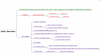
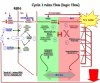
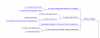
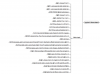
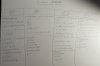
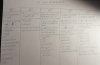
n+1 column study
F node
By nature, I know that F is the surge of an increasing volume bar w/ color change. In SCT terms this would either be 2b if B2B intiated the segment, or 2R if R2R initiated the segment. It's a return to dominance move. In RDBMS terms, this would be the appearance of a b-turn and we'd be informed that at least, shortest, less complete into completeness, a C Set of trend is underway. Appearance later of back to non-Dom would definitely build the path to a D set. So far, good.
According to the MADA finite series document, at F you hold for ( H or J) or you hold for L. H deals with n+2 column and J even farer, while L is in the n+1 column. At first, the problematic issue that English language constitutes for me, I wondered what "hold for" meant. Hold for = hold until ? hold because of = hold if ?
Let's dig deeper.
E node
It is a choice node at the beginning of n+1 column. You must choose F or G. As seen, F is increasing volume w/ color change, while G is surge of volume superior to prior peak, whichever the color is. Here I meet another little crux. The peak term. From what I DD for now, I'd say the peak in question cannot be a merely increasing move volume being before the possible G node. Why so ? because to arrive at G node, according to the possible paths that are exposed in the ExSc thread, C is the node that is before G. C is VDU/DU, so in a nutshell and at my level of understanding (LOU), it deals with midday AND then low volume range. I think then if C node comes before G AND as C is cool cause we must wait and meet G condition, it must surely mean G is when volume exceed the prior peak in SCT terms = in the form of a peak = from a, to b which is >a, to c<b. So like T1-P2-T2P in RDBMS. Therefore the visual illustration of my handrawn version of the FCC1 would be wrong.
Thus, at E, you choose either F or G. So either it's INC volume w/ color change, or you have an INC volume superior to prior peak, correctly understood, with any color<. Both situation deal w/ Dom.
G node : see E.
L node :
When we are at L, it mean svolume lock in occurs for either an F or a G type (n+1 bar). Lock in is defined as n+1 volume > n volume. In the MADA finite series document, I learnt that if L, then you hold for M (doji). And you exit if loop N>>L repeats. N is too far towards the right side of the FCC1 to be studied and thoroughly included for now.
So basically, L nod emeans the current volume bar is above prior volume bar. this is, evidently, the surge of Dom.
I might add that, from my current LOU, to state we're either at F or G, we must use PRV. In other words, PRV is what lets one ID a given bar as in a F or G state, at F or G node. We're not yet talking about the level of the current unfolding bar at its second 300. We are talking about its anticipated final level, provided and continuously calculated by PRV. There is only one condition, one occurence, that would make PRV right (in the case whre PRV says "we'll meet lock in", and this would be the case of a lock in reached before EOB. It terms of nodes, This would be L node from what I understand. So if L occurs, then we meet lock in and we are in a Dom move. What, now, about color ? if color is opposite to prior exceeded volume bar, then we are at F and we hold. This would clear up the "you hold for" words. i'd rephrase it and say : you hold because the oppearance of. On the other hand, color could be the same as priro bar. Could this be G ? Again, from what i've seen , G comes from C. G is the occurence of exceeding prior peak with any color. When I dealt with F, I had to have determined prior bar as being a trough, thanks to PRV. Before G, is athere a trough ? I can feel there is something quite subtle here. before G there is C, and C is midday so it's VDU or DU so it's low volume range. So, in a way, yes there's a trough before G, but not necessarily a trough just before G. So F and G seems to imply kind of different nature of bars before each.
As a conclusion, L is when current bar exceeds, into the context we're in (n+1), prior volume bar. If color is the same as prior bar, it could be G. If color changes, then it's F. I can feel this is partly correct. Let's see what occurs next and if leads to greater clarity or so.
The remaining non studied node is M.
M node
By nature, M is the occurence of a doji. From the MADA finite series document, we know that when M happens, we do N test. Once again, N is not in the currently studied column. Let's let it aside for now.
From the ExSc thread's post #127, I learn that doji is sentimental. One sentiment (so short or long) leading to an equal (C = O) and opposite (so long after short, or short after long). Ok, this phrase helps me quite a lot about the doji move. Until now, I've always considered doji to be the quality of a given price bar when its close finishes equal to its open. By the way, on each log I've recently posted, anyone could find on the 30min and 5min columns, a D being here occasionally, and this means the sent at 30min or 5min is neutral, equal so close = open so C = O.
Moreover, I learn that an IBGS is a pre doji. Ok, IBGS is a pre doji. To have a doji situation, I understand we need to see price beginning to move from the O of the bar, then going with at least one tick in one direction. And then, from there, from this first move, price can do two things. Or along its formation it will at least once go back in the other direction, or it will make pause or not but, in any case, will continue towards the same initial direction it had gone to. In the case price begins by a first tick to go in a given situation and then makes pause or not, but in any case, always goes towards the same direction along the formation of the bar, there is then no way this bar could be a doji. What do we need to have a doji bar in my terms ?Close equal to open. Is that possible with the occurence of the scenario described above ? No, it isn't. Therefore, there is another option. After opening and going towards any of the two senses, price can go back towards the direction of the O. From there, again two possibilities, either it (price) will meet open, and we'll meet doji point or it will not. And to finish, again two possibilities : when at the open level, either price will break out past open level and sentiment will change, or price will not cross this threshold and it will be back until EOB towards the other direction. Or it could end, at EOB, on the O level without ever crossing Open level. As a conclusion, I DD that : accordingly with the definition of the flow of dojiness AND remembering that IBGS is a pre-doji, then a doji is when a bar shifts its sentiment along its formation. And plus, an IBGS would be a bar that takes its close from a given point after a only-one-direction-after open, towards doji quantuum. I understand doji so M node is like a test. Oh, good because in the MADA finite series doc I learn at M we do N test. And N test is the doji test and is the nodes of all the nodes as said in the ExSc thread by we know who.
So my current LOU tells me that when a bar sees its close going back towards the open level, this is occurence of an IBGS. This is a shift in the direction of the move inside the bar. An IntraBar Gaussian Shift. After that, price could or could not reach open level. Whether it does so or not, I see the path as an IBGS one. And if the O level is reached, then we meet M node. And if we meet M node, we test if close breaks out the threshold. I guess this is N test. It would clear up the text I had not understood about N test with "one tick further in sentiment but remains limited ...", in the MADA finite series doc (let's call it MADA doc, i'm fed up with writing it each time).
To be continued...



 3 days of work to read the entire Condensed and Edited version of th Exact Science Thread. All relevants ideas, keywords, clear explanations, sequences descriptions has been noted on a post it, pasted on each corresponding page.