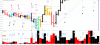
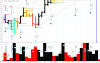
Little review
The system is wholly and completely defined. It involves and is made up of two variables that in relation with each other. The variables are price and volume. Price depends on volume, so volume dictates price. RDBMS is volume focused first. From volume me deduce price.
The dynamic dialectic yields logically that from price we obtain a permission to measure volume for then ID the unfolding sequences one after another, so that we can track segments. We always degap, it is a requirement, no degap is a shortcut for loosers. Everything that is measured is relatively to degap. RDBMS. Relative.
Each variable is breakable into pieces. Ensuing the process until its end leads to break each item into the smallest constituent atom, piece, grain. We talk about granularity. We build from the most granular on up.
When doing so with price, we end up with ten price cases. 7 of them need volume corresponding bar to know is we can measure the given volume information. The 3 remaining do not care about volume, they are always measured no matter what.
This process leads to either have a measurement or not. If not, we have a wait which prevents us to any more work on the info. If we get permission, we measure. The measurement is done via the VTVP and written in the log. By the way, immanency whithout a doubt led JH to call the log " the log" cause in the oldest language of humanity , the root "log" refers to collect, welcome, receive. We do collect all available info and never miss any of them, for then catching what in Radical Theory could only be called "the real move". Things line up.
Once volume is measured, we have an item called a volume element. Any bar that is not a wait will be a volume element. As long as a trend continues, the volume sequence continues. And then every bar receives a unique combo of price/volume ID.
Once a trend has come to its end, the corresponding volume bar is not only a volume element but also an EE. Therefore, any EE is a volume element, and not all volume elements are EE.
Once an EE is IDd, the trend is over and an opposite one is beginning. Practically, some EE tell us the next trend begins on the same bar the prior one has just ended, while other EEs tell us the new trend will begin practically on next bar.
From volume concatenation we obtain boundaries. Those boundaries are Bands'. There are 8.
When a Band is active, we know one of its EE can happen. Again the major clue to get it with EEs is to know which of the bands is in the state of activeness. Some bands, when appear, kill prior one's activeness while other do not.
Like volume follows its OOE, EE's are IDd one after another. Thus, we can ID EE's concatenation. The EE's sequences give us the identity of each turn going on. The concatenation of turns gives us by usinf the MT, the nature of each trend. A trend can be of two natures. Complete or incomplete. A complete trend can be of two kinds, same for incomplete ones.
A normal trend is described by the archetypal pattern and it can be found in this Journal many times, and in many other places. A normal trend is complete, by definition. It has three moves. Geometrically and this sends us to SCT, M1 is from pt1 (and ftt) to pt2 (in RDBMS terms P1 to P2), M2 is from pt2 to pt3 (in RDBMS terms P2 to T2P) and M3 is from pt3 to ftt is Set C (in RDBMS terms, from T2P to P3P). M1 is always supported by dominant volume, M2 non dominant volume and M3 dominant volume. At a higher fractal level, the M1 is made up of the segment from M1 to M3 exposed just before. If this first fractal level described was a FF, the second one just discussed in this sentence would be the TF. And then, the segment from M1 to M3 of TF would be leg 1 = M1 of SF. Higher, so slower fractal level.
At a beginner level we open at beginning of M1, hold through M2 and reverse at end of M3.
The C-turn reverse is for the TF.
At an expert level we are only in a hold/reverse action.
At my current LOD, I DD that being as Jack mentionned many times there are around 30-40 EEs per session AND there around 30-35 trades a day to do, we are to take advantage of any end of any trend. In other words, there is a possibility if the necessary skill is here, of reversing at each EE.
Necessarily, as I've seen along the 44+16 MADA sessions fully annotated and logged I've performed so far, when entering a trade at a given EE, there is a possibility of having to reverse right after entering. From my LOD, this would be a wash trade. JH states when this happens, he loses 1 or 2 ticks. As
@Sprout said one day, it's true there are some losses but they are ridiculous compared to CW traders losses. And now I might add that those losses find themselves almost immediately absorbed.
Reasoning around this paragraph I'm writting sent me IF1/IF2 APA. Recently, I've read this
post from JH concerning the item in question. It helps me. It makes me understand better.
Let's have now a little discussion around Bands.
From my LOD :
We know the major clue to get EE's is to know which band is in effect. We also know, although I've seen in
@Simples ' Journal some of you ("you" know who they are) statinf it is not before refining and re explaining to end up with saying it is, that some bands appearance kills prior ones, while others do not.
A-band is defined by P1 and T1, and appears when P2 is there. A-band kills PP! except for some items.
B-band is defined by P2 and T2P and appears when T2P is there. B-band does not kill A-band EE's.
C-band is defined by T2P and T2F and appears when T2F is there. C-band kills A-band and B-band EE's.
The text states that later after the T2P and T2F have appeared, the F- context comes into view. So we can ID an F-Band EE only one bar after T2F has appeared.
G/H/K-bands need more work from me nowadays to be understood. The imannency of sequences along a session makes that B-band is already rare. So, G/H/K way more. They are needed to work with confidence as they are part of the completeness from which comes this same confidence. No big deal for now, it will be solved. It is an indescriptible but only feelable emotion to deeply know with no need of external confirmation that the longest and hardest is now, behind me.
Recently, I've begun to log real-time sessions. By the way, right after ending to write this post I'll debrief Friday's session and will log as long as I can today's session, real-time.
Back to thinkings, reasoning and DDs.
As I said, I started recently to log in real-time. I begin today the third week of logging this way. During the first week, the real-time made surge some questions. And the second week brought some answers to them and to questions I had prior to the moment I began to log real-time.
It deals with bands and EE's. It's not always easy to make each text, sheet and post converge and line up with a given ID on a chart. Sometimes, as practitionners we've seen conflicts in the writings, mistakes on charts, revisited versions of sheets etc. The reconciliaton betwee all this must/con only be made by DD.
My DD from real-time logging :
I know concerning bands, that some kill prior ones, while others do not. Some bands live within bands. We've had some troubles already together (each concerned knows it) when discussing for example Aa, Fd, Hb etc. It is not so easy to clear up things. We'll always find a given sentence that will tend to invalidate someone ID/assertion, and it all resides it finding the context in which this sentence has been said. As JH always said, in trading the context is what most matters. In a given context something true can/must/will be false and vice-versa.
So, what I understand and most fits with the litterature for me at the moment is that :
in real time, we see some volume bars having the same ID from the 1st to 300th second. For example a same given bar can be from 1th to 150th second a T1, then be a P2 at lockin.
What I understand and what helps me a lot is to understand the connection between "present" and "at lock in", when talking about a bar. I mean, an ID.
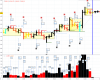
Illustration :
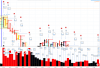
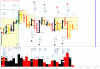
I'll talk about fourth bar. At lock in, prior bar is P2. SO, A-band is there, established and active. We can find A-band EE.
-green zone : at the very first second of the building of the bar, it is an Ab LVBO. In fact, after P2, except if volume overpasses prior bar (so P2) in one second or less, we have AbLVBO. If at lockin volume remains in this green zone, I'd see AbLVBO.
- yellow zone : here is the thing I understand now : if volume enters in yellow zone it MUST have been into the green one so AbLVBO has occured but at the timeframe we observe from, on the same interval, volume is higher now. When volume is in the yellow zone, it's a T2P and no EE is there. If at lock in it is still in yellow zone, T2P and then on next bar B-band AND A-band EE can both appear.
- pink zone : this is great. It must have passed by AbLVBO AND T2P. So when volume enters into pink zone, I consider T2P is there : it is into the bar. So into the bar, B-band is there and if volume ends in pink zone, it's the Bc zone. Wow, but is this was true, how could P2 repeat exist ? I DD the last DD is not true. I know in this sequence, as long as volume remains in pink zone it's a repeat P2. So, we can't consider T2P is there, we must wait until lock in ID.
- blue zone : if T2P was considered to be here, because of having its value when in yellow zone, it would not change anything to my view which says this bar if in blue zone is a P1revchron. If P2 was > P1 and we were not in a Lat, I'd see AgVEBO.
So I can see there is maybe no difference between "present" and "at lock in". Or maybe there's one and I don't see it for now.
For example, the text for AaHVBO clearly states T2P needs to be present in the trend. And so does the A-band sheet. So, present : along the bar or at lock in ? If at lock in, it means we need to be at least on 6th bar of the sequence to have a Aa. I precise that I disagree with the fact that Aa can be found when UL is on the line, being as the text is more precise than the sheet. The handwritten version sheet says interruption (wait, UL) is required, while the text says we need a WAIT along the line. A WAIT, not a UL. If the text is more precise than a sheet, I go with the most precise info. This sounds logic to me.
So a wait needed AND T2P present in the trend.
If present means at lock in, then by using the illustrated sequence of this post and if we include a wait along the line, could we have an Aa HVBO if volume on last bar ends in blue zone ? No. Cause we never had any TP2 AT LOCK IN.
If present means along the bar unfolding, could we have Aa ? Yes.
This questions remains present into my mind for any Band EE. I feel it's crucial.
It reminds me this :
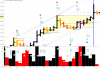
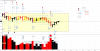
We can see an Fd which is a F-Band EE and I know the F-context appears later AFTER T2F has appeared. Here, T2F never appears cause it's, by sheet, killed of <T1. When I discussed this some days ago, it has been said to me that with this comprehension of T2F killed if <T1, some EE's would not exist. I have to DD why, and I've not managed yet to do so. From my understanding, we could have FdLVBO if before this bar and after prior one, so in between, we had been T2F at lock in. Here, the T2F value which is described in the text as being between T2P and T1, is never reached.
There is an issue here.
Seems like sometimes the "present in trend" means "at lock in", while in other moments it means "along the bar unfolding". I don't believe/think this can be. I think it must always be the same logic. Either present always means at lock in, or it always means in the development of the bar.
The prior paragraph exposes the core of the shadow zone I have to clear up. I will be done by DD.