Making JH' SCT and all his material alive

Am I wrong or everything is linked with everything ?

If each part (table, log cell, knowledge area) is linked with the others, how to determine any of those is an operating point ?

I mean, last years I've tried to fill a lot of logs without success because I was missing many things. Along the last year, I've moved to a given sum of rereadings in order to clarify how to be able to log, which is the difference that makes the difference, and the thing that will merge everything I know since long. So the objective for me now, to follow your instructions and advices, is to log. To be able to log, I need :

1- to be able to fix the hour of each bar -> I'm able

2- to be able to label each bar number starting from the first one opening RTH -> I'm able

3- to be able identify Turns : last year, all the necessary conditions to make me believe and understand I had it with turns were gathered. Recently, I learnt that finally -> I'm not able because the Turns are in fact not what I learnt last year, but rather "what I learnt last year updated with Modrian Table"

4- to be able to label each price case - > I'm able

5- to be able to Degap and know when it's necessary -> I don't know if I'm able fully

6 - to be able to note the UL -> I'm able

7- to be able to perform VTP -> I know i'm not able

8- to be able to put additional notes -> I don't know if I'm able as I don't know what's it about

9- to be able to label the Event which is deduced from VTP so -> I'm not able

10- to be able to use retro when it's appropriate -> I'm not able

11- to be able to ID the Trend Type, which is deduced from all the above so -> I'm not able

12- to be able to ID the EE -> I'm not able

13- to be able to determine the Action to take -> I'm not able.

What am I not able to do then ? -> Identify Turn types, degap, perform VTP, add notes, label the Event, use the Retro, ID the Trend type, recognize the EE, take the Action.

To ID Turns, I need to understand the Modrian and Move Reversal tables.

To perform VTP, I need to understand how it works. From there I could deduce the Event.

Then could I ID trend type. But only if I can ID the EE.


It's an infinite loop. So, last year I tried to perform VTP. I failed cause some things were missing in my mind. Then I tried to decypher the EE descriptions to be able to have something more. I failed. Now I'm trying to understand the Modrian Table in itsef with the Move reversal one, and a simple color coding is causing me issue.

From all this, could you please ubicate the operating point I've already been through/not already been through, and that doesn't begin by a problem ?
Thank you very much !

Your psyching yourself out again.

Be confident, you’re in a good place.

To simplify, your learning to ride a bicycle for the first time.

Seeing that there is a bike to ride (Reading Jack)
Helmet on head,....check (Doing Drills)
Straddle the seat,...check (MADA)
Hands on handles,...check (Annotating)
Feet on pedals,.... fail, whenever I put both feet on the pedals I fall down. (Logging)

Yep, until you stand on one foot, shift your axis, apply weight on a single pedal and propel yourself forward (bar-by-bar logging) you will not discover balance (how all the elements fit together)

You just have to be willing to stand on one leg vs all the reasons you haven’t already.

Once you have balance, steering then makes sense. Steering before balance makes no sense at all in learning to ride a bike.
 
Last edited:
Seeing that there is a bike to ride (Reading Jack)
Helmet on head,....check (Doing Drills)
Straddle the seat,...check (MADA)
Hands on handles,...check (Annotating)
Feet on pedals,.... fail, whenever I put both feet on the pedals I fall down. (Logging)

You made me laugh a lot :p


Yep, until you stand on one foot and propel yourself forward (bar-by-bar logging) you will not discover balance (how all the elements fit together)

Ok, so let's start again a log from scratch. After all I've been through, what is a bit more of " a lot of work" ?:sneaky:


@Sprout , thank you for your presence, it is radically decisive.
 
Degapping may be done mentally, and the column is there to note wether this was done or not. Degapping may inform of intrabar PV sentiment in relationship to previous bar.
Hmmm... when degapping is not needed? Why not always degap? When degapping is noted, when will this info be used? Is it in columns in MADA logging?

Internals are ideally IB, 2 bars where the last bar is 100% contained within bar #1 H and L. Stitches require additional differentiation both in price and volume, in order to determine price geometry and volume measurability. OB's are composed of two levels, ie. XB and XR, or in opposite order. While OB bars build, there is translation, so not generally regarded as "internal". "Wait" is for bars regarded as too insignificant, ideally making the method independent of time.
Don't understand certain things above. Do they affect any columns from 'Time' to 'Arrows UL'? If not affecting, then maybe can save it for later in due course. JHM can be overwhelming. I need to focus each column first in order to understand better.

Bar #1 of internal may be measurable, if not itself internal bar #2 and DV or Lat 3 DV w/no Retro.
Same as above, if not related to columns up to 'Arrows UL', I think better to keep aside first.
Refer to comment above.

IB and OB are used in PA.
I find JHM seems like PA bar-by-bar, but more depth and finer price bar-by-bar analysis than AB's PA. AB mentions about price bar shape can change shape from one form to another during the 5 min duration, that's why important to wait till close. But as far as I know, he doesn't use 10 price cases and analyse it in very detail. However, I'm not PA expert, I maybe wrong though.

Thank you for your guidance @Simples.
 
Refer to comment above.

IB and OB are used in PA.
I find JHM seems like PA bar-by-bar, but more depth and finer price bar-by-bar analysis than AB's PA. AB mentions about price bar shape can change shape from one form to another during the 5 min duration, that's why important to wait till close. But as far as I know, he doesn't use 10 price cases and analyse it in very detail. However, I'm not PA expert, I maybe wrong though.

Thank you for your guidance @Simples.

Degapping may not be required when not making any difference. All the info in the log is used to inform NOW and later.

@Sprout may be better guide for logging.

IB and OB are important in JHM, PA is not. Everything in JHM is based upon an entirely different fundament: that volume leads price = The Pattern. There is some "PA" in the Failsafes, but better keep to JHM terminology and understanding, at least at first.

It's not just a new language, but an entirely different culture too!
 
Degapping may not be required when not making any difference. All the info in the log is used to inform NOW and later.

@Sprout may be better guide for logging.

IB and OB are important in JHM, PA is not.
Everything in JHM is based upon an entirely different fundament: that volume leads price = The Pattern. There is some "PA" in the Failsafes, but better keep to JHM terminology and understanding, at least at first.

It's not just a new language, but an entirely different culture too!

@Sprout is expert in JHM. Need to learn from him. :cool:

You are not logging, only doing annotating? :thumbsup:
Have you started live trading with?

Yes, JHM is more comprehensive than PA. New language, new culture!
I believe that volume leads price. It's just that I'm not sure how to utilize it.
Volume can only increase and decrease.
Increasing volume continue price up/down and decreasing volume will change price trend.
But, is it that simple? JHM proofs that it is not that simple.

Thank you for your input. You help me a lot.


All, due to timezone difference, I may not be able to stay long.
I hope that I am welcomed here.
See you tomorrow. :)
 
@Sprout is expert in JHM. Need to learn from him. :cool:

You are not logging, only doing annotating? :thumbsup:
Have you started live trading with?

Yes, JHM is more comprehensive than PA. New language, new culture!
I believe that volume leads price. It's just that I'm not sure how to utilize it.
Volume can only increase and decrease.
Increasing volume continue price up/down and decreasing volume will change price trend.
But, is it that simple? JHM proofs that it is not that simple.

Thank you for your input. You help me a lot.


All, due to timezone difference, I may not be able to stay long.
I hope that I am welcomed here.
See you tomorrow. :)


You certainly are welcomed here. And if you want to assimilate the material best to simultaneously start a journal, where you can log the results of you doing drills that are prerequisites to logging via VTP.

As a circle of peers, we each have a different perspective as well as different ways of saying something. Each person’s path is a bit different. I would encourage any inspired to chime in. There are some ‘locks’ in JHM that can only be opened when one takes on passing it forward.


Starting at the basic granularity of market data:
So with the pics that you posted, doing it with your own hand makes a difference. That is the 10 price cases. Include if you will the appropriate math for each case.

Next would be the 5x5 grid of how a single bar forms.

Degapping comes later, for it’s more about symbolically linking the structural forms one builds in their mind to the realtime expression of those forms. It is more easily perceived as one degaps the RTH from the extended hours. Intraday, it’s about filtering noise from the Bid/Ask spread during an arbitrary time increment.

The market operates by an Order Of Events that take place in time yet are decoupled from time.


As for the simplicity of the Hypothesis Set, it is sublime and quite beautiful in it’s elegance but until one has other pieces of the puzzle assimilated and internalized, applying it prematurely has spun out many an impatient wanderer to a hasty and false conclusion.

The fork in the road initially is;

Show me the truth

vs

Show me the money


One requires a substantial amount of persistent and diligent work and the rewards are a bargain in measure.

Cheers!
 
@Sprout is expert in JHM. Need to learn from him. :cool:

You are not logging, only doing annotating? :thumbsup:

I'm coding sort of "log", but it's not the same as using the JHM log or intrabar trading, so can't really speak from experience in that area unfortunately. Coding is how I best understand the concepts, although building it piecemeal according to evolving understanding. Just copying everything found didn't provide any coherence and coding can't be rushed. I doubt coding saves me any time! :p

Have you started live trading with?

I'm forward testing on simulated account, but not currently focusing in that area. Haven't found time to do live trading, but have tried various non-JHM algos before, both simulated and live. JHM is very comprehensive, so became sort of hobby as I can't justify using it live yet. Benefits of the method is thinking beyond CW. Doing psychological damage won't help any sane person I think, only brokers if that.

Yes, JHM is more comprehensive than PA. New language, new culture!
I believe that volume leads price. It's just that I'm not sure how to utilize it.
Volume can only increase and decrease.
Increasing volume continue price up/down and decreasing volume will change price trend.
But, is it that simple? JHM proofs that it is not that simple.

Thank you for your input. You help me a lot.

I'll help where I can, though will also be honest where my understanding falls short.

All, due to timezone difference, I may not be able to stay long.
I hope that I am welcomed here.
See you tomorrow. :)
 
You certainly are welcomed here. And if you want to assimilate the material best to simultaneously start a journal, where you can log the results of you doing drills that are prerequisites to logging via VTP.

As a circle of peers, we each have a different perspective as well as different ways of saying something. Each person’s path is a bit different. I would encourage any inspired to chime in. There are some ‘locks’ in JHM that can only be opened when one takes on passing it forward.

Starting at the basic granularity of market data:
So with the pics that you posted, doing it with your own hand makes a difference. That is the 10 price cases. Include if you will the appropriate math for each case.

Next would be the 5x5 grid of how a single bar forms.

Degapping comes later, for it’s more about symbolically linking the structural forms one builds in their mind to the realtime expression of those forms. It is more easily perceived as one degaps the RTH from the extended hours. Intraday, it’s about filtering noise from the Bid/Ask spread during an arbitrary time increment.

The market operates by an Order Of Events that take place in time yet are decoupled from time.

As for the simplicity of the Hypothesis Set, it is sublime and quite beautiful in it’s elegance but until one has other pieces of the puzzle assimilated and internalized, applying it prematurely has spun out many an impatient wanderer to a hasty and false conclusion.

The fork in the road initially is;

Show me the truth

vs

Show me the money

One requires a substantial amount of persistent and diligent work and the rewards are a bargain in measure.

Cheers!

Hi @Sprout,
Thank you for the support and encouragement.

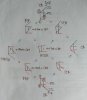
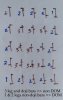
I have done the manual hand drawing of 10 price cases and 5x5 grid.
I was inspired by @Simples in https://www.elitetrader.com/et/threads/on-10-case-geometry-and-beyond.310880/page-14. Thanks @Simples.
Refer to attached.
In a single bar, there are up to 3 moves/legs. This is due to there are 4 components in a bar: OHLC (Open High Low Close). The price movement is OH, HL and LC (Open to High, High to Low and Low to Close). If in a bar, the O=H or H=L or L=C, we don't need to count the leg.

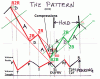
In the same link above, there is 'the pattern'. I attach it again here.
The heading shows OOE too. As per glossary, OOE stands for Order of Event and it makes up a trend (volume based). (I attach my rework glossary. It is text-searchable, the old one is not searchable because of image based)

'the pattern' shows down trend, reversal and up trend. I'm trying to read the pattern, from left to right, from bear to bull:
1)
price is too high, market topping, ftt of bull ltl. bull starts distribution phase with high volume.
vol pane: ... to P(eak)
price pane: ftt
2)
bear in the sideline. price declines to bull rtl, yet volume is low because bull doesn't want to buy anymore.
vol pane: P to T(rough) -> 2R
price pane: prior ftt becomes pt1 of downtrend
3)
after price manages to break bull rtl, it's confirmed downtrend. bear jump to sell (accumulation) and late bull close position. volume is high.
vol pane: T to P -> 2R
price pane: pt2
4)
to reduce risk, etc, bear starts distribution/unload/profit taking. after no more buying, pt3 is established and downtrend continues. buy volume in bear is usually low.
vol pane: P to T -> 2B
price pane: pt3
5)
price is too low and market absorbs the price. bear distributes/close position and bull buy for value. volume is high. not sure about 'compressions' here.
vol pane: P1
price pane: ftt of bear trend
6)
the rest is for bull trend, similar like event 1 to 5 with different volume naming and OOE, due to buying will have DU+FRV.

If I'm not mistaken, the annotation of volume depends on event in price pane and should help on determining what value to place in the vol pane.

Kindly let me know if there is anything incorrect or miss out.

I think one must learn the truth. Money is just a by product of truth. :)
To successful traders, money is not the objective anymore.
There should be other factors more satisfying than money, such as helping others, etc.
Men doesn't live only by money.

@Sprout and the rest, thank you for sharing the truth.
 

Attachments

  • jh 10 price cases.jpeg
    jh 10 price cases.jpeg
    180.5 KB · Views: 26
  • jh 5x5.jpeg
    jh 5x5.jpeg
    75 KB · Views: 24
  • jh the pattern gif 3 simples.gif
    jh the pattern gif 3 simples.gif
    73.9 KB · Views: 28
  • JH Glossary.pdf
    JH Glossary.pdf
    24.3 KB · Views: 22
Wow you know how to do coding..
I don't really write coding for trading platform.
Wish that you can complete the coding for JHM and profit from it soon.

Your journal helps me in solving some puzzles.
Though you didn't do it purposely, you have helped me and other seekers with many pointers found in your journal.
Thanks a lot. :thumbsup:
 
Back
Top