Making JH' SCT and all his material alive

But until my AHA moment, I can only keep on working and putting the pieces all together...anyway we're almost all way better when we have no choice. As I sacrified everything for accomplishing the SCT, I have no choice left now.

From my perspective you can't get here from there. As a state of being, it requires a sympathetic resonance to a very distinct vibrational state. It's like the difference between the optimist's and pessimist's experience of the same phenomenon. One see's more light the other less and their bias informs their perception.

Lastly, I integrated sport, meditation, naps, friends and social support in my routine. It works WAY better.

:thumbsup:
Way Better !!

Comments within quoted text.
 
It seems everybody's willing to give you general recommendations (I disagree with some of them), keeping their more useful knowledge for themselves. It's understandable

As often, what causes a real problem is not what is said, but rather what is not. I might then add to your statement : It's understandable , being as were's in this world, this context.

I totally agree with what you feel, I had noticed it. This is LOGICAL for this world, but honestly, it also deals with the absolute opposite we talked about earlier : humbleness. The one (I'm not targeting anybody) who comes here and talks until he stops when comes the moment of talking seriously honestly and to transmit the core, is simply loving his EGO. It's an "I know, you do not, and I'll enjoy this difference, making you believe you'll get it".

So don't worry, I had been warned about this, I was already aware of this as i've been reading on ET for years and years now. And most importantly : Thank you !

It seems everybody's willing to give you general recommendations (I disagree with some of them), keeping their more useful knowledge for themselves. It's understandable (but it also means that you can't know who knows what they're talking about, and who is just parroting what they read).

The more you add to your plate, the further you are from your goal, excepting if you "luckily" step into a working solution, AND if you recognize it! (by the way: I don't believe that you can attain Enlightenment by "luck", nor by hard work; it has to be meant to be)

Remember how Jack's posts, and spydertrader's posts changed over time. If Jack came with more and more ways of looking at the markets, spydertrader reduced and simplified the toolset he used, eventually, at traderslaboratory, pointing to only a small set of basic principles, and talking about learning how to learn.

Maybe it's time to clean up your to do list, keeping only those basics, that both Jack and spydertrader said they're enough to trade profitably.

And, I'll share a useful AHA: trends overlap! As a tool, use the (non-)stationary window!

THANK YOU VERY MUCH BARO-SAN. I love your attitude and will be working on what you say from now.

You share honest and real informations, properly said. I appreciate it a lot and give you huge thanks for that.

Can you just help me with what is the "non stationnary windows" ?
 
Do you look at the market in the smallest granularity possible?
It's what I try to do as best as I can yes.

Do you look at the market with two bar tapes and expand it out from there?
it's part of what I do, yes
AHA moments come from meticulously following OOE's

Quote from Jack Hershey:

Visualize OOE's that are interlocking as market flows.

Price cases GIVE PERMISSION to MEASURE volume using a VOLUME TEST PROCEDURE.

You write result in LOG.

You LOOK UP this status as an END EFFCT of a trend. I will give you a SET of end effect look up sheets (they are already posted in MANY places).

If there IS an END EFFECT, then you determine the related TYPE OF TURN. (1 sheet for this called "Modrian table")

To make money by taking trend profits you look at final MOVE REVERSAL SHEET. you find the solution by analysis of the PRESENCE, or NOT on the sheet AND by three arrows which stand for sentiment, turn direction and LEG 2 of the present bar.

For every turn there are three choices: execute, hold thru or sideline.

That is the kind of honest, powerful and generous comments all SCT workers need.
Thank you very much for taking time to answer, and to provide this kind of quality inside your answers.
The four above fit together and there is a sequence to understand.

To begin, start with three three-ringed binders.

One is for the 11 eleven sheets that are located in the previous mentioned threads and place them in tabular organization. This is the thinnest binder. You can start with 6-steps, VTP, Failsafes, Volume Element Ranges, PP!'s, A-Band, B-K Band and Turns. On the front outside witin the clearslip insert the Modrian table and on the back the Move Reversal table.

As a drill, start with the ten price cases and add the form possibilities of a third bar. Do this with increasing and decreasing volume for each form. You will generate a matrix that is a finite set of what three PV bars and all the permutations of volume can be. Organize this matrix. In this matrix are the PP!'s. Draw the forms of all the PP!'s put this in your binder in it's appropriate tab. Notecards , graph paper, HB pencils and ruby red erasers are your friend. There are more 3 bar combinations then there are PP!'s.

Knowing what these are increases one's confidence of knowing that you know.

Do the same with the A-Band definitions and H-K Band definitions. You want a catalog of bar forms that you can visually scan quickly. You are building from 1 bar legs to 2 bar price cases to 3 bar to 4 etc,.. These are trend segments. Trend segments are pieced together with the combination of the Modrian, Move Reversal Table, Turns and Trend types. To make this easier to assimilate and integrate put the Modrian, Move Reversal Table, and Trend Types to the side.

The focus is logging bar-by-bar. By building your capacity to locate EE's then you build a foundational reference dataset by which to understand how the M,MR,T&TT fit and work together. There will be gaps in what you ID as EE's. There will be strings of BO,T1's and BM,rev's. When you debrief, look to see how these can be filtered out to form larger trend segments. For example in 4bars, there can be two BO,T1's presenting. When the pressure of RTH has subsided, one can see that on closer look, the 4bars create a single EE on the A-band.

In the OOE there is a RTL. This RTL can continue to contain price or when XO'd change into it's opposite parallelogram to continue to contain price. FTT to FTT contains price. This form can be observed on a single bar and on every additional bar as one groups bars. When this is not true a VE has come into the present from the future.

The RTL can be accelerated, touched or fanned. This RTL is part of the two Failsafes. When the RTL is XO'd then you KNOW that the container is changing and expanding in one of two directions. What come before this XO is an ftt/FTT. This event in the OOE is what you are building to discern in Realtime. Annotating your charts will support this discerning process, logging will progress it faster.

The second Failsafe is a BM at the pt1 of price that also begins the RTL. This BM can be recycled through the progression of trend. It's like a trailing stop. If price reverses, place the opposite BM appropriately. The two work like two paddle boards that contain the inside spread of lateral price movement on non-Dom traverses.


Binder two is where you place your annotated chart of the day and the 4 sheets of your log. Keep a copy of the full day's price action in the scale that you observe, this might require multiple sheets depending on volatility. This assists in calibration in perceiving volume pace changes and dependent price moves. Another printed chart that is scaled to include the whole day as a summary. Tab each month, segment by day. The more this is organized, the more efficient, streamline of assessing ID's will be. You'll start building a catalog of all the EE's. They have infinite variety within the form within a finite set of contextual states. It's pretty fascinating.

Binder three is where you record your trades and your performance stats.


To start a log, just start and fill in as much as you can. To begin, locate a P1. A P1 can occur on a peak or trough. It's contextual and based on the previous trend.

One of the easier places to locate a P1, is to look to see where there was a XO of a RTL. The OOE then continues from this point. The next volume bar is then compared if it's measurable. It's either a wait, repeat or next in the OOE. Record the Event as True of False in your log under the appropriate column heading.

The trend segment continues until it's interrupted. On the ES 5m this happens quite frequently. Trend segments are pieced together in D-D, D-nD, nD-D segments. These segments are based on EE's. EE's string together on the Modrian table. The Modrian table contains a subset of all the possible trend segment combinations. You use the 30m and Daily to pass or gate the signals from the 5m.

It's easier to think about JHM as a descriptive language. It's similar to descriptive geometry.


Post a chart and it's associated log for the RTH ES 5m. Fill in as much as you can (this goes for anybody following along). It's ok to stumble through it and by design is self-correcting by debriefing it iteratively. Your sticking point will change through time and accelerate by debriefing.

It came time for me to tell you what I think about you Sprout : you're a great teacher. Yhank you for that generosity, endurance, patience and support.
Thank you very much.
The more I see you all kick my ass in the right direction, give help, support, answers and thoughts, the better I feel with the huge amount of work remaining.

A global and HUGE THANK YOU.
Logging is the difference that makes the difference.
drilling on it today
 
The four above fit together and there is a sequence to understand.

To begin, start with three three-ringed binders.

One is for the 11 eleven sheets that are located in the previous mentioned threads and place them in tabular organization. This is the thinnest binder. You can start with 6-steps, VTP, Failsafes, Volume Element Ranges, PP!'s, A-Band, B-K Band and Turns. On the front outside witin the clearslip insert the Modrian table and on the back the Move Reversal table.

As a drill, start with the ten price cases and add the form possibilities of a third bar. Do this with increasing and decreasing volume for each form. You will generate a matrix that is a finite set of what three PV bars and all the permutations of volume can be. Organize this matrix. In this matrix are the PP!'s. Draw the forms of all the PP!'s put this in your binder in it's appropriate tab. Notecards , graph paper, HB pencils and ruby red erasers are your friend. There are more 3 bar combinations then there are PP!'s.

Knowing what these are increases one's confidence of knowing that you know.

Do the same with the A-Band definitions and H-K Band definitions. You want a catalog of bar forms that you can visually scan quickly. You are building from 1 bar legs to 2 bar price cases to 3 bar to 4 etc,.. These are trend segments. Trend segments are pieced together with the combination of the Modrian, Move Reversal Table, Turns and Trend types. To make this easier to assimilate and integrate put the Modrian, Move Reversal Table, and Trend Types to the side.

The focus is logging bar-by-bar. By building your capacity to locate EE's then you build a foundational reference dataset by which to understand how the M,MR,T&TT fit and work together. There will be gaps in what you ID as EE's. There will be strings of BO,T1's and BM,rev's. When you debrief, look to see how these can be filtered out to form larger trend segments. For example in 4bars, there can be two BO,T1's presenting. When the pressure of RTH has subsided, one can see that on closer look, the 4bars create a single EE on the A-band.

In the OOE there is a RTL. This RTL can continue to contain price or when XO'd change into it's opposite parallelogram to continue to contain price. FTT to FTT contains price. This form can be observed on a single bar and on every additional bar as one groups bars. When this is not true a VE has come into the present from the future.

The RTL can be accelerated, touched or fanned. This RTL is part of the two Failsafes. When the RTL is XO'd then you KNOW that the container is changing and expanding in one of two directions. What come before this XO is an ftt/FTT. This event in the OOE is what you are building to discern in Realtime. Annotating your charts will support this discerning process, logging will progress it faster.

The second Failsafe is a BM at the pt1 of price that also begins the RTL. This BM can be recycled through the progression of trend. It's like a trailing stop. If price reverses, place the opposite BM appropriately. The two work like two paddle boards that contain the inside spread of lateral price movement on non-Dom traverses.


Binder two is where you place your annotated chart of the day and the 4 sheets of your log. Keep a copy of the full day's price action in the scale that you observe, this might require multiple sheets depending on volatility. This assists in calibration in perceiving volume pace changes and dependent price moves. Another printed chart that is scaled to include the whole day as a summary. Tab each month, segment by day. The more this is organized, the more efficient, streamline of assessing ID's will be. You'll start building a catalog of all the EE's. They have infinite variety within the form within a finite set of contextual states. It's pretty fascinating.

Binder three is where you record your trades and your performance stats.


To start a log, just start and fill in as much as you can. To begin, locate a P1. A P1 can occur on a peak or trough. It's contextual and based on the previous trend.

One of the easier places to locate a P1, is to look to see where there was a XO of a RTL. The OOE then continues from this point. The next volume bar is then compared if it's measurable. It's either a wait, repeat or next in the OOE. Record the Event as True of False in your log under the appropriate column heading.

The trend segment continues until it's interrupted. On the ES 5m this happens quite frequently. Trend segments are pieced together in D-D, D-nD, nD-D segments. These segments are based on EE's. EE's string together on the Modrian table. The Modrian table contains a subset of all the possible trend segment combinations. You use the 30m and Daily to pass or gate the signals from the 5m.

It's easier to think about JHM as a descriptive language. It's similar to descriptive geometry.


Post a chart and it's associated log for the RTH ES 5m. Fill in as much as you can (this goes for anybody following along). It's ok to stumble through it and by design is self-correcting by debriefing it iteratively. Your sticking point will change through time and accelerate by debriefing.

Beginning right now, and planning on post it tonight.


Have a great day everyone !
 
A considerable amount of work and things to study on has been asked to me. I am happy to have so many things to do cause it means my effort is fertile.
Nonetheless, I am completely overwhelmed now. This is simply too much. WAY too much. There are too many things to work on at the same time, I cannot anymore.


I've done my best in what I post to integrate absolutely everything that is to appear on the chart since my level on the SCT.


@Sprout, I have also drilled on the 3 rows of Volume arrows. It is quite the same feeling as doing the VTP. I used the example you provided me, tried to see the end of the arrows after B2B or R2R on pts 2, but I do not even see that at each time on your own chart.
A question about this : is each row of volume arrows related to each of the three nested fractals ?


I maybe need a day off. The VTP is really something that drives me mad, in a serious sense. In all the explanations I have read about it, there may be some things forgotten, implicit, badly said or volunteerly hidden by those providing the explanations. It is not normal I can't do this test yet.


As a drill, start with the ten price cases and add the form possibilities of a third bar. Do this with increasing and decreasing volume for each form. You will generate a matrix that is a finite set of what three PV bars and all the permutations of volume can be. Organize this matrix. In this matrix are the PP!'s. Draw the forms of all the PP!'s put this in your binder in it's appropriate tab. Notecards , graph paper, HB pencils and ruby red erasers are your friend. There are more 3 bar combinations then there are PP!'s.


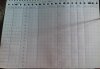
I join the matrix I think you want me to draw. Is it what you expected ?

And do you want me to combine the volume cases to each of the 100 cases ?

This seems enormous to me as for combinations, that's why i'm asking as it looks weird.

And I do not know what are PP!'s.

Do the same with the A-Band definitions and H-K Band definitions. You want a catalog of bar forms that you can visually scan quickly. You are building from 1 bar legs to 2 bar price cases to 3 bar to 4 etc,.. These are trend segments. Trend segments are pieced together with the combination of the Modrian, Move Reversal Table, Turns and Trend types. To make this easier to assimilate and integrate put the Modrian, Move Reversal Table, and Trend Types to the side.


I don't know how the bands work, neither what they refer to. I don't undrstand what is meant to do.


I've given my best to do everything that is posted, especially the VTP but the only feeling I have is that I filled the cells whithout any comprehension nor any idea of what I'm doing. Almost everything must be false. It makes no sense to me.

Can anyone please take the sequence I post here, and join the VTP applied ? So I could compare and maybe understand something...

 

Attachments

  • Matrix.jpg
    Matrix.jpg
    640.2 KB · Views: 53
  • Log 1.jpg
    Log 1.jpg
    1.3 MB · Views: 54
  • Log 2.jpg
    Log 2.jpg
    1.4 MB · Views: 47
  • Log 3.jpg
    Log 3.jpg
    1.2 MB · Views: 42
  • Log 4.jpg
    Log 4.jpg
    1.3 MB · Views: 44
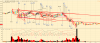
  • MADA ES5min.png
    MADA ES5min.png
    228.2 KB · Views: 51
I believe it was 1 bar added to the 10 price case (2 bar combinations), with IV and DV petmutations.

You seem quickly excited. Maybe focus on the simple steps first, as mentioned by baro and james, and take the larger steps over longer time? It will require time and pondering to make steady progress. Spend time to relax, fun and enjoy life as well! PP! or whatever are revealed in earlier Jack posts, but will take due time to integrate for me as well.
 
A considerable amount of work and things to study on has been asked to me. I am happy to have so many things to do cause it means my effort is fertile.
Nonetheless, I am completely overwhelmed now. This is simply too much. WAY too much. There are too many things to work on at the same time, I cannot anymore.


I've done my best in what I post to integrate absolutely everything that is to appear on the chart since my level on the SCT.


@Sprout, I have also drilled on the 3 rows of Volume arrows. It is quite the same feeling as doing the VTP. I used the example you provided me, tried to see the end of the arrows after B2B or R2R on pts 2, but I do not even see that at each time on your own chart.

You'll have to post bar numbers.


A question about this : is each row of volume arrows related to each of the three nested fractals ?

Yes AND,... the AND is where you need more discernment. It's not as rigid as you think. It's more like sailing than it is going around a racetrack with a curb at the edges. One can apply racetrack thinking to sailing and it's symmetry.


I maybe need a day off. The VTP is really something that drives me mad, in a serious sense. In all the explanations I have read about it, there may be some things forgotten, implicit, badly said or volunteerly hidden by those providing the explanations. It is not normal I can't do this test yet.


I join the matrix I think you want me to draw. Is it what you expected ?

Yes, AND,...
1) draw tapes on the these bars. Notice when the third bar gets included in the on a fan and when it is not. What is volume doing? What is the form? What is the sentiment of the bar? There are repeats that can be distilled and reduced to a finite set of unique bar combinations.

What happens when volume is now added?


And do you want me to combine the volume cases to each of the 100 cases ?

That's how one gets fully differentiated. To define more clearly that which has not been defined.


This seems enormous to me as for combinations, that's why i'm asking as it looks weird.

It is work. Only a few will attempt it, most will think that reading will accomplish the same thing or that it's too complex and that there is a simpler way.


And I do not know what are PP!'s.

It's a the broad classification for all the PPx's.


I don't know how the bands work, neither what they refer to. I don't undrstand what is meant to do.

That's because you have not discerned the 3bar PP!'s. Just like in the geometric organization of the price cases, the internal bars are a wait and not measurable, the majority of the 3bar combo's are not EE's. They are in the thread you mentioned in your first post. If you do not know where to find the answer, then you are not reading for comprehension nor making notes for reference.


I've given my best to do everything that is posted, especially the VTP but the only feeling I have is that I filled the cells whithout any comprehension nor any idea of what I'm doing. Almost everything must be false. It makes no sense to me.

It's looking good. There are mistakes, it's not a big deal, iterative refinement combs over it until the sticking points get cleared away from your own logical deductions.

A couple of things.

1)
The "X" in the P1 cell gets marked only when T1 is False.

2)To get to T2P one needs to do reverse chron on each prior event of the OOE to collect Falses. It's only then does one circle around the False in the P1 cell to return to T2P. Sometimes this reverse chron process stops at a True for P1.


Can anyone please take the sequence I post here, and join the VTP applied ? So I could compare and maybe understand something...


Comments within quoted text,..
 
@WchPl. Jack's systems in his final years are an iterative refinment of his older stuff. The premise remains the same. If what you are doing is stressing you, go back to a simpler time and start with Spyder. Simply find and trade the FTT during a market pace that will make you money.

Edit: You can use a two bar tape to find the FTT and simply download and rank ES volume and range data. The details are in the older threads.
 
...

Can you just help me with what is the "non stationary windows" ?

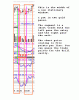
It is the range of bars of interest for your current trade, on your trading fractal. I attached an older snippet of Jack's. At the time he was using indicators, but you can do the same with price and volume only. Notice his bar coloring.

paneful first drill.gif
 
A suggestion to you is to do all of the drills, in the order given.

So you have done the price cases, you annotate and you log them.
Then you have done the volume cases, you annotate and you log them.
Then you take timely action. You log the emotions that you have.
Then you debrief at the end of the trading day.

If you find that you do not know that you know, sideline and get your definitions to a place where you do know that you know.

Do you look at the market in the smallest granularity possible?
Do you look at the market with two bar tapes and expand it out from there?

2 bars ftt will slap your head off
 
Back
Top