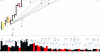
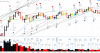
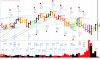
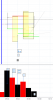
On 10/02
6:50 : again it deals with your LOD that sees rtl where I don't. I'd only see BMrev.
Depends on how you see an internal non-measurable bar. Even though through the methodology some bars are measurable and others are not, price is still changing. Also since the FS has been activated on decreasing volume, it satisfies volume being a T1. It's six of one, half dozen on another type of thing. What's important is that you are consistent in application. It's what builds the muscle memory. So you can not see a BO,T1 and cascade your ID's from there. Does it extract more capital from the long diagional?
No it doesn't change a thing. Except when ID turns with MT and dealing with multi FS as n-1 EE.
Multi-FS as an n-1 EE is an operating point to explore but it's not the issue. The important aspect is using the market as the final arbitrator of truth. Whatever OP one chooses, does the consistent application of it provide greater clarity? extract more capital? If not, time to explore different OP's.
7:45 : the reason why I agree with BMrev is tricky. 2 bars ago we've had BM long. Personally, I'd have put a BMrep at low of the prior bar (prior to 7:45) for its low is below it AND close is above. BMrep. And, when current (7:45) bar comes, then AFTER DEGAP I'd have put the prior long BM one tick upper and this would lead me to see the BMrev. I suspect you either did not bother yourself with those things and directly saw it whithout need of additional drawings OR what led you to ID this BMrev is different than I. Anyway, I see BMrev too.
On debrief: 7:20 - PP2 would be a BO,T1, 7:35 - PP3 would be a BO,T1
Absolutely
9:40 : interesting. Of course, I understand the PP3 and the fact I discuss it is just a share about a little crux I still have with it, among others (like PP2 for example). I've always wondered if, if the INT is (for PP3) on the first P1 (then it's a UL), this kills PP3 ? In this case, it's a bit more complex being as first P1 is in the Lat. So it's an INT, and I could say it's a UL being as its volume level exceeds prior measured bar. I've always wondered if this is considered BETWEEN the two P1's. Logically, between means after the initiating boundary and before ending boundary. So I've always considered (if you see the opposite on any of my past chart it's just an artifact of my mind being in conflict with no awareness about it at the moment I IDd the bar) it does not kill a PP3 if INT (UL or Wait) is on first P1 when IDing a PP3. This tends to be confirmed here as you see PP3 with first P1 being an INT part of a Lat. Great !
If one didn't ID the PP3 and let the progression of trend continue, it would have been an even greater extraction of capital.
Yes, and that's I would have done as for me, by applying the "a Lat must have two closes out of its boundaries to not exist anymore", then Lat5 is still in the Lat and the Lat still exists so there's an INT between the two P1's so PP3 would b killed for me due to my comprehension of the "INT kills" columns of PP!sheet. I don't get yet why you see "wait" kills for PP6 for example, whereas I only have "INT" on the head of the column of the sheet. INT can be wait or UL. All waits are INT, but INT means both UL or wait. Something needs clarification here for me. The above would be false for me if the bar after Lat5 had its close back inside the Lat boundaries, so we'd be in a Lat and then PP3 comes back to be gated.
An internal's action is a wait, unless it's a UL or activates a FS. Internal is a description of the price case form as a class - UL, FS and 'waits' are descriptions of an action to perform within that class.
10/01
8:45 : in hindsight T2F is not there and one needs it to be to be into the F-context and to find any F-band EE. Unless this deals with real-time but even with this I don't see any possibility it would change a thing, I see BO,T1 yes, but Ab LVBO and not Fd LVBO. F-Band is not there yet.
T2F is present in trend.
According to my comprehension of the Volume element range sheet (VERS), T2F is gated first after T2P and is killed if < T1. Here the bar after T2P never reches T1 level so for me, there is no T2F. I really wonder what you see here. Even in real time volume did never pass through the state of T2F, as the requirement for that is to overpass T1 level while still remaining below T2P. I don't understand what you state here. Still Ab at my LOD.
In how you understand it, if T2F is killed when < T1, then Fd, Hb's would not exist. The measurable volume bar is always one of the 11 volume elements.
In addition is can also be an EE.
For me, in this particular trend segment, as soon as the bar starts building it can be a T2F and then it can transform into other volume elements. If it stops building and is below T1, then as a T2F < T1 then it qualifies as an EE.
9:10 : again, you surely saw the acceleration between 2 of the three P1's which does not make sense for me at the moment. Would have seen Not PP1 followed by BO,T1.
Three P1's, acceleration is present, therefore PP1.
Whithout additional comments I'm not able to understand this. If :
- you are talking about price pane, but you've said you don't as acceleration for PP1 deals with volume, then there is no acceleration as the slope between secon P1 and third is less than the one between first and second P1.
- you are talking about volume gape between first two P1's and last two P1's, and once again, volume gap is greater between first two P1's than between last two.
- or you're talking from real-time which provides something I cant' see for the now
- or something else that, again, I can't search nor think about yet because I have not elements enough to discuss and work into this.
It's a judgement call - in taking the dataset, do you observe acceleration or not?
11:45 : I disagree with Af. We need P2 > P1, it's not the case AND we need to be in a Lat, it's not the case either. Weird you see that and weird your, once again, not fanning, did not lead you to see BO,T1 on this bar. At my LOD, I'd have fanned and seen P1revchron surely followed by BO,T1. The sequence would then be P1revchron-BO,T1-P1-P1(not PP1)-BO,T1.
Af and Ag are interesting money making cases. Collect more of a dataset and catalog. Discern the difference that makes a difference.
It will be done
10/03
8:35 : although I agree with that third P1, I suspect real-time to bring the explanation of your use of the concept of acceleration.
At some point, it just becomes a judgement call and you work it out from there.
I can't wait to get what you see here.
7:25 : It begeins to be usual to see you ID an Af whereas we're not in a LAT AND while P2 is less than P1. My A-band sheet says Af must be in Lat and P2 must exceed P1. For me here, just P1revchron. Resulting cascading effect would be Wait-Ab LVBO-T1-P2-AbLVBO-P1-PP1 etc..
Yeah, more refinement around it.
Building the catalog AND for now the only explanation I DD is that at the first second of 7:35 bar, in real-time we're in a Lat and then you go backwards and see what I'd have seen as P1revchron as Af cause this bar is in a "currently Lat" so Af is gated. BUT accroding to my A-band sheet, for Af the AddReq is to have P2>P1 which is not the case here. So, your conclusion is not understandable for me now. Collecting and doing catalog meanwhile.
Af has P2 < P1 leftmost.
9:25 : unless I've not understood the extension length of a Lat in geometry terms on price pane, I would not have extended it until including Lat9. I have to clear something up here. At my LOD, Lat9 does not exist as it's technical BO of the Lat and then, not part of the Lat anymore. This is just a matter of convention I believe.
This is how laterals are grouped; by definition in a descriptive, functional, or another dimensional way. A lateral continues until it ends. It ends on a BO bar.
I currently do not see any difference that could make me see this Lat9 anything else than the first bar since Lat1, out of the Lat and killing it definitively. In the following for example, then why didn't you put Lat5 on the last bar ? Ig there's a differnce with the discussed example (Lat9), I can't see it for now.
View attachment 211709
On my logs I label X the BO bar of the lat as BO latX. So in this example, BO lat9. It's how I organize my charts and logs.
I can see your logic of not labeling that bar lat9 since it doesn't conform to the geometry of the lateral.
There are cases where the BO bar is an internal, is measured and the lateral does not end on this bar. Therefore the convention of using the logic behind 'lat9'
9:40 : non fanning action, ok for BO,T1 although I'm unable to deal with it this way yet. Not fast enough, nor deep enough in the detection of trend segments.
This is one of the areas that had me, in general, not fan the 5m rtl's anymore. If one did fan, a BO,T1 would have still ended the trend segment but the DA of MADA would have waited longer to act.
I understand perfectly what you say but I ignore what makes this gated.
11:05 : I disagree with this PP3. According to my comprehension and my PP! sheet, the upper limit for PP3 is second P1, lower limit is first P1. Here volume exceeds second P1, therefore I'd see T1. Next would be BO,T1.
The T1's volume is in between the two prior P1's volume. It is a PP3.
If this is true, it means my understanding of the PP3 according to the PP!sheet was reduced. PP3 is then gated mor often than I thought. Great !
12:00 : interesting. Of course, I see a BMrep due to degap, but you do not always do it. Wondering why sometimes yes, others no.
I don't know what a BMrep is.
I was gonna say : you told me to put BMrep standing for Bookmark Repeat when a BM is penetrated while keeping the close inside of it BUT of course, due to your reaction I won't haha I simply thought that was the name you provoed me in a past post for this scenario. Anyway, if I'm wrong and you never said it, I am talking about this kind of happening that you sometimes put on your chart (like new higher BM short or new lower BM long) and sometimes not. No big deal it's not very important I think.
The difficulty in translation has to do with BM's placed at EE's and how they can be different than assigned P1's.
BM's are placeholders - they hold a mental position of shape and change of shape. P1's are new windows.
13:10 : I would have placed a short rtl from n-1 bar.
No the bar is lat3. Upon degap the H's of lat1, lat2 and lat3 are all the same. Lat2 is a BO,T1, c turn, trend set B. All this means go short with a stop one's tolerance above the BM.
A rtl would be placed if it was more like a T1 on this bar.
Interesting. Effectively, upon degap all three H's are the same. I just think that if I follow the "rtl's are good enough" concerning degap AND if I apply your way of starting rtl when the given PC does not, if the required degap is not done, allow it geometrically BUT by degapping yes it gates it, then I thought one can draw rtl when it is allowed geometrically on the price pane even though after degap it is not. I thought the reciproque could be true. Apparently, no.
NB : don't understand how a less like T1 bar would have gated any rtl..
Degapping is degapping. It is done before anything else.
A rtl would be placed if it was 'more like' a T1 on this bar.

Comments within quoted text.
Last edited: