
You are using an out of date browser. It may not display this or other websites correctly.
You should upgrade or use an alternative browser.
You should upgrade or use an alternative browser.
MAGA Achieved: 100k+ Dead, 40 million unemployed, riots & no wall
- Thread starter exGOPer
- Start date


Dr. Deborah Birx said the US is in a new phase in its fight against the coronavirus pandemic, saying that the deadly virus is more widespread than when it first took hold in the US earlier this year, CNN reports.
Said Birx: “What we are seeing today is different from March and April. It is extraordinarily widespread. It’s into the rural as equal urban areas.”
She added: “To everybody who lives in a rural area, you are not immune or protected from this virus. If you’re in multi-generational households, and there’s an outbreak in your rural area or in your city, you need to really consider wearing a mask at home, assuming that you’re positive, if you have individuals in your households with comorbidities.”
Said Birx: “What we are seeing today is different from March and April. It is extraordinarily widespread. It’s into the rural as equal urban areas.”
She added: “To everybody who lives in a rural area, you are not immune or protected from this virus. If you’re in multi-generational households, and there’s an outbreak in your rural area or in your city, you need to really consider wearing a mask at home, assuming that you’re positive, if you have individuals in your households with comorbidities.”

Dr. Deborah Birx said the US is in a new phase in its fight against the coronavirus pandemic, saying that the deadly virus is more widespread than when it first took hold in the US earlier this year, CNN reports.
Said Birx: “What we are seeing today is different from March and April. It is extraordinarily widespread. It’s into the rural as equal urban areas.”
She added: “To everybody who lives in a rural area, you are not immune or protected from this virus. If you’re in multi-generational households, and there’s an outbreak in your rural area or in your city, you need to really consider wearing a mask at home, assuming that you’re positive, if you have individuals in your households with comorbidities.”
I currently wear a mask inside of the house I live in. Goggles too, if I expect someone to be up when I come home. I eat elsewhere. Over a month ago, one of our roommates was sick and tested positive for Covid-19. Statistically, I expect one of our roommates will be infected with Covid every four months, indefinately.
“The dollar is flashing a warning sign to U.S. policy makers — get a grip on the virus,” Bloomberg reports.
“After hitting an all-time high in March, a gauge of the greenback has lost 10% of its value, with declines accelerating in recent weeks as infections spread seemingly unchecked across the nation. Much of the sell-off has come during New York trading hours, suggesting domestic investors are closing out bets on U.S. strength and spurring renewed questions about the supremacy of the dollar. Meanwhile, a popular model that’s guided dollar traders for the past two decades has warped.”
“After hitting an all-time high in March, a gauge of the greenback has lost 10% of its value, with declines accelerating in recent weeks as infections spread seemingly unchecked across the nation. Much of the sell-off has come during New York trading hours, suggesting domestic investors are closing out bets on U.S. strength and spurring renewed questions about the supremacy of the dollar. Meanwhile, a popular model that’s guided dollar traders for the past two decades has warped.”
Last Wednesday, also from Bloomberg ....
And finally, here’s what Joe's interested in this morning
The US dollar has fallen almost 10% since late March. Between that and the surge in gold and Bitcoin, the aggressive Fed actions, the high deficits, and of course the virus, there's a lot of giddy talk about some major change afoot. Goldman was out with a note yesterday about growing warnings on the end of the dollar's global reserve status. It's all very exciting stuff. Lots of vivid stories to tell.
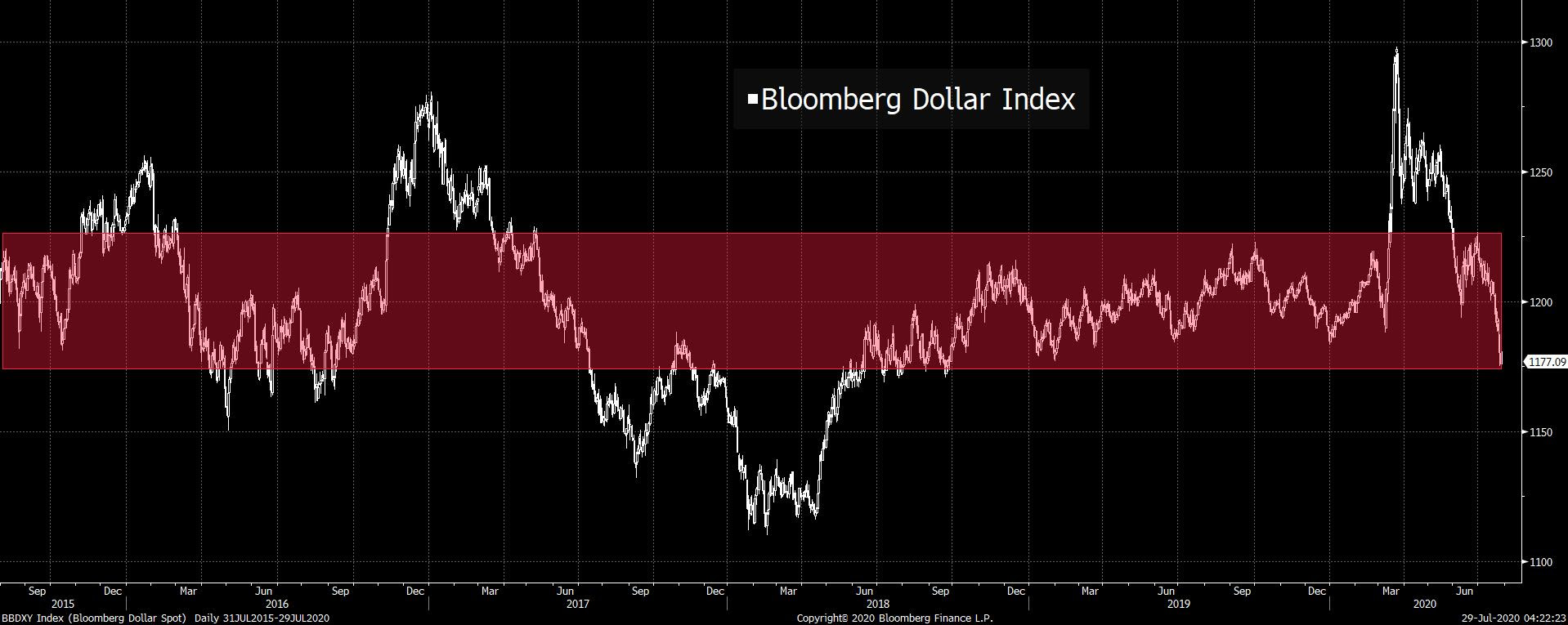
So here's a boring story about how the dollar's move just isn't that dramatic. To start, here's a 5-year chart of the Bloomberg Dollar Index. One thing that stands out is that if you put your fingers over March and April and block out that historic spike in volatility and massive surge in demand for dollar liquidity, the dollar is basically just trading in the same range it's traded in for years. It's at the lower end, but really nothing special outside those insane months. Focus on the red bar, and it looks ho hum.
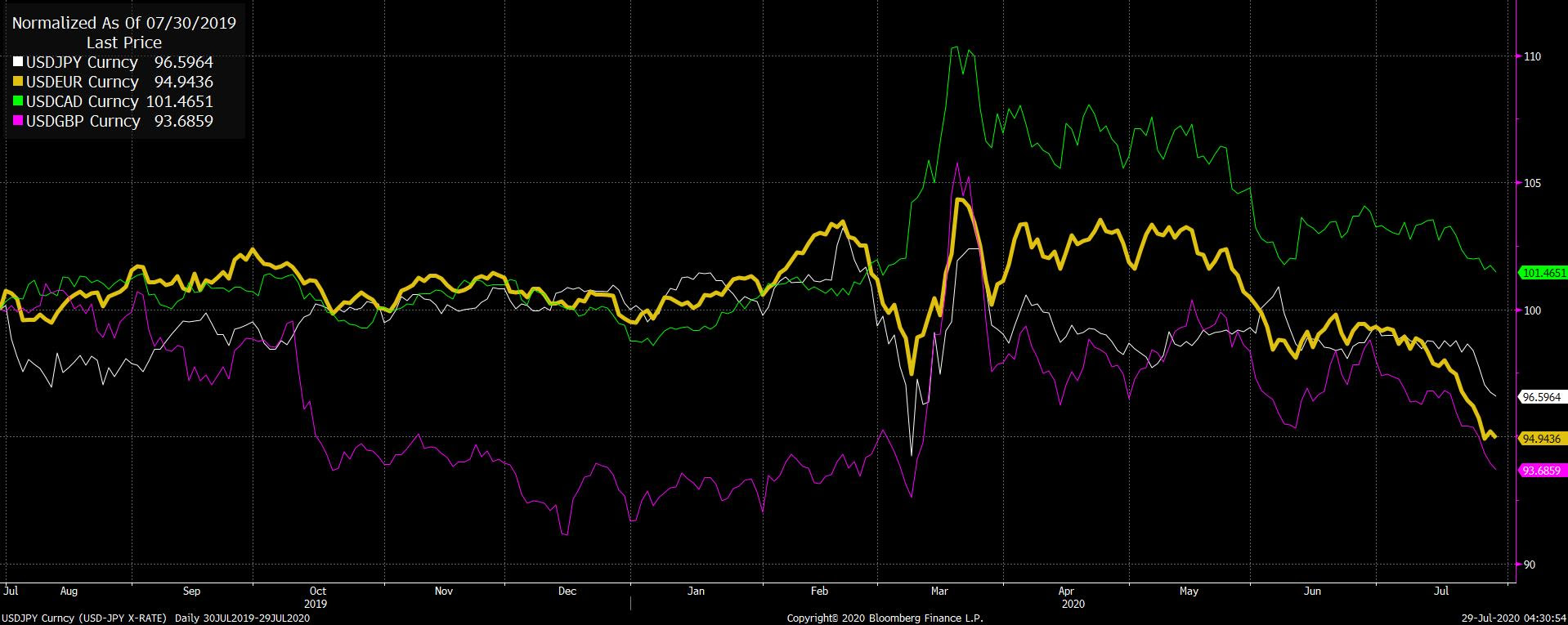
The next thing to realize is that a big part of this weakness is against the euro specifically. Here's the one-year performance of the dollar against the euro, yen, Canadian dollar, and British Pound. Combined, these four currencies comprise nearly 70% of the Bloomberg Dollar Index. Only against the euro is the dollar even at its weakest level of the last year.
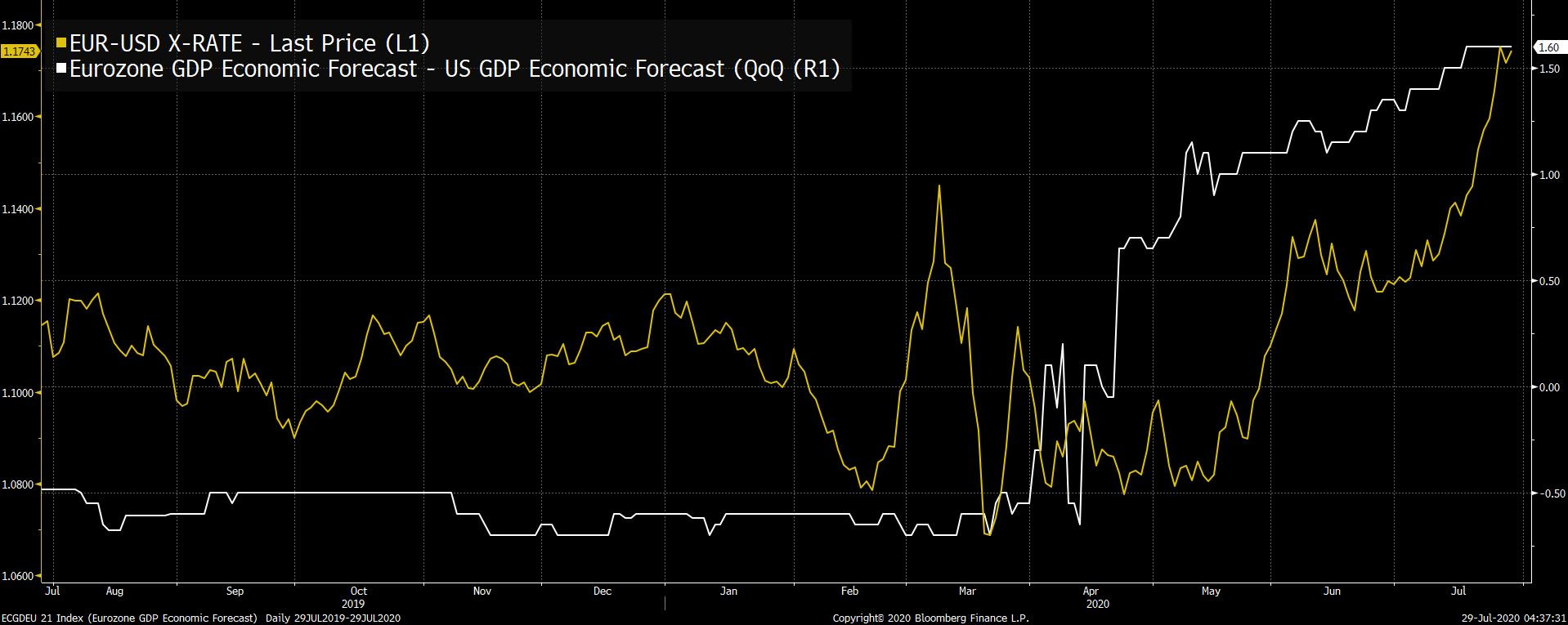
As for the euro, the big story there is that we're in a rare moment where European growth is expected to outpace U.S. growth. According to IMF data, this has happened only eight times since 1992. Between its seemingly superior virus suppression and improvement on addressing fiscal issues, Europe is definitely regarded as a bright spot right now.
As you can see, since the end of March, estimates for euro area GDP in 2021 have increased relative to U.S. GDP. And so we've seen the euro rally along with that.
Bottom line: With a little perspective, the dollar story is less dramatic than it first appears. A big part of it is just coming off the boil in March and April. Outside of that, it's not that dramatic. Furthermore, a big chunk of it can be explained by the euro specifically, which is expected to do better in the short term than the U.S. It's interesting and important stuff, but nothing indicating some major foundational issue with the dollar's place in the world.
And finally, here’s what Joe's interested in this morning
The US dollar has fallen almost 10% since late March. Between that and the surge in gold and Bitcoin, the aggressive Fed actions, the high deficits, and of course the virus, there's a lot of giddy talk about some major change afoot. Goldman was out with a note yesterday about growing warnings on the end of the dollar's global reserve status. It's all very exciting stuff. Lots of vivid stories to tell.
So here's a boring story about how the dollar's move just isn't that dramatic. To start, here's a 5-year chart of the Bloomberg Dollar Index. One thing that stands out is that if you put your fingers over March and April and block out that historic spike in volatility and massive surge in demand for dollar liquidity, the dollar is basically just trading in the same range it's traded in for years. It's at the lower end, but really nothing special outside those insane months. Focus on the red bar, and it looks ho hum.
The next thing to realize is that a big part of this weakness is against the euro specifically. Here's the one-year performance of the dollar against the euro, yen, Canadian dollar, and British Pound. Combined, these four currencies comprise nearly 70% of the Bloomberg Dollar Index. Only against the euro is the dollar even at its weakest level of the last year.
As for the euro, the big story there is that we're in a rare moment where European growth is expected to outpace U.S. growth. According to IMF data, this has happened only eight times since 1992. Between its seemingly superior virus suppression and improvement on addressing fiscal issues, Europe is definitely regarded as a bright spot right now.
As you can see, since the end of March, estimates for euro area GDP in 2021 have increased relative to U.S. GDP. And so we've seen the euro rally along with that.
Bottom line: With a little perspective, the dollar story is less dramatic than it first appears. A big part of it is just coming off the boil in March and April. Outside of that, it's not that dramatic. Furthermore, a big chunk of it can be explained by the euro specifically, which is expected to do better in the short term than the U.S. It's interesting and important stuff, but nothing indicating some major foundational issue with the dollar's place in the world.


U.S. Satisfaction at 13%, Lowest in Nine Years
-Satisfaction down from 20% in early June and 45% in February
-Percentage "satisfied" has not been this low since November 2011
-Current figure is just six points above all-time low recorded in 2008
https://news.gallup.com/poll/316736/...ine-years.aspx
The plunge in the U.S. mood, both in the past month and since February, is mostly occurring among Republicans.
Republicans' satisfaction today (20%) is about half what it was a month ago (39%) and down 60 points since February, after the Senate acquitted President Donald Trump in his impeachment trial. The current figure is easily the lowest for Republicans during the Trump administration, with their prior low being 38% in October 2017.
-Satisfaction down from 20% in early June and 45% in February
-Percentage "satisfied" has not been this low since November 2011
-Current figure is just six points above all-time low recorded in 2008
https://news.gallup.com/poll/316736/...ine-years.aspx
The plunge in the U.S. mood, both in the past month and since February, is mostly occurring among Republicans.
Republicans' satisfaction today (20%) is about half what it was a month ago (39%) and down 60 points since February, after the Senate acquitted President Donald Trump in his impeachment trial. The current figure is easily the lowest for Republicans during the Trump administration, with their prior low being 38% in October 2017.