I still dont get what you mean with "wholesale liquidity". You seem to be the only one using this term.
There's nothing to it. Most people use Market orders, so when you BUY you get matched with the momentary lowest OFFER/ASK price. When you SELL you get matched with the BID price. So you "pay the spread" as an ordinary retail trader. That's the definition of "retail".
Wholesale is a bit more difficult to define but, in general, it's an attempt to become a "liquidity provider" and "make prices", rather than the retail guy who just "takes" available prices. Exchanges like LMAX allow participants to "compete" with limit orders at "Best Bid", for example, and thus have the opportunity to Buy at a much lower price, subject to "liquidity". In other words, there has to be a counterparty to sell to your Bid. At most Forex venues, you do not have a genuine opportunity to compete on a "level playing field" with the Banks and other liquidity providers. At Dukascopy, for example, you can easily use an order type which places yourself at "Best Bid" on their "ECN". But you'll find that there's nobody who wants to sell to you, as the participants are themselves all wholesale liquidity providers. So you are doomed once again to Buying at the Ask (Retail) since you can't get a lower price.
So that's the difference between Wholesale and Retail pricing. With Wholesale pricing, or some approximation of "better than Retail pricing" you have the possibility to "make a portion of the spread at least", as well as covering your costs, to some extent, on a probabilistic basis. Algorithmic scalpers do this all the time, it's just not a mode of trading which has been available to individual traders, until recently as better "fair and anonymous exchanges" bring liquidity to the smaller operator.
Here I am not talking about simultaneously buying the Bid and selling the Offer in a single transaction. To succeed at this game you have to deal with Partial Fills, probabilistic fills, and have the ability to be persistent, usually through algorithmic or computer assisted placement of orders. You cannot guarantee that you will be filled at Best Bid, and others will quickly join you or jump over you, so this is a rather fast game. Rather, you have to be patient in your Bids and Offers, picking fills over time, and there is a cumulative effect over time which enables you to Buy much lower and Sell much higher through competing with others for Best Bid and Best Offer, and having "Retail players" or others who are setting their prices "by mistake" (i.e. the non-professionals) who will "hit" your Bids and Offers, thus giving you liqudity as a counterparty. Thus you become a "mini Market Maker", if you want to think of it in that way... Theoretically (and this is just theoretical) you can make money all day long, but the Market price doesn't really move in any significant way. This is not a good way to make money, but it is a theoretical possibility given "perfect" Wholesale pricing opportunity through sufficient liquidity to provide counter-parties to your Bids/Offers... Not even the Big Outfits get the lion's share of their revenue through this "spread scalping" but it is a component of their much lower overall costs.
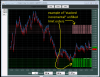
People think you need to have an order which "jumps" in price in milliseconds in order to do this. That's not true. Much easier is to "stack" your Bids at Increments in price from your Best Bid, on down in price. Then as the market "runs into" your Bids, they are filled, thus giving you a much lower average Buying price. So a lot of this "game" involves what is known as "Cost Basis Averaging" in which your position is the result of many Buy fills at various prices and lot sizes, a VWAP if you like "volume weighted average price" which represents your Long Entry price, for example. On the Sell side you do the same thing, averaging your VWAP higher through multiple fills. The difference between your VWAP Buy price and your VWAP Sell price multiplied by Lot Size is your theoretical Gross Profit potential.
You can use what I call "incremental trading" even if you are doomed to buying Retail, but you can see the leverage which Wholesale Buying Power provides to enhance your outcomes by lowering your trading costs. Even a Retail player knows how to play the "averaging game" to some extent, so this isn't a new concept.
Hope this helps !!
HyperScalper
Last edited:
 HyperScalper